






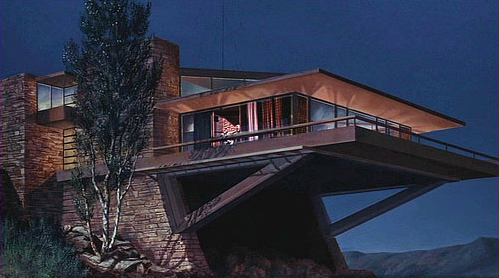

Villains who live in opulent, remote modernist houses may have been a cliché since the last century, but given Hollywood’s addiction to the tried and true, they do still turn up now and again. Unsurprisingly, few filmmakers have managed to use them anywhere near as memorably as Alfred Hitchcock did. Think back to North by Northwest, that showcase of both late-fifties high style and unadulterated Hitchcockery, and any number of images come right to mind: the deadly crop duster bearing down on Cary Grant, the hang off the edge of Mount Rushmore, the cheeky cut to the train entering the tunnel. But on the architecturally inclined, the deepest impression is made by not a shot but a set: the house — modernist, opulent, remote — occupied by James Mason’s villain Phillip Vandamm.
“The pioneering decision to feature a modern house as the villain’s lair in North by Northwest arose from both the practical needs of the script and the desire to explore innovation in architectural representation,” writes Christine Madrid French, author of The Architecture of Suspense: The Built World in the Films of Alfred Hitchcock.
The look of the Vandamm House betrays considerable inspiration from the work of Frank Lloyd Wright, especially his “iconic Fallingwater, best known for its astonishing projected porches cantilevered over a running stream.” As the Hollywood story goes, Hitchcock asked Wright himself about the possibility of designing the house, but when the architect asked for ten percent of the film’s entire budget, the job went to production designer Robert F. Boyle.
![Tour the North by Northwest Home [CG Tour]](https://i.ytimg.com/vi/284iZJ0zzts/hqdefault.jpg)
Despite the highly un-Wrightian steel beams supporting the cantilevered living room (inserted because Grant needed a way to climb in), moviegoers left the theater assuming that they’d witnessed a showdown in one of his houses. In fact, like so many of Hitchcock’s famous built environments, the structure didn’t actually exist: Boyle and his collaborators constructed pieces on sets, completing the rest with matte paintings. Yet their work did, in a sense, bring the Vandamm House into the world. A North by Northwest fan since childhood, architect John Boccardo just this year achieved his $45 million dream of building it for real. Apart from faithfully replicating onscreen details, he also put in an eighteen-seat home theater, possibly on the safe assumption that the buyer will be a fellow cinephile — who, given that the house overlooks Park City, Utah rather than sits atop Mount Rushmore, will surely rue the day Sundance decided to move to Boulder. See photos here.
If you would like to support the mission of Open Culture, consider making a donation to our site. It’s hard to rely 100% on ads, and your contributions will help us continue providing the best free cultural and educational materials to learners everywhere. You can contribute through PayPal, Patreon, and Venmo (@openculture). Thanks!
Related content:
16 Free Hitchcock Movies Online
Alfred Hitchcock Explains the Plot Device He Called the ‘MacGuffin’
1,300 Photos of Famous Modern American Homes Now Online, Courtesy of USC
A Meditative Tour of Fallingwater, Frank Lloyd Wright’s Architectural Masterpiece
Salvador Dalí Creates a Dream Sequence for Spellbound, Hitchcock’s Psychoanalytic Thriller
Based in Seoul, Colin Marshall writes and broadcasts on cities, language, and culture. He’s the author of the newsletter Books on Cities as well as the books 한국 요약 금지 (No Summarizing Korea) and Korean Newtro. Follow him on the social network formerly known as Twitter at @colinmarshall.


