





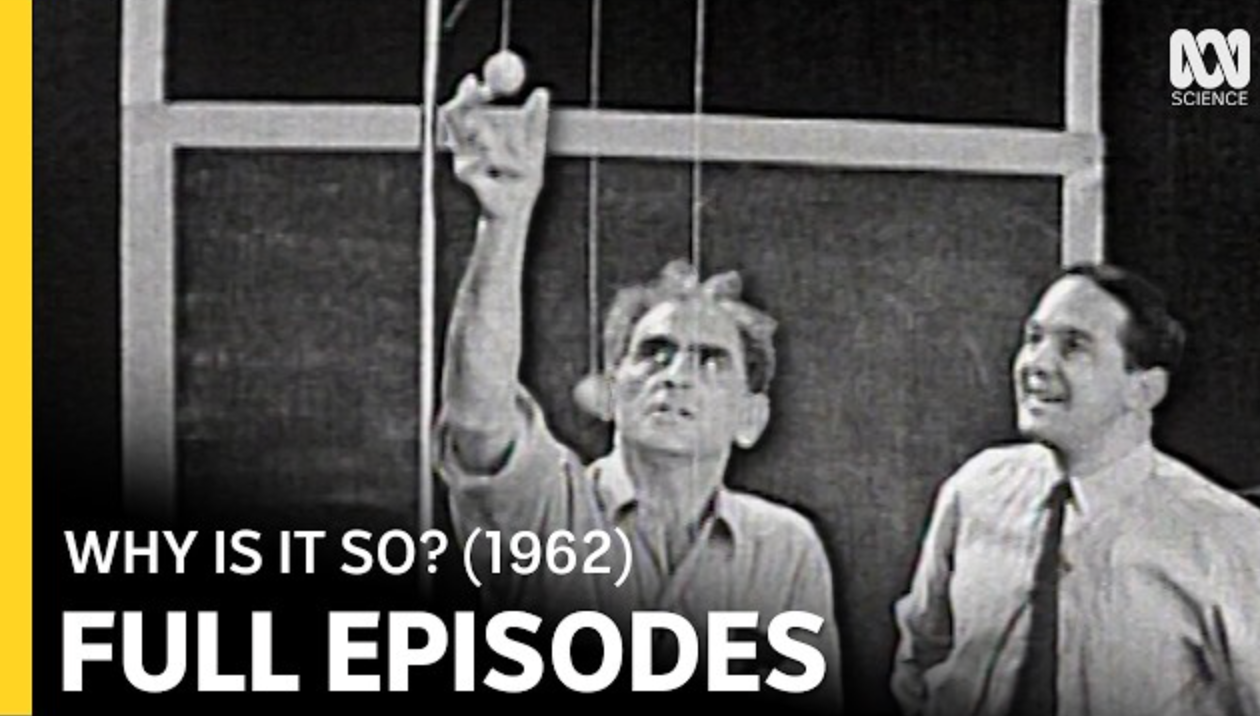
“We are approaching a darkness in the land. Boys and girls are emerging from every level of school with certificates and degrees, but they can’t read, write or calculate. We don’t have academic honesty or intellectual rigor.” That quote may sound like a familiar lament today, but it’s actually drawn from an interview conducted about half a century ago with the physicist and television host Julius Sumner Miller. If that name sounds familiar to you, there’s a fair chance you’re an Australian who grew up between the sixties and the eighties — and it’s hardly impossible that, thanks to his program Why Is It So?, you went on to pursue a career in science or engineering.
Generations of young viewers down under and elsewhere learned from Why Is It So? that physics and its principles could be fun. Even if you weren’t among them at the time, you can now watch full episodes of the show uploaded to YouTube by ABC, the Australian Broadcasting Corporation.
As you may notice after just a few seconds of listening to him, Miller himself was American. The Massachusetts-born son of immigrants from Latvia and Lithuania, he studied physics at Boston University and thereafter taught and performed research at various institutions (befriending Albert Einstein along the way) before taking a long-term position at El Camino College in Torrance, California in 1952.

?si=Xli51nEj2zgiS6UE
Miller’s popularity at El Camino, the school’s proximity to Hollywood, and television’s rapid expansion into a mass medium led to his launching Why Is It So? on KNXT in Los Angeles in 1959. By the mid-sixties, he was also explaining scientific phenomena on Disney’s Mickey Mouse Club, Great Moments in Science, and Science and Its Magic, as well as on Steve Allen’s late-night talk show. He made his debut on Australian television when the University of Sydney brought him out as a visiting lecturer. The appearance went wrong when he couldn’t perform his standard trick of driving a drinking straw through a potato, but what it nevertheless got him — apart from an office filled with the domestic straws he’d jokingly criticized on-air — was a new home for Why Is It So? on ABC.

ABC has so far made available seven full broadcasts originally aired between the early sixties and the early seventies. Despite their black-and-white production and lack of visual effects, they hold up well today in both educational and entertainment value. However engaging his personality as what we would now call a science communicator, it seems that “Miller could be a terror in the classroom,” according to his Los Angeles Times obituary from 1987, “intolerant of misspelled words or misplaced punctuation” and insistent that “most faculty were not rigid enough and that students were not learning enough.” He’d hardly be pleased with what’s happened to intellectual standards in the nearly four decades since his death, but he’d surely appreciate that his teaching continues to reach “everybody ages four to 94,” as he liked to describe his audience. Age, nationality, and even credentials didn’t matter; what counted was genuine curiosity and the willingness to pursue it, whether in the classroom or the living room.
Related Content:
Watch a Young Carl Sagan Appear in His First TV Documentary, The Violent Universe (1969)
Based in Seoul, Colin Marshall writes and broadcasts on cities, language, and culture. He’s the author of the newsletter Books on Cities as well as the books 한국 요약 금지 (No Summarizing Korea) and Korean Newtro. Follow him on the social network formerly known as Twitter at @colinmarshall.


