






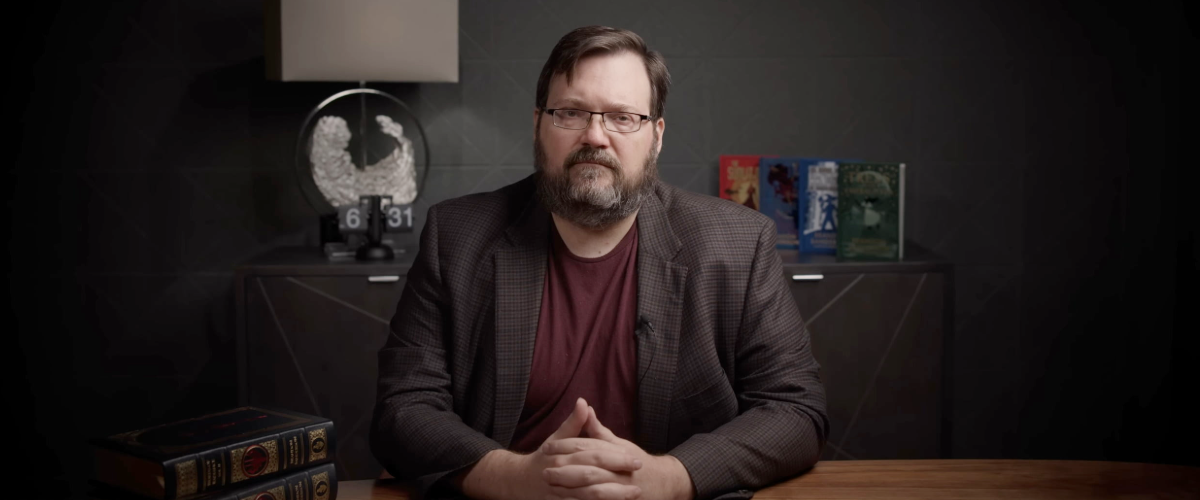
Late last year, the fantasy novelist Brandon Sanderson gave a talk at Dragonsteel Nexus, an annual conference organized by his media company. It was titled, “The Hidden Cost of AI Art.”
As Sanderson explains, early in his address: “The surge of large language models and generative AI raises questions that are fascinating, and even if I dislike how the movement is going in relation to writing and art, I want to learn from the experience of what’s happening.”
Sanderson makes it clear that he disapproves of AI-generated art (“my stomach turns”), but he wants to understand better why this is the case. To do so, he begins considering and then ultimately dismissing a series of common objections:
- Does he dislike AI art because of the economic and environmental impacts? “Well, those do concern me, but if I’m answering honestly, I would still have a problem with it even if AI were not so resource hungry.”
- Does he dislike AI art because it’s trained on the work of existing artists? “ Well, I don’t like that. But even if it were trained using no copyrighted work, I’d still be concerned.”
- Does he just hate the idea of a machine replacing a person? Sanderson references the folk tale of John Henry attempting to beat a steam drill in a tunnel-digging competition that culminates in Henry’s death. “We respect him, but as a society we chose the steam drill. And I would too…The truth is, I’m more than happy to have steam engines drilling tunnels for me to drive through.”
So what is it?
Sanderson ultimately lands on a more personal reason. Talking about his struggles with his first (failed) book manuscripts, he identifies the key value of art: it changes the artist who attempts it. As he elaborates:
“Maybe someday the language models will be able to write books better than I can. But here’s the thing: Using those models in such a way absolutely misses the point, because it looks at art only as a product. Why did I write [my first manuscript]?… It was for the satisfaction of having written a novel, feeling the accomplishment, and learning how to do it. I tell you right now, if you’ve never finished a project on this level, it’s one of the most sweet, beautiful, and transcendent moments. I was holding that manuscript, thinking to myself, ‘I did it. I did it.’”
As a writer myself, I’ve also been thinking about this question recently. I like Sanderson’s take, but I’ve been developing one of my own. I understand art to be an act of deep human communication, in which the artist uses a tangible medium, such as a page of prose or a painted canvas, to transmit a complex internal cognitive state from their brain to that of their audience.
It’s telepathy. And it’s one of the most beautiful and human things we do.
This makes the idea of reading a book written by a language model, or watching a film generated by a prompt, intrinsically absurd, if not anti-human. It’s the heroin needle providing a quixotic simulation of love.
What really struck me about Sanderson’s talk, however, was his conclusion. If art is deeply human, he argues, then it’s up to us to define it. “That’s the great thing about art – we define it, and we give it meaning,” he says. “The machines can spit out manuscript after manuscript after manuscript. They can pile them to the pillars of heaven itself. But all we have to do is say ‘no.’”
I’ve noticed a trend in recent AI commentary toward a certain nihilistic passivity. You probably know what I’m talking about – the now popular style of essay in which the author, with a sort of worldly weariness, lays out some grim scenario in which AI destroys something sacred, and then sort of just leaves it there, like a cat dropping a dead bird on the doorstep.
I’m getting tired of this meekness.
Sanderson reminds us that we have agency. In the areas that matter most, it’s us, not the whims of Sam Altman or Dario Amodei, that determine how we shape our existence. All we have to do is say “no.”
Correction:
In last week’s AI Reality Check episode of my podcast, I said the following:
“If you go back and look at the release notes for Anthropic’s earlier, less powerful opus 4.6 LLM, they say the following: their researchers used Opus to find, quote, ‘over 500 exploitable zero-day vulnerabilities, some of which are decades old.’ And let’s stop for a moment because that note, which was hidden in the system card for opus 4.6, is almost word for word what anthropic said about Mythos.”
Some of this wording was sloppy, so I want to clarify it here. I was referring to this report on Opus 4.6, which Anthropic published the same day it was released. This is not technically the system card for Opus 4.6, but it is accurately described as release notes (or perhaps supplementary release notes).
This report said: “Opus 4.6 found high-severity vulnerabilities, some that had gone undetected for decades.” In another place, it said: “So far, we’ve found and validated more than 500 high-severity vulnerabilities.” Both the title of the report and the conclusion refer to these vulnerabilities as “0-day.”
The specific quote I provided, however, does not appear in the report. It’s actually a summary of the report from this tweet. In my opinion, the summary is accurate, but the way I worded the above implies that it was actually found in the report, which it was not.
Thank you to the AI researcher who pointed out these issues. I appreciate corrections! You can always send concerns or notes to podcast@calnewport.com.


