







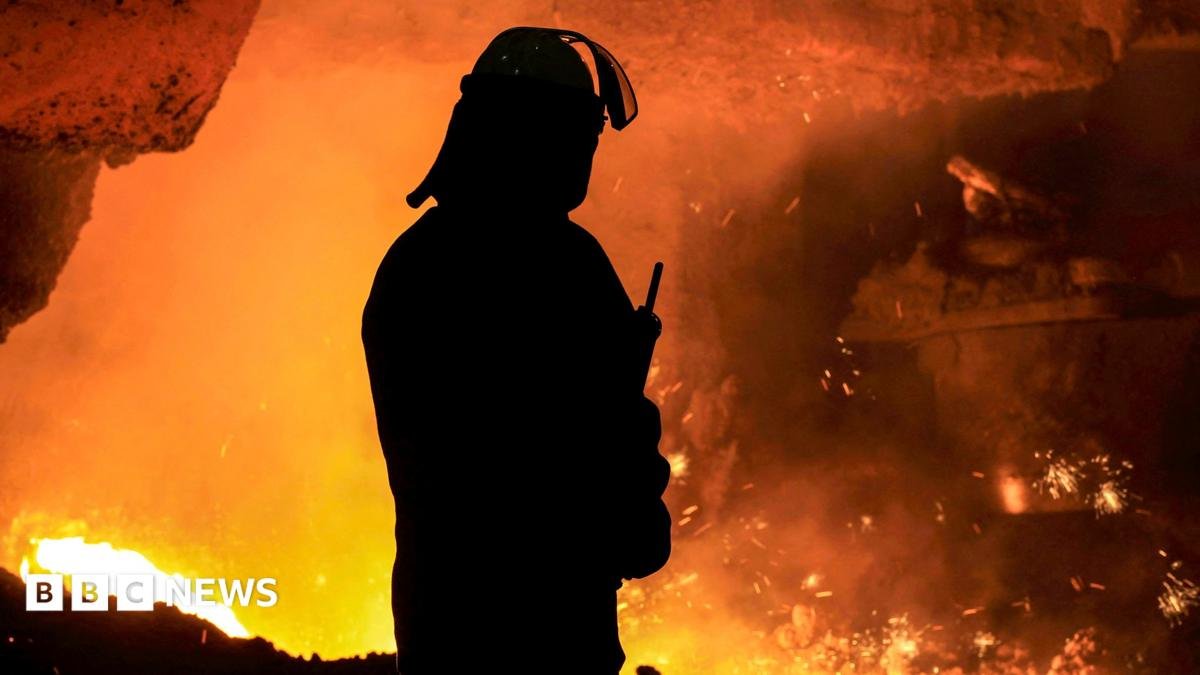
Blast furnaces are designed to run continuously. Allowing them to cool can cause serious damage, and extensive work is required to restart them. Even a planned refurbishment can cost tens of millions of pounds.
The remaining furnaces at Scunthorpe are very old. The one called Queen Anne opened in 1954, while Queen Bess has been producing steel since 1938.
Both are approaching the end of their operational lives, so restarting them once cooled would have been financially prohibitive for a company that was already losing a great deal of money.
The government wanted to keep them open as they are the UK’s last remaining source of “virgin”, or new, steel directly produced from iron ore.
If the plant stopped producing virgin steel, the UK would become the only member of the G7 group of leading economies without the ability to make it.
Steel output elsewhere in this country relies on electric arc furnaces (EAFs), which recycle scrap metal into new products.
Although the government’s long-term strategy is for all domestically produced steel to come from EAFs, which are cheaper and much less carbon-intensive to run, it does not want to lose production at Scunthorpe yet.
The plant produces types of steel that are not yet made anywhere else in the country, much of it needed by Network Rail and the construction industry.
The fear had been that losing this output would be disruptive and make the country too reliant on imports. So the decision was made that Scunthorpe should be kept open until alternatives are available.
There are also jobs to consider. As well as those directly employed by British Steel at Scunthorpe, the plant supports thousands more in the supply chain.
The plant is an economic anchor in North Lincolnshire, but abrupt closure of the furnaces could have put many jobs at risk.
Simon Boyd, managing director of Reid Steel, a structural steel manufacturer in Dorset, said the nationalisation “had to be done”.
Boyd, whose company buys thousands of tonnes from British Steel each year, told the BBC’s Today programme Jingye had been “sabotaging the infrastructure” at the company and the government “had to step in”.
He said the government would need to invest heavily in British Steel and would not see a return for 10-20 years.
But he said it “now belongs to the British people”. A bid to sell it on to private investors would have required government support, and in the past has been seen to “benefit the private companies and not the British people”, he added.


