






The New Right is taking a victory lap. Treasury Secretary Scott Bessent says that manufacturing is “roaring back at its fastest pace in years.” He followed that up, calling this a “manufacturing renaissance.” And when the August payroll data showed factories adding jobs, the White House called the report “explosive” and proof that the tariff agenda is working. Checkmate, economists.
Not quite. An honest comparison of 2025 and 2026 reveals the economists were right.
In 2025, the US ran what can only be described as the largest, most aggressive tariff experiment in nearly a century. The average effective tariff rate peaked at 22.4 percent in April, which was the highest since 1909. By comparison, that figure was about 2.4 percent in 2024. But the worst part of 2025 was not the increase in the tariff rate; it was the chaotic manner in which trade policy shifted. Rates could be announced one week, doubled the next, paused a few days later, and then reinstated at an altogether new number months later. They could be imposed due to trace amounts of fentanyl crossing a border, other countries not buying enough of our products, or because President Trump didn’t like a person’s tone during a phone call. Americans were told that tariffs were going to apply to countries with which the US ran trade deficits in order to reduce those deficits. But then tariffs were imposed on the UK and Australia, with both of which the US runs trade surpluses.
Unfortunately, this wasn’t even the beginning of the uncertainty. Americans were told by Commerce Secretary Howard Lutnick that tariffs were “here to stay,” but later that same week, President Trump himself said that he was ready to negotiate with affected countries. In another instance, President Trump said that tariffs would be deployed to create jobs, but then Lutnick said that the jobs brought back would be automated.
“The army of millions and millions of human beings screwing in little screws to make iPhones — that kind of thing will come back to the America,” Lutnick said, “it’s going to be automated, and great Americans, the tradecraft of America, is going to fix them, is going to work on them.”
Likewise, Americans were told that tariffs would bring in trillions of dollars in revenue. But at oral argument before the Supreme Court, Solicitor General John Sauer said, “these are regulatory tariffs. They are not revenue-raising tariffs. The fact that they raise revenue is only incidental. The tariffs would be most effective, so to speak, if no person ever paid them. They achieve their goals and so forth.” Here, Sauer is pointing out that if a tariff is generating revenue, then it is not blocking imports and, by extension, not leading to domestic consumers shifting to buying domestically made products. Thus, the goal, according to Sauer, was to not raise revenues at all.
Others associated with the Trump administration saw things differently.
In a lengthy post on X and in The Wall Street Journal, Stephen Miran — formerly the chair of the Council of Economic Advisers and Federal Reserve board member — wrote that “it would have interfered with the legal case if I had said that tariffs were good for revenue and tax purposes, even if that’s not actually the reason we gave in law for the tariffs.” In other words, the tariffs were about revenue, except they weren’t, but really they were.
In 2025, Scott Bessent described tariffs as a “gun [that] will always be loaded and on the table, but rarely discharged.” The reality is that in 2025, there was no clear explanation of why the US was using tariffs, nor was there any clear indication of what the tariffs were ultimately trying to accomplish.
The combination of high tariffs with uncertain start dates and unclear goals proved disastrous for firms looking to make long-term investments. As a result, the manufacturing sector shrank. The ISM’s Manufacturing PMI fell into contraction and stayed there for ten months. Factory payrolls fell for eleven straight months, resulting in a loss of about 92,000 manufacturing jobs. Economists had predicted these outcomes and warned that the tariff agenda would produce them.
2026, by comparison, has brought the exact opposite: tariff relief. In February, the Supreme Court struck down the IEEPA tariffs. The White House immediately replaced these with a 10 percent tariff under Section 122. At the same time, the White House announced Section 301 investigations were beginning. While the findings of those investigations were almost certainly predetermined, they resulted in tariff rates of between 10 and 12.5 percent, which were (again) still lower than those in 2025. In other words, tariff rates in the US fell in 2026 compared to 2025.
But the remarkable thing about 2026 is how stable tariff policy has been compared to 2025. If anything, the uncertainty surrounding 2026 is characterized more by which tariffs the president is going to reduce, not impose. When beef prices rose, President Trump lowered tariffs to help ease the burden on households. When the price of steel, aluminum, and copper threatened domestic industry, the president lowered tariffs to “more effectively address national security threats, spur investment in American agriculture, housing, and manufacturing, and facilitate US production of related products.” Certain provisions of the Big Beautiful Bill, such as full expensing even for construction, took effect. Where 2025 can only be described as “raising taxes,” 2026 is a paragon of lowering taxes.
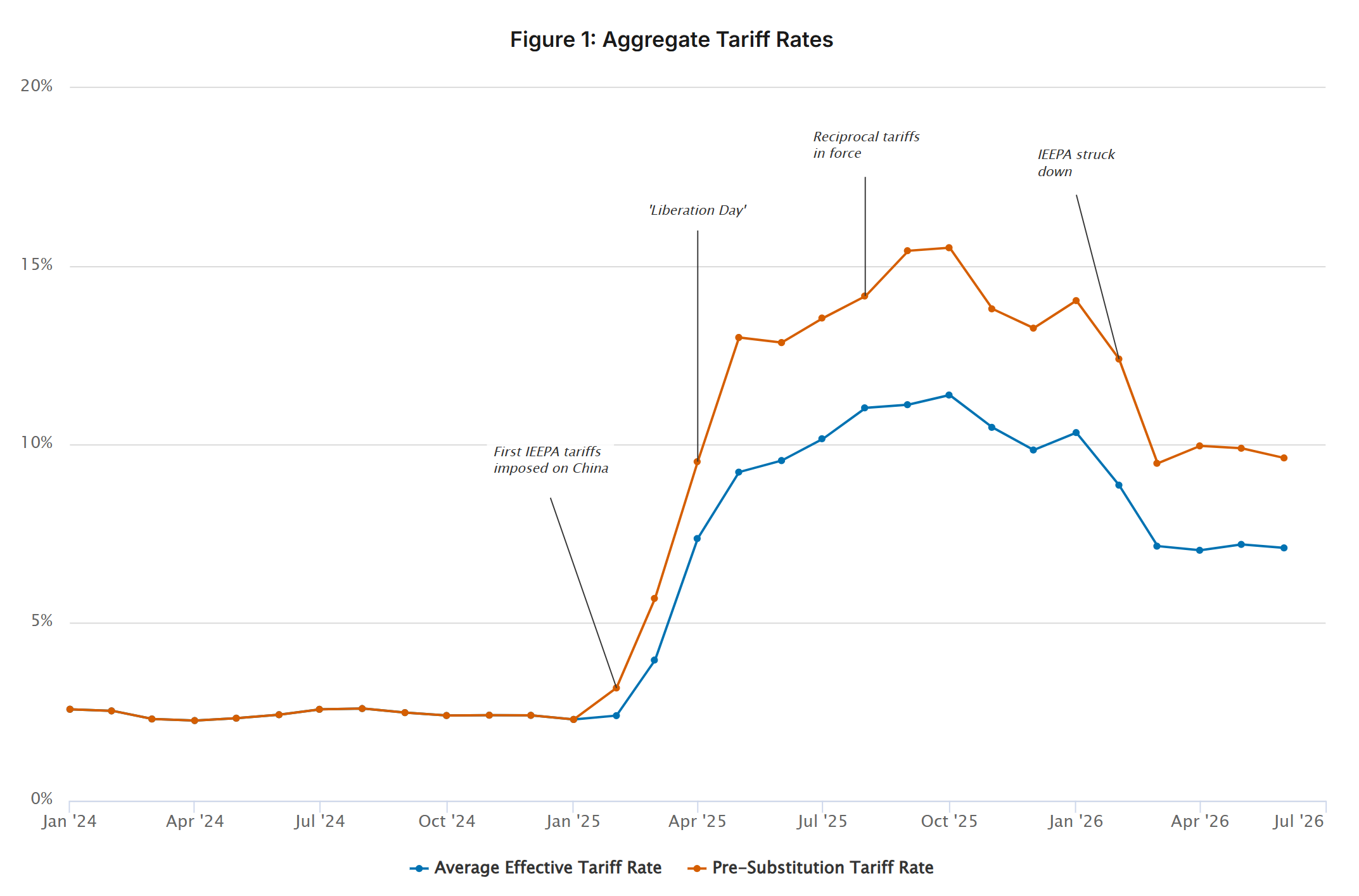
And what happens when taxes, especially those that affect manufacturing formation and expansion, are lowered? Manufacturing expands. And that is exactly what has happened in 2026. The ISM’s Manufacturing PMI crossed into expansion in January and has stayed there for eight months. Factory payrolls, which bottomed out in December 2025, have grown by 58,000 jobs. What’s more, the manufacturing job growth is concentrated in the very industries that are less exposed to tariffs.
None of this should surprise anyone who has sat through an economics course. A tariff is a tax. It makes Americans poorer by forcing us to pay more for less. Given the composition of US imports, tariffs land disproportionately on two groups: low-income households and manufacturers, since roughly half of all US imports are either raw materials or intermediate inputs used in American production. Tariffs make those goods more expensive. Take steel as an example. US steel prices have increased dramatically as tariffs have priced out foreign suppliers. As a result, manufacturing (which uses steel) becomes more expensive, too. It doesn’t take an economist to understand that when the cost of production rises, production slows down.
The manufacturing renaissance that is happening right now is not because we imposed tariffs on the rest of the world. It’s because we lowered tariffs and made it easier for American workers to get access to the materials they need to produce.
That the New Right would rush to claim this moment as a victory was not hard to foresee. Last December in The Wall Street Journal, I wrote that “When tariffs don’t deliver the promised renaissance, administration officials push back the timeline. First it was weeks, then months. Now, we need ‘the right timeline’ and must not grade policy ‘on a news cycle.’” I argued that they were “buying time until the economy improves despite tariffs, at which point the administration will claim victory.”
This is exactly what is happening. The timeline was stretched from weeks, to months, to “don’t grade us on a news cycle.” The economy, and specifically the manufacturing sector, improved the moment the tariffs were lowered. The officials who spent a year explaining away the damages their policies were causing are now taking bows after mitigating the harms of their own policies.
So let’s just be clear. Manufacturing shrank when tariffs were high and erratic. Manufacturing rebounded when tariffs fell and became more stable. Far from being tariff-induced, the “manufacturing renaissance” is what happens when you lower taxes on steel, chips, and components. None of this takes a crystal ball. Ironically, all of this matches exactly what the standard economic textbooks — the very textbooks that the New Right insists are wrong and in desperate need of updating — have been saying all along. All that the administration has done is dig a hole and then partially fill it back in.
If we want to see manufacturing continue to rebound, we need to be cutting tariffs even further and making sure that they are stable and predictable.


