







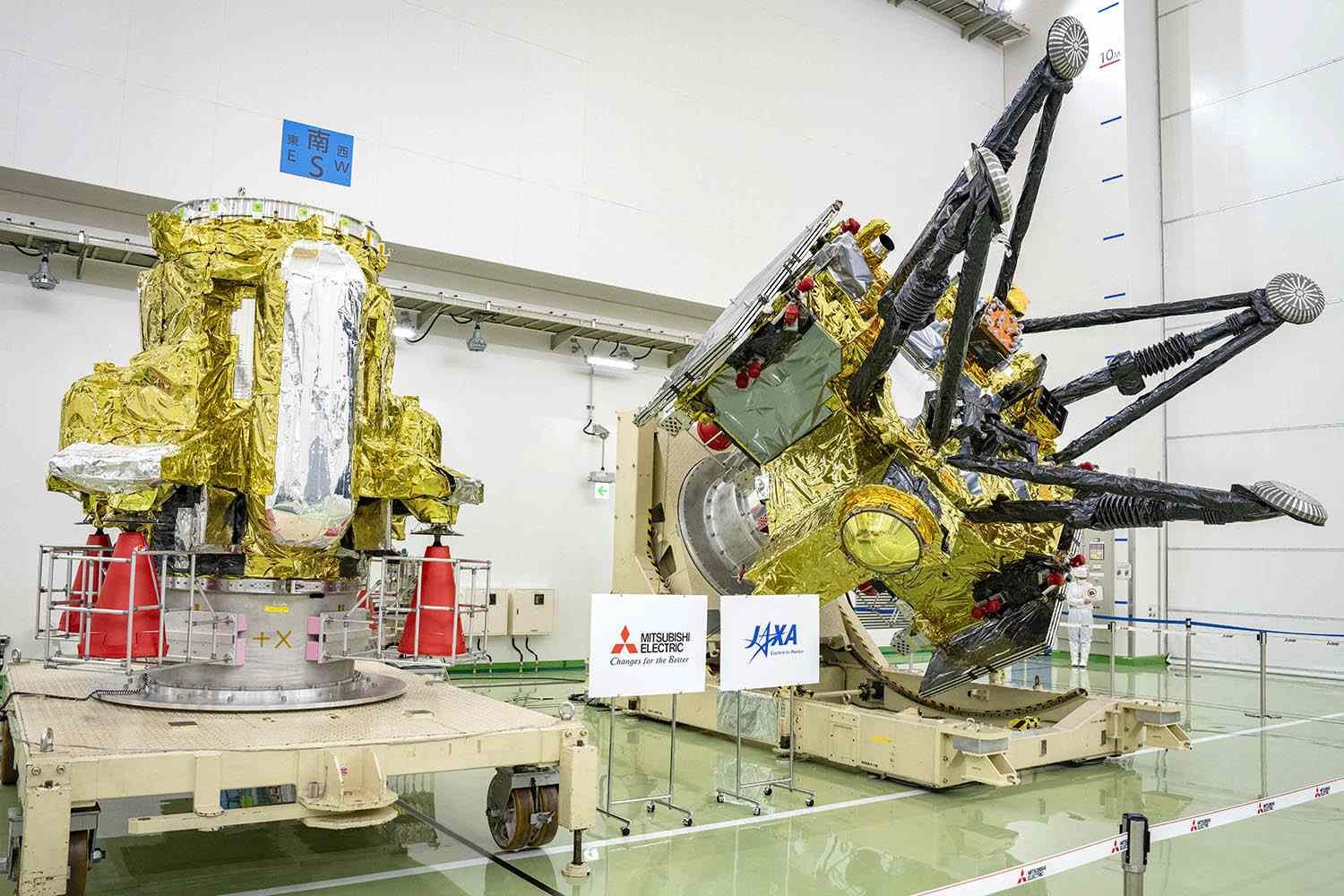
The samples of soil from Mars are scheduled to return in 2031


Credit: Yuichi YAMAZAKI / AFP via Getty
NEED TO KNOW
- Japan’s MMX spacecraft launched on Tuesday, Oct. 20, and will collect soil from Phobos, one of Mars’ two moons
- The five-year mission aims to return 10 grams of material to Earth in 2031
- “Nothing has ever been returned from the Martian sphere before,” JAXA Astronaut Yoneda Ayu said
A little bit of Mars’ moon could be coming back to Earth, thanks to a new mission.
Japanese space agency JAXA (Japan Aerospace Exploration Agency) has officially sent one of its spacecraft — called MMX — to land on Phobos, one of Mars’ two moons. The objective is to gather a sample of soil and bring it back to Earth.
The moons, Phobos and Deimos, represent the Greek mythological twin spirits of fear and panic, and were discovered by American astronomer Asaph Hall in August 1877.


Credit: Yuichi YAMAZAKI / AFP via Getty
JAXA stated that the journey, which began on Tuesday, Oct. 20, will take five years. However, before landing on Phobos, the spacecraft will first stop on Mars.
MMX’s targeted return is projected for 2031.
“The Martian Moons eXploration (MMX) mission will primarily focus on Phobos, a Martian moon that has never been explored. The mission will observe the topography, internal structure, composition, and gravity of the moon, and return samples of regolith,” the agency said on its website.
“This will be the most important unexplored body within the solar system,” Yasuhiro Kawakatsu, the mission project manager, added in translated remarks during a JAXA prelaunch news conference on Sunday, Oct. 18, The New York Times reported.
Part of the mission will be to determine “how the planetary formation process unfolded in the transition region between the inner and outer Solar System, including mechanisms that transported key materials – such as water and organic matter–necessary for the emergency and habitability of life on terrestrial planets,” per the agency.
If completed, it would be the first time humans have retrieved samples from Phobos.
“Nothing has ever been returned from the Martian sphere before. These samples may provide clues to the origins of life and the planets, and expand the possibilities for humans to explore Mars,” JAXA Astronaut Yoneda Ayu said.
JAXA Astronaut Suwa Makoto called the MMX launch from Tanegashima “a truly grand challenge.”

Credit: Ehsan Monajati/picture alliance via Getty
“For years, we’ve been asking questions like, ‘Well, how did water get delivered to the Earth? Did the same processes deliver water to Mars, to Venus, to Mercury? Where did organic materials come from, and so on,’” Tom Statler, NASA’s MMX program executive and scientist, during a pre-launch press conference, said, per ABC News.
Never miss a story — sign up for PEOPLE’s free daily newsletter to stay up-to-date on the best of what PEOPLE has to offer, from celebrity news to compelling human interest stories.
“Understanding where Phobos and Deimos came from goes to understanding what was going on at that time and where that stuff was coming from,” Statler continued.
The 10 grams of soil are expected to be collected through two soft-landing operations on Phobos. The capsule from the journey is slated to be retrieved in Australia on Sept. 5, 2031, per JAXA’s website.


