






Inflation looks better than it did a month ago, but not because it improved much in August. Revisions from the Bureau of Economic Analysis (BEA) lowered estimates of recent inflation without materially changing the rapid growth in overall spending, which is still rising too quickly for inflation to return to the Federal Reserve’s 2 percent target. In short, the Fed still has work to do.
The Personal Consumption Expenditures Price Index (PCEPI), the Federal Reserve’s preferred measure of inflation, rose 0.3 percent in August, according to new data from the BEA, up from 0.1 percent in July. The index has risen at an annualized rate of 3.6 percent over the last six months and is 3.4 percent higher than a year ago, unchanged from July’s rate.
Core PCEPI, which excludes volatile food and energy prices, increased 0.2 percent in August, up from 0.1 percent in July. It has risen at an annualized rate of 2.7 percent over the last six months and is 3.0 percent higher than a year ago, also unchanged from July.
In August, the BEA reported that prices had risen 3.7 percent between July 2025 and July 2026. After this week’s annual update of the national accounts, the BEA now estimates that prices rose just 3.4 percent over the same period. The apparent improvement therefore reflects revisions to earlier data, not a decline in the year-over-year inflation rate in August. The revisions reflect more than the BEA’s regular updating of recent estimates. The annual update incorporated newly available and revised source data, improved estimation methods, and updated seasonal adjustment factors. Among other changes, the BEA revised how it measures prices for portfolio-management services, legal services, and computer software.
As the chart below shows, the old and revised figures track each other closely through 2025 before beginning to diverge this spring. The BEA now estimates that inflation reached 3.8 percent in May, rather than the 4.1 percent reported last month, and that core inflation was 3.0 percent in July, rather than 3.3 percent. On the revised data, both headline and core inflation were unchanged in August.
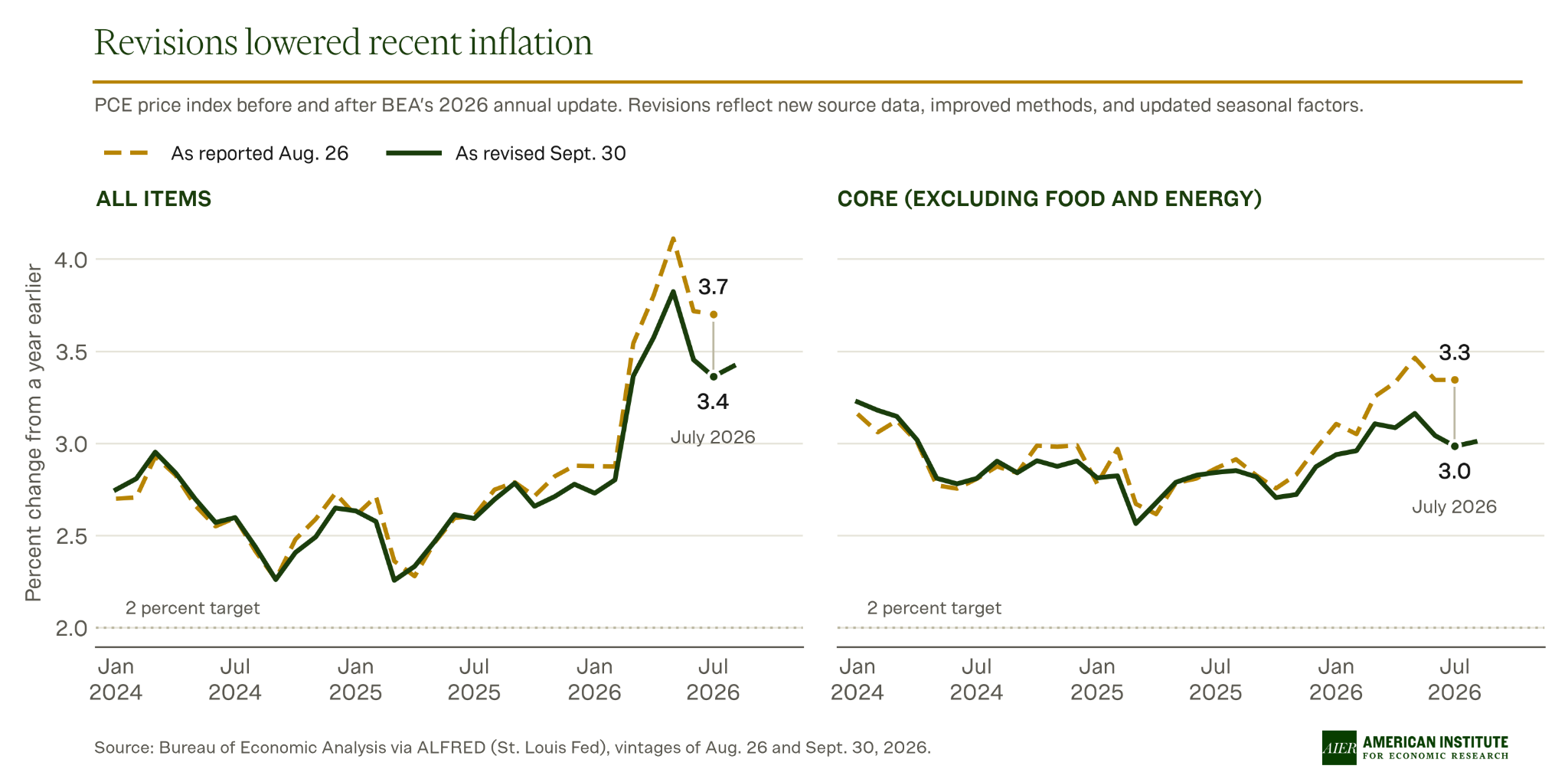
The revisions lowered the level of recent inflation. They did not change its trend. Even on the revised data, prices are rising faster than they were a year ago, when the inflation rate was 2.7 percent. Over the past three years, both headline and core prices have risen at an average annual rate of about 2.9 percent, above the Fed’s 2-percent target. That trend is why the Fed raised its target range for the federal funds rate by a quarter point, to 3.75 to 4 percent, at its September meeting. “Inflation remains elevated,” the committee’s statement said, and the increase “will support a timelier return to the Committee’s 2-percent goal.”
The trend that matters most for where inflation is headed is in total spending. Nominal spending, the dollar value of all final goods and services produced in the economy, grew 6.3 percent over the year ending in the second quarter, according to the third estimate the BEA released on Wednesday. That is slightly below the 6.6 percent previously reported, but the revision does little to change the underlying trend. Nominal spending growth has exceeded 4 percent in every year-over-year comparison since early 2021, and has averaged about 5.8 percent annually over the past three years. More importantly, it has accelerated recently, rising from 4.8 percent in the year ending in the second quarter of 2025 to 6.3 percent over the latest year.
Nominal spending cannot consistently outpace the economy’s productive capacity without ultimately leading to higher inflation. The Fed’s latest Summary of Economic Projections (SEP) puts longer-run real output growth at 2 percent per year. Add the Fed’s 2 percent inflation target, and nominal spending should grow about 4 percent per year over the longer run. Instead, nominal spending has grown 6.3 percent over the past year, more than 2 percentage points above that benchmark. At that pace, nominal spending is rising too fast for inflation to return to 2 percent, which means monetary policy remains too loose.
There has been progress. Core inflation has risen at an annualized rate of 2.7 percent over the last six months, down from 3.9 percent over the six months ending in May. And because monetary policy affects the economy with a lag, the full effects of the Fed’s September rate increase have yet to appear in the inflation data. But with spending growing this fast, inflation is unlikely to return to 2 percent without further rate hikes.
That rapid rise in nominal spending should shape the Fed’s next move at its October 27–28 meeting. But markets read the report differently: the downward revisions to recent inflation likely reduced the perceived need for further tightening, contributing to a decline in the odds of an October rate increase. Those revisions do little to change the case for tighter policy. Measured inflation fell by a few tenths of a percentage point, but the trend in nominal spending did not change.
December’s meeting will bring the Fed’s first Summary of Economic Projections incorporating the BEA’s revised inflation and spending data. In September, 16 of 18 participants projected at least one more increase this year, and four projected two. Lower inflation figures should not lead them to scale back while overall spending in the economy is still running this hot.
Unfortunately, the BEA releases third-quarter GDP the day after the Fed’s October meeting ends. If it shows nominal spending still growing well above 4 percent over the past year, monetary policy is likely still too loose. Until that gap closes, the Fed’s inflation fight is anything but over.


