







In a previous essay coauthored with economist Rahim Taghizadegan, we described “Flag Theory,” a concept referring to how individuals can move themselves, their companies, and their assets to where they are most welcome, optimizing for a combination of tax and lifestyle advantages. In markets, consumers enjoy a variety of goods and services supplied by companies competing on price and quality. Yet, states supply inferior services at higher prices — like any other monopoly.
Flag Theory changes the governance game by suggesting that, despite states monopolizing governance within their territories, individuals can shop among those monopolies by foot-voting to another state’s territory entirely. For this reason, the term Flag Theory is often used interchangeably with “geo-arbitrage,” and I personally also use the terms “governance shopping” or “the market for governance.” The underlying idea between each of the terms is the same: exit relatively worse systems towards better ones.
For those holding all their assets within the same jurisdiction where they work and live (and within their home country), Flag Theory may come across as a phenomenon that only benefits its practitioners, while offering no greater societal benefit. This essay attempts to help the reader see these greater societal benefits.
Governance Shopping and Societal Benefits in Academic Literature
Charles M. Tiebout argued in a 1956 paper that local levels of government are better able to satisfy the “preference pattern for public goods” of mobile “consumer-voters” than national levels of government. “Spatial mobility provides the local public-goods counterpart to the private market’s shopping trip,” he wrote. “In this model and in reality, the city manager or elected official who is not able to keep his costs (taxes) low compared to those of similar communities will find himself out of a job.”
For someone holding the political opinion that maximizing tax revenue, no matter what, is necessarily “good for society” (even when services are subpar), Tiebout competition may sound like a bad idea. But for someone focused instead on maximizing the quality of services while minimizing costs to taxpayers, introducing competition into governance is a welcome change. Producing better governance isn’t exclusively beneficial for Tiebout’s mobile consumer-voters; the native population benefits too.
Albert O. Hirschman’s book Exit, Voice, and Loyalty explored how “member-customers” seek to resolve problems in the decline of firms, organizations and states either by exiting (leaving) or by voicing grievances. Hirschman, like Tiebout, focused his analysis on the benefits to the individual, not to “society.” Yet he understood that:
[…] exit has an essential role to play in restoring quality performance of government, just as in any organization. It will operate either by making the government perform or by bringing it down, but in any event, the jolt provoked by clamorous exit of a respected member is in many situations an indispensable complement to voice.
Barry R. Weingast’s 1995 paper described a concept called market-preserving federalism: an economic system enabling thriving economies, not only through property rights and law of contract but also “a secure political foundation that limits the ability of the state to confiscate wealth.” (18th-century England and 19th-century United States operated as de facto and de jure market-preserving federalist systems respectively.) Weingast argued that jurisdictions under this federalist system thrive by offering “menus of public policies” to attract mobile labor and capital. “The mobility of resources” he wrote, “raises the economic costs to those jurisdictions that might establish certain policies, and they will do so only if the political benefits are worth these and other costs.”
David D. Friedman used an interesting thought experiment in his book The Machinery of Freedom to make the case for privatized defense. We can use the same thought experiment more narrowly to illustrate the social benefits of mobile foot-voters:
Consider our world as it would be if the cost of moving from one country to another were zero. Everyone lives in a housetrailer and speaks the same language. One day, the president of France announces that because of troubles with neighboring countries, new military taxes are being levied and conscription will begin shortly. The next morning the president of France finds himself ruling a peaceful but empty landscape, the population having been reduced to himself, three generals, and twenty-seven war correspondents.
In Adam Smith’s The Wealth of Nations, he wrote that every individual in the market “neither intends to promote the public interest, nor knows how much he is promoting it.” Each individual “intends only his own gain, and he is in this, as in many other cases, led by an invisible hand to promote an end which was no part of his intention. Nor is it always the worse for the society that it was no part of it. By pursuing his own interest he frequently promotes that of the society more effectually than when he really intends to promote it” [emphasis mine].
Smith’s invisible hand metaphor explains how individuals pursuing their own interests often produce great public benefit — even if unintentionally.
The idea is to introduce competition to governance, wherever possible, so that policymakers, (heads of state, governors) are forced to produce less-abysmal governance. Knowing that the local population has the power to punish political actors at will — both at the ballot box and, more effectively, by exiting the political system altogether — is likely to keep political ambitions within the range of preferences that the local population is willing to accept.
Consent in Moral and Political Philosophy
Tom W. Bell’s book Your Next Government argues that each of the major approaches to moral philosophy (consequentialist, deontological, and aretaic) treats consent as “at least a prima facie good.” “The virtue of justice”, Bell argues, “constrains us from violating others’ rights without their consent. More generally, consent plays a vital role in cultivating habits of right action. Virtue weakens, withered by inaction, when not exercised through freedom of choice.”
Bell’s full argument is beyond the scope of this essay, but the gist is that consent is hardly binary — consent versus non-consent. Consent is, in fact, a matter of degree. To the extent that transactions move up the “ladder of consent” toward something closer to expressed consent, they hold higher moral justification.

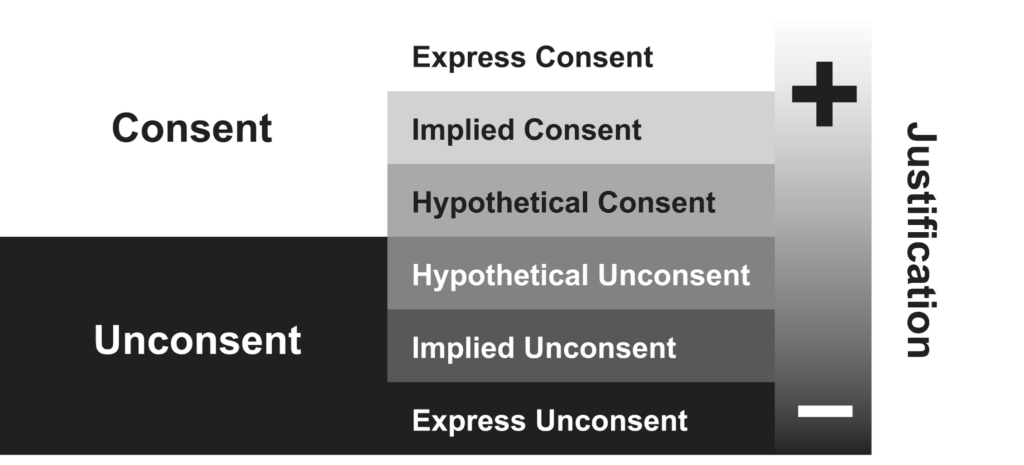
The ladder of consent’s relevance to governance and taxation is that if states are able to fund their activities through more expressed consent rather than merely relying on Jean-Jacques Rousseau’s social contract to justify confiscatory taxation, their actions are more easily justified in moral terms. (On the above graphic, Rousseau’s social contract would qualify as hypothetical consent.) Governments receiving money from foreigners willing to pay for access to many of the same rights and obligations as local residents or citizens should then be seen as a welcome source of income — especially when the cultural practices of the newcomers are not at major odds with those of the locals, and especially when governments can make the case to local taxpayers that sourcing money from abroad will provide them with tax relief.
One final point on consent as it relates to political philosophy is that Rousseau’s own minimum conditions to justify the social contract are not met — according to Rousseau himself. (This is also a point made by Titus Gebel.) Rousseau emphasized the necessity to go back to “an original convention”:
For if there were no prior covenant, where would the obligation be (if the election were not unanimous) for the minority to submit to the choice of the majority, and how could it be right for the votes of a hundred who wanted a master to be binding on ten who did not? The law of the majority vote itself establishes a covenant, and assumes that on one occasion at least there has been unanimity.
In other words, modern states do not derive their political authority from any prior covenant in which every member of a community expressed consent. Thus, to cite Rousseau’s social contract in political discourse to justify most modern forms of taxation is to misuse it. But let’s not kid ourselves — states aren’t going away. The least we can do is emphasize the importance of states finding the least unjust sources of revenue possible (those climbing the ladder of consent, as close to expressed consent as possible).
Governance Competition Benefits Everyone
One major point emphasized in this essay is that continuing to patronize bad governance, or to pay high taxes in exchange for poor quality public services, is to incentivize more of the same bad governance. Similarly, moving one’s physical self and family, incorporating one’s business, and relocating one’s assets to jurisdictions where the persons, businesses, and assets involved are more welcome, is to reward better governance. It isn’t only the individual (or his family) who benefits from spatial mobility, but also others who must live under the same government. Entrepreneurial and highly skilled individuals who remained behind the Iron Curtain of the Soviet Union by choice — when they were permitted to leave — undoubtedly improved the lives of locals in the short term, but by not leaving, they also helped sustain a broken system that continued to oppress those same locals for longer.
Flag Theory practitioners come in many shapes and sizes. Many have their life’s savings, business income, or a pension and are willing to invest in a country’s Citizenship by Investment (CBI) or Residence by Investment (RBI) program. Many of these programs take the form of a direct payment to the government of that country. Others involve purchasing government bonds or parking money with one of that country’s commercial banks. In still other cases, the requirement is a real estate purchase or simply proof of foreign-sourced minimal monthly income sufficient to sustain the person without relying on local taxpayers.
In most of the above cases, the government is essentially selling the foreign foot-voter the right to live, work, invest, or open a business. As such, governments are encouraging economic activity (attracting capital from abroad) while also often increasing revenue that can be used for infrastructure, pensions, national defense, and the like. This can create great positive benefits for the country, providing tax relief for the local population — subsidized by foreigners who hope to make a better life for themselves.


