







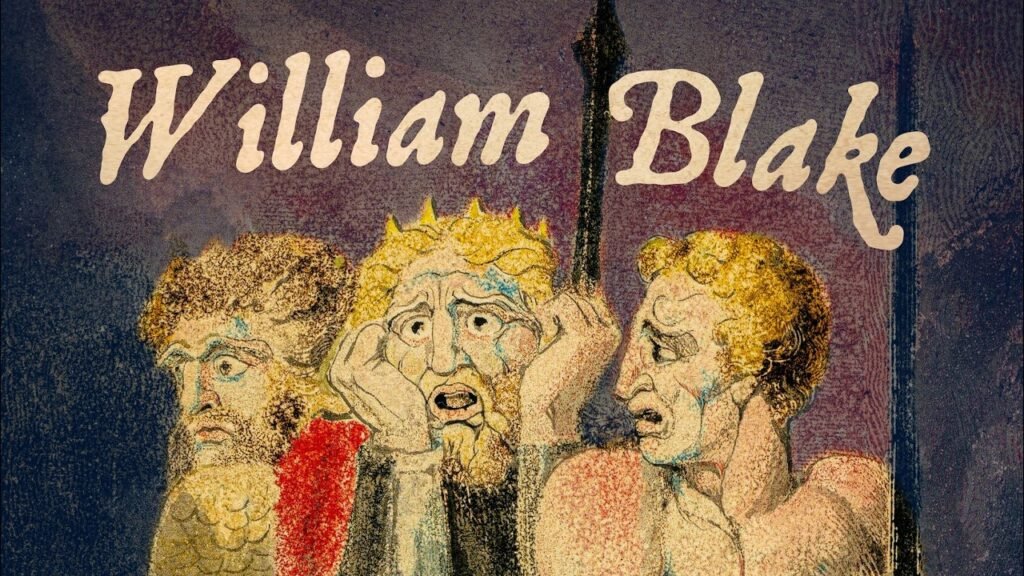

William Blake is a household name, or not far from it, but things get more complicated when it comes to professional description. He was a poet, a painter, and a printmaker, at least insofar as he wrote poetry, painted paintings, and made prints. But we can’t hope to attain even a basic understanding of his legacy if we regard him as one man who happened to have the energy to do three different things. In fact, the ostensibly separate artistic pursuits in which he engaged were but three aspects of a unified act of creation, resulting in the likes of Songs of Innocence and of Experience and his illuminated “prophetic books”: unclassifiable works by “the patron saint of unclassifiable artists.”
So Evan Puschak, better known as the Nerdwriter, labels him in his new video above. Blake made books, “which he designed, wrote, etched, colored, and printed himself, using a technique that he invented.” They “mix and synthesize categories, and as a result, the artwork of the late seventeen- and early eighteen-hundreds didn’t really know what to make of them.”
It didn’t help that the Royal Academy of Arts, founded when Blake was in adolescence, had laid down its own strict aesthetic, generic, and formal standards. Officially an engraver and accorded the lowly status thereof, Blake devoted his labors to realizing his elaborately idiosyncratic visions using images and words together in ways that no artist had done before.
This choice “to work as maker of words, maker of images, and crossbreeder of both, amounted to a decision to live in incommensurable neighborhoods of meaning,” writes The Cambridge Companion to William Blake author Morris Eaves as quoted by Puschak. Blake swam against the current “of modern human understanding, whose bedrock is the principle of specialization.” Today, nearly two centuries after his death, that principle still obtains, and in some ways more rigidly than ever. But his work remains, from the Songs and the prophetic books to his illustrations of classics like the Divine Comedy, Paradise Lost, and even the Biblical Book of Job, which he read as “the story of a man who believes, mistakenly, that salvation requires a slavish obedience to words written in a book.” With his rules, divisions, and categories, man has cut reality apart; through his art, Blake sought to make it whole again.
Related content:
The Radical Artistic & Philosophical World of William Blake: A Short Introduction
William Blake’s Hallucinatory Illustrations of John Milton’s Paradise Lost
The Otherworldly Art of William Blake: An Introduction to the Visionary Poet and Painter
William Blake: The Remarkable Printing Process of the English Poet, Artist & Visionary
Based in Seoul, Colin Marshall writes and broadcasts on cities, language, and culture. He’s the author of the newsletter Books on Cities as well as the books 한국 요약 금지 (No Summarizing Korea) and Korean Newtro. Follow him on the social network formerly known as Twitter at @colinmarshall.


