







By Sally Rufus, updated July 28, 2026
Choosing an exchange these days feels less like picking a broker and more like planning a route through a city with no central map. Back when Bitcoin was the only game in town, you just needed a platform that didn’t collapse under pressure. Now your portfolio might hold ETH on mainnet, SOL in a Phantom wallet, USDC on Arbitrum because that’s where the yield made sense, and maybe some MATIC you forgot about.
How Crypto Exchanges Are Competing in 2026
Moving between these is rarely a single click. You check the bridge. You compare slippage. You wonder if the destination wallet even supports the token. By the time you’re done, you’ve spent more energy on the transfer than on the trade itself.
That’s the gap services like ChangeNOW have stepped into. Non-custodial, no account, no deposit. You connect your wallet, pick the pair, and the platform handles the routing through its cross chain swap functionality. No KYC for smaller amounts. No waiting for funds to clear. Just a swap that lands on the destination chain without ever touching the platform’s balance sheet. The frustration of managing multiple exchange accounts and watching funds sit in limbo suddenly disappears.
The big players haven’t gone anywhere. Binance, Coinbase, and Kraken still dominate when you need real depth and serious tools. But the competition has moved elsewhere. MiCA has forced everyone in Europe to rethink user data, reporting, and asset segregation. The exchange that nails compliance might win the institutional flow, even if its spot volume trails a rival.
What’s shifting is the mindset. Few people look for a single platform that does everything. They assemble a stack – derivatives here, staking there, a non-custodial service for quick moves, a hardware wallet for the bulk holdings. That fragmentation feels permanent.
How We Selected the Top Crypto Exchanges in 2026
A ranking based purely on volume is easy to produce and equally easy to dismiss. Volume gets inflated, wash-traded, or concentrated in pairs most users never touch. What actually works depends on who you are.
A scalper needs low latency and deep futures liquidity. A long-term holder cares about custody and regulatory clarity. Someone hunting early-stage projects wants tokens that haven’t hit the top tier yet. Different use cases. Different tools.
We looked at liquidity across major pairs, not the headline number. We checked security track records, not marketing copy. We verified which networks each exchange supports – a platform that only handles ERC‑20 won’t help if you hold native Solana. Fees mattered, but so did transparency. And we paid attention to what each exchange was built for, because using a derivatives platform for a casual swap is like taking a race car to the grocery store.
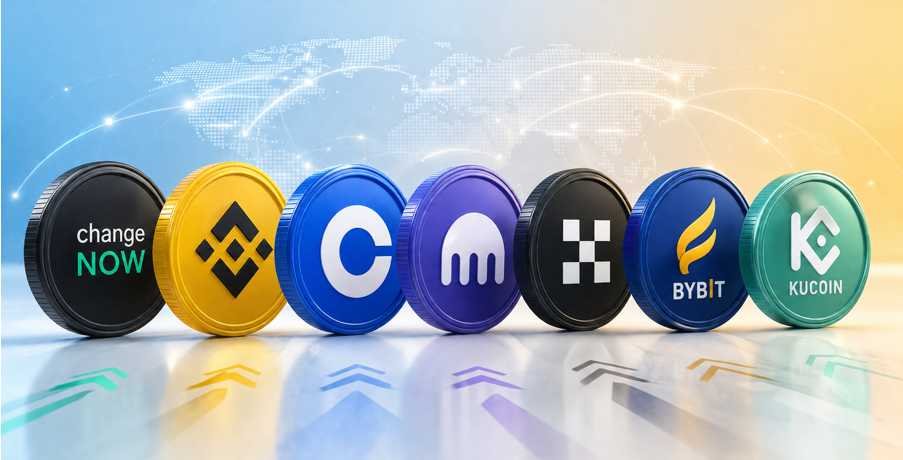
The seven below serve distinct needs. No single winner. Just different tools for different jobs.
1. ChangeNOW: Best for Cross‑Chain Crypto Swaps
ChangeNOW launched in 2017, which makes it older than many DeFi protocols that now compete for the same space. The model is simple: you swap directly from your wallet, the platform aggregates liquidity from multiple sources, and the assets land on the destination chain without ever passing through a ChangeNOW wallet.
Network support is broad – Bitcoin, Ethereum, Solana, and a decent list beyond that. That versatility matters if you hold assets across several ecosystems and don’t want to register on an exchange every time you rebalance. A detailed ChangeNOW crypto exchange review 2026 breaks down how its fees and speed stack up against other instant swap services, especially when you’re moving larger amounts.
What you won’t find here is order books, margin, or derivatives. It’s a swap tool, period. For some users that’s precisely the point. For others it’s a limitation.
Key advantages
- Non-custodial model. Users exchange assets directly from their own wallets without keeping funds on the platform.
- Wide network support. Multiple supported assets help simplify conversions between different blockchain ecosystems.
- Fast swaps. The service is designed for users who need straightforward exchanges without order books or advanced trading tools.
2. Binance: Best for Liquidity and Advanced Trading
Binance, also from 2017, grew into the exchange everyone else measures against. The liquidity on BTC/USDT and ETH/USDT is deep enough that even chunky market orders execute without much slippage – critical when you’re managing real size.
The product set is broad. Spot, futures, options, staking, launchpad, yield products. But availability depends on where you live. Regulatory pressure has forced Binance to restrict certain services regionally, and they’ve poured resources into compliance to meet MiCA standards in Europe.
Key advantages
- High liquidity. Large trading volumes improve order execution and make Binance suitable for users managing significant positions.
- Advanced trading features. Spot markets, derivatives, and additional tools support different trading strategies.
- Wide market access. Binance serves users across multiple regions, although available products vary depending on local regulations.
3. Coinbase: Best for Regulatory Compliance and US Market Access
Coinbase has been around since 2012 – ancient history in crypto terms. The Nasdaq listing in 2021 locked in its reputation as the most regulatorily transparent exchange in the US. For institutions and conservative retail investors, that compliance focus often outweighs other considerations.
Beyond retail trading, Coinbase Prime handles custody, execution, and reporting for funds and corporations. Several spot Bitcoin ETF issuers rely on them for custody, which puts Coinbase at the centre of mainstream adoption.
Key advantages
- Regulatory focus. As a US-based company, Coinbase places strong emphasis on compliance and reporting standards.
- Institutional services. Its custody infrastructure supports companies and investment firms entering the crypto market.
- Simple interface. The platform is designed for users who want an accessible way to buy and manage digital assets.
The interface is clean. Almost too clean for some. Experienced traders often grumble about the limited toolset and higher fees. If regulatory clarity and brand trust matter most, Coinbase is a natural fit. If you want low-cost trading or advanced order types, look elsewhere.
4. Kraken: Best for Security and Experienced Traders
Kraken predates most rivals – roots in 2011, live in 2013. Over a decade, it’s built something rare in this industry: a reputation for operational integrity. No major hacks. No catastrophic failures.
Kraken Pro offers sophisticated charting, advanced order types, and margin trading. Spot and futures are available in eligible regions. They’ve also been ahead of the curve on European compliance.
Key advantages
- Security track record. Kraken has operated for more than a decade without major exchange hacks, strengthening its reputation among long-term users.
- Advanced trading tools. Kraken Pro provides professional features, including advanced order types and market data.
- Transparent operations. The company regularly shares information about security practices and platform standards.
They don’t chase meme coins or exotic offerings. They list assets with some track record and liquidity. That conservatism appeals to users who value stability and control over novelty. Steeper learning curve than beginner platforms, but for those who prioritise security and transparency, Kraken delivers.
5. OKX: Best for Web3 Features and Trading Tools
OKX started in 2017 and evolved into a hybrid – traditional exchange plus built-in Web3 wallet. You trade spot or derivatives, switch to the wallet, interact with dApps, NFTs, multiple networks. All without leaving the ecosystem.
The trading toolkit is comprehensive. Futures, options, automated strategies, various order types. The Web3 integration supports a growing list of chains, useful if you move frequently between CeFi and DeFi.
Key advantages
- Advanced trading tools. Spot markets, futures, options, and automated features support different trading strategies.
- Web3 integration. The built-in wallet connects users with decentralized applications and on-chain assets.
- Global presence. OKX operates across multiple regions and continues adapting to local regulatory requirements.
The breadth can overwhelm beginners. But if you already understand both centralised and decentralised finance and want a single interface, OKX offers a compelling package. Regional restrictions apply.
6. Bybit: Best for Derivatives Trading
Bybit entered in 2018 with a singular focus – perpetual futures. The matching engine was built for speed, and they quickly attracted traders needing reliable execution on leveraged positions. Over time they added spot, copy trading, and Web3 services, but derivatives remain the core.
Extensive range of perpetual markets. Advanced order types. Position management tools. Real-time analytics. Copy trading has also gained traction among retail users who prefer to follow experienced traders.
Key advantages
- Strong derivatives focus. Bybit provides extensive futures markets with tools designed for traders who use advanced strategies.
- Trading features. The platform offers options such as copy trading, automated tools, and detailed market analytics.
- Fast-growing ecosystem. Beyond derivatives, Bybit has expanded into spot trading, Web3 products, and additional crypto services.
The product suite can intimidate newcomers. Someone who just wants to buy and hold ETH doesn’t need 100x leverage. But for active traders comfortable with risk management and wanting deep derivatives liquidity, Bybit remains a top contender.
7. KuCoin: Best for Altcoin Selection
KuCoin carved out a niche as the go-to for altcoin hunters. Since 2017, they’ve listed hundreds of tokens that haven’t made it to larger platforms. That breadth attracts users looking for early-stage projects or diversification beyond the top caps.
Spot, futures, staking, earn products – all available. But the main draw is the sheer number of trading pairs. Global user base, though regulatory developments have affected some services.
Key advantages
- Wide asset selection. KuCoin lists a large number of cryptocurrencies, giving users access to markets beyond major assets such as Bitcoin and Ethereum.
- Trading variety. The platform offers spot markets, derivatives, and additional tools for different trading approaches.
- Global user base. KuCoin serves users across many regions and has developed a broad international presence.
The tradeoff: not every listed token has deep liquidity or a proven track record. Smaller caps can be volatile. Spreads on less traded pairs can widen unexpectedly. Do your own research. KuCoin remains valuable if you prioritise variety over safety.
How to Choose the Right Exchange
Start with your habits. How often do you trade? What assets and networks do you use? Do you need leverage, or just swaps? These questions narrow the field fast.
When comparing platforms, consider:
- Trading conditions – liquidity, spreads, order types, fees
- Asset support – does the exchange cover the cryptos and networks you actually use?
- Regulation and security – licensing, custody practices, account protection
- Storage model – exchange custody for convenience, non-custodial for control
Licensed exchanges offer some protection against sudden shutdowns or asset freezes. Custody practices vary – some keep most funds in cold storage, others use multi-sig hot wallets. The difference matters if something goes wrong.
Storage is another layer. Leaving funds on an exchange is convenient but adds counterparty risk. Non-custodial gives you control but requires managing private keys. Neither is inherently better. It depends on your risk tolerance and activity level.
The idea of a one-size-fits-all exchange feels outdated now. Most users maintain a primary platform for active trading, a secondary one for specific features, and a wallet for long-term holdings.
Outlook for Crypto Exchanges
The trend is specialisation. Large players will keep investing in compliance, institutional custody, and liquidity. Smaller services will focus on niches – cross-chain swaps, derivatives, emerging tokens.
Regulation is no longer background noise. MiCA is already reshaping Europe. Other jurisdictions are drafting similar rules. Exchanges that adapt early gain an edge. Those that resist lose access.
Institutional demand is another driver. Spot Bitcoin ETFs in the US have increased the need for reliable custody and execution. Exchanges that serve institutional clients with the same standards as traditional finance will capture a growing share.
At the same time, wallet technology and cross-chain bridges are improving, reducing reliance on centralised platforms for asset movement.
Three scenarios:
- Base case: leaders maintain positions through compliance, liquidity, and product refinements.
- Optimistic: clearer rules and better infrastructure drive broader adoption.
- Stress: regulatory restrictions, security incidents, or weak market conditions squeeze smaller players and accelerate consolidation.
The most likely outcome is a segmented ecosystem. Users combine multiple platforms based on specific needs. The exchanges that thrive will be those that excel at a defined set of functions rather than trying to be everything to everyone.
Final Thoughts: Choosing a Crypto Exchange in 2026
Choosing an exchange this year isn’t about finding a single best platform. It’s about matching the right tool to your specific job. Active traders need speed and depth. Long-term investors want custody and regulatory clarity. Casual swappers value simplicity and low friction.
The exchanges that succeed will be the ones that acknowledge these differences. They won’t solve every problem. They’ll solve a few problems exceptionally well and let users decide what matters most.
FAQ
- What is the best crypto exchange in 2026?
No exchange is universally best. The optimal choice depends on your trading frequency, asset preferences, fee sensitivity, and regional constraints.
- Which crypto exchange is best for beginners?
Beginners tend to prefer platforms with clear interfaces and transparent fee structures. Coinbase and ChangeNOW are often cited as accessible entry points.
- What should active crypto traders look for in an exchange?
Liquidity, execution speed, order type variety, and derivatives availability are the primary factors. Binance and Bybit are built around these requirements.
- Are regulated crypto exchanges safer?
Regulation adds oversight and can improve operational standards, but it does not eliminate all risks. Users should still evaluate security practices and custody arrangements.
- Should crypto be stored on an exchange or in a personal wallet?
Convenience favours exchanges, control favours personal wallets. The choice depends on whether you prioritise ease of trading or direct ownership of your private keys.
Disclaimer
This article is for informational purposes only and does not constitute financial, investment, or trading advice. Cryptocurrency markets are volatile, and users should conduct their own research before selecting an exchange or making any decisions involving digital assets. The information presented may change as platforms, regulations, and market conditions evolve.


