







?si=sPXB5teJO7wsm71F
The Pacific Palisades fire of January 25 destroyed much of that coastal Los Angeles neighborhood, but it somehow spared the Charles and Ray Eames house. Anyone who’s paid it a visit, or at least pored over the many photos of it in existence, knows that it’s more than a preserved work of California modernism once inhabited by a famed pair of husband-and-wife designers. In truth, it’s more like a world, or at least a worldview, made domestic. From the outside, one first notices the clean, vaguely Japanese lines, the sharp angles, and the planes of Mondrian color. Once inside, one hardly knows what to look at first: the Isamu Noguchi lamp? The Native American baskets? The kokeshi dolls? The Eames Lounge Chair?

?si=DQ-M1lsNTauOahsy
After a few months’ closure to repair smoke damage, the Eames House re-opened to visitors last summer. But wherever in the world you happen to be, you can tour the place in its prime, and as its makers would have wanted you to see it, through the short film from 1955 at the top of the post.
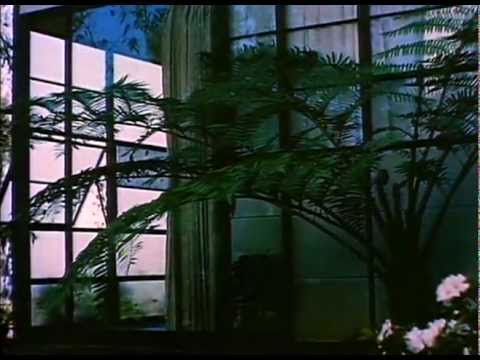
Titled simply “House: After Five Years of Living,” it briefly animates the title building’s construction process, shows its context in nature and some of the textures to be seen on and around its exterior walls, and soon makes tentative moves— albeit almost entirely with still shots — toward the interior. Shot and edited by the Eames themselves, the film showcases their aesthetic and communicative sensibility as much as does the house itself, or indeed the pieces of furniture inside that they themselves designed.

?si=Weh1Zn9TcEOFLV_M
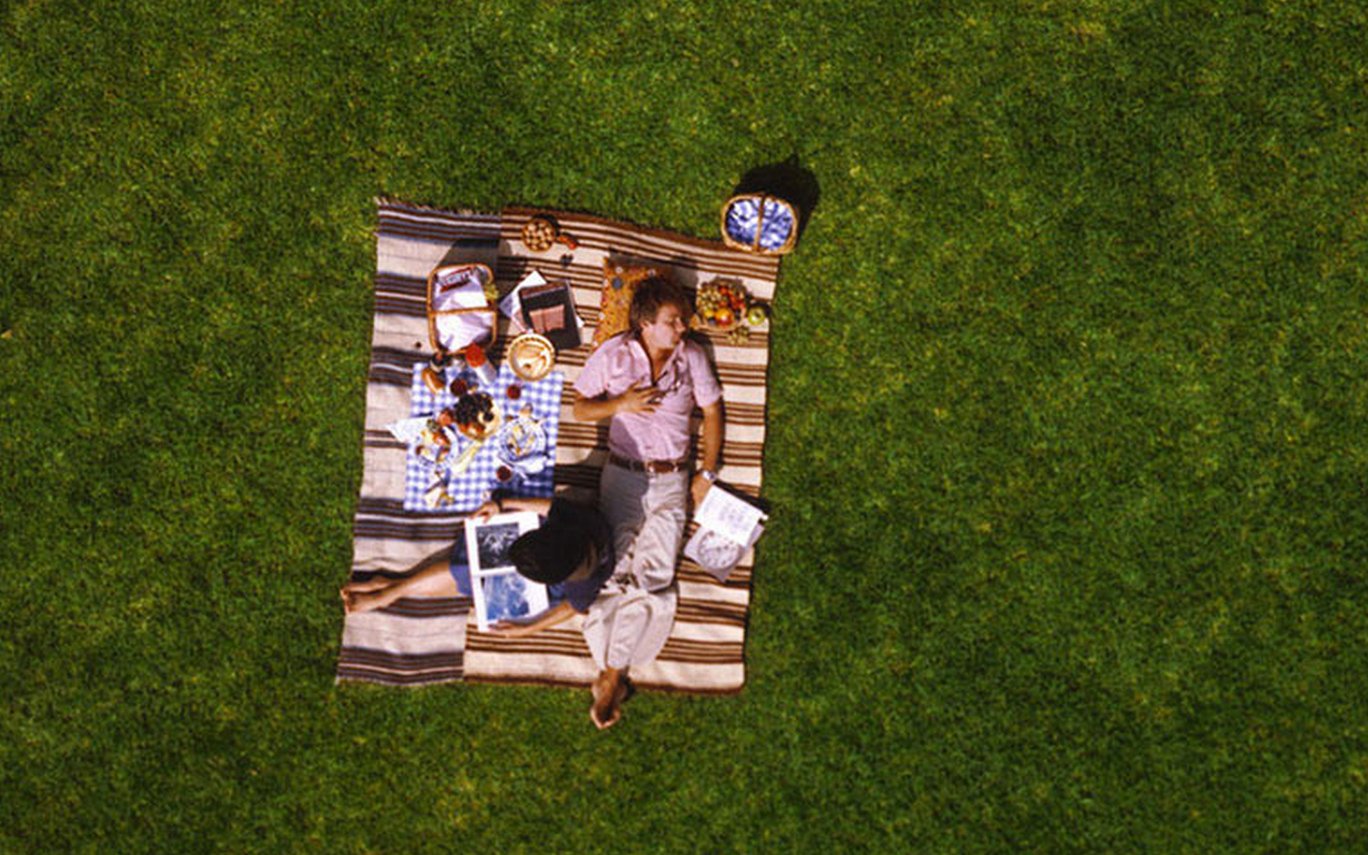
So, each one in a different way, do the 35 Eames shorts collected on this Youtube playlist. It includes, of course, “Powers of Ten,” an eight-minute-long zoom out from a picnic on Lake Michigan to 100 light years away in outer space, then back again and down to the microscopic scale of “a proton in the nucleus of a carbon atom beneath the skin on the hand of a sleeping man at the picnic.” In addition to stewarding the house, the Charles & Ray Eames Foundation has plans to bring that acclaimed film back out for its 50th anniversary next year. Until then, this playlist will give you a chance to get acquainted with a bit more of their large body of cinematic work, reflecting as it does the Eameses’ signature instinct for modernist creativity and lighthearted pedagogy, but also their proximity to the world that the mid-twentieth century was fast bringing into being.

?si=VqVk3JmW1IiVZbk_
Take the series of productions they did for IBM, like “A Computer Perspective: Background to the Computer Age” just above, commissioned for an exhibition of the same name. Beginning its story with humanity’s earliest calculating machines, it makes its jazzy visual-historical way up to the postwar decades, during which, as the narrator puts it, “the variety of demands on the computer began to multiply. It was asked to be not only calculator and analyzer, but information storage and retrieval device, instrument of communication, and interlocutor.” If only the Eamses could have lived, we might think, to see how fully the computer would come to occupy that last role. Nor, revisiting “Powers of Ten,” could any of us ignore how much the viewing experience reminds us of our idle explorations on Google Earth, a technological development they surely wouldn’t have found implausible — and surely would have found captivating.
Related Content:
Charles & Ray Eames’ Iconic Lounge Chair Debuts on American TV (1956)
Charles & Ray Eames’ Short Film on the Mexican Day of the Dead (1957)
“They Were There” — Errol Morris Finally Directs a Film for IBM
Based in Seoul, Colin Marshall writes and broadcasts on cities, language, and culture. He’s the author of the newsletter Books on Cities as well as the books 한국 요약 금지 (No Summarizing Korea) and Korean Newtro. Follow him on the social network formerly known as Twitter at @colinmarshall.


