







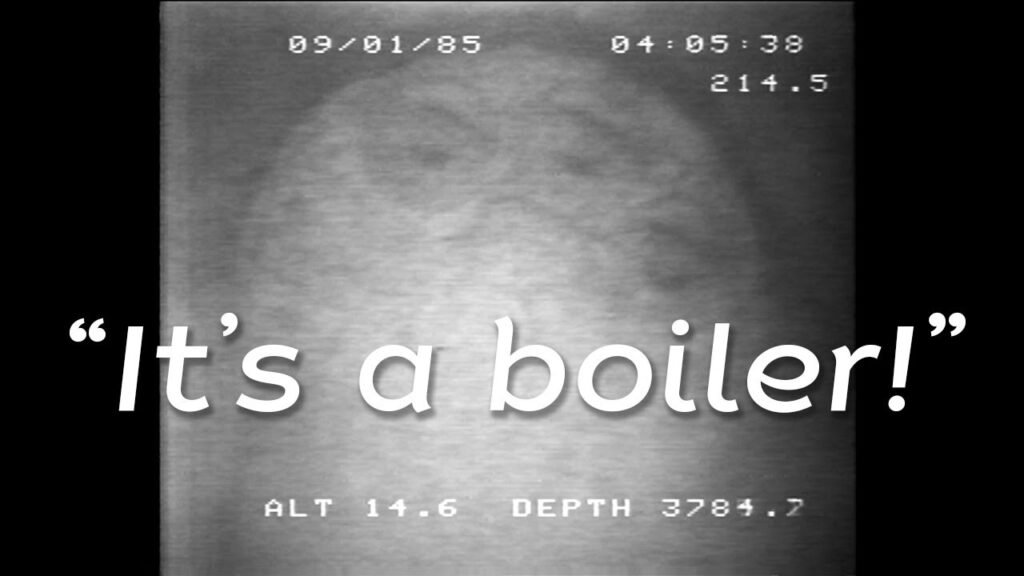

The wreck of the RMS Titanic has never ceased to command attention, from pop-cultural fascination to scientific scrutiny and everything in between. That can make it seem, especially to the younger generations, as if humanity has been gazing upon its remains since they first settled at the bottom of the North Atlantic Ocean. In fact, the precise location of the shipwreck went unknown for more than 73 years, between the day of the disaster, April 15th, 1912, and that of the discovery, September 1, 1985. In the video above, you can watch the very moment debris from the Titanic first came into the view of Argo, the unmanned undersea camera used by the researchers seeking it out.
“Somebody should get Bob,” says one of the crew as soon as it becomes clear, even on their low-resolution black-and-white monitor, that they’re looking at man-made objects on the sea floor. And well they should have: the Bob in question is oceanographer and Argo inventor Robert Ballard, who’d been actively thinking about how to find the Titanic since at least the early nineteen-seventies and boarded Woods Hole Oceanographic Institute’s R/V Knorr with intent to find it.
In truth, the voyage was financed by the U.S. Navy, which had much less interest in finding the wreck of the Titanic than those of the USS Scorpion and Thresher, two nuclear submarines lost in the sixties. If Ballard could look for them, so the deal went, he could use the expedition’s spare time and resources on his life’s mission.

After determining that the Scorpion and Thresher had imploded, Ballard and the Knorr crew continued on to the general area in which the Titanic sank. Knowing that the infamously “unsinkable” ocean liner would have been subject to the same mighty undersea pressure, they kept their eyes open, through Argo, for similarly scattered fragments rather than intact sections of the hull. As the video shows us, the strategy worked: only when a trail of debris leads them to an identifiable boiler, proof positive that they’d found what they were looking for, does the cheer go up. Ballard would go on to discover other widely known shipwrecks — the battleship Bismarck, the aircraft carrier USS Yorktown in 1998 — but one suspects that nothing quite matches that first Titanic high.
Related content:
Based in Seoul, Colin Marshall writes and broadcasts on cities, language, and culture. He’s the author of the newsletter Books on Cities as well as the books 한국 요약 금지 (No Summarizing Korea) and Korean Newtro. Follow him on the social network formerly known as Twitter at @colinmarshall.


