







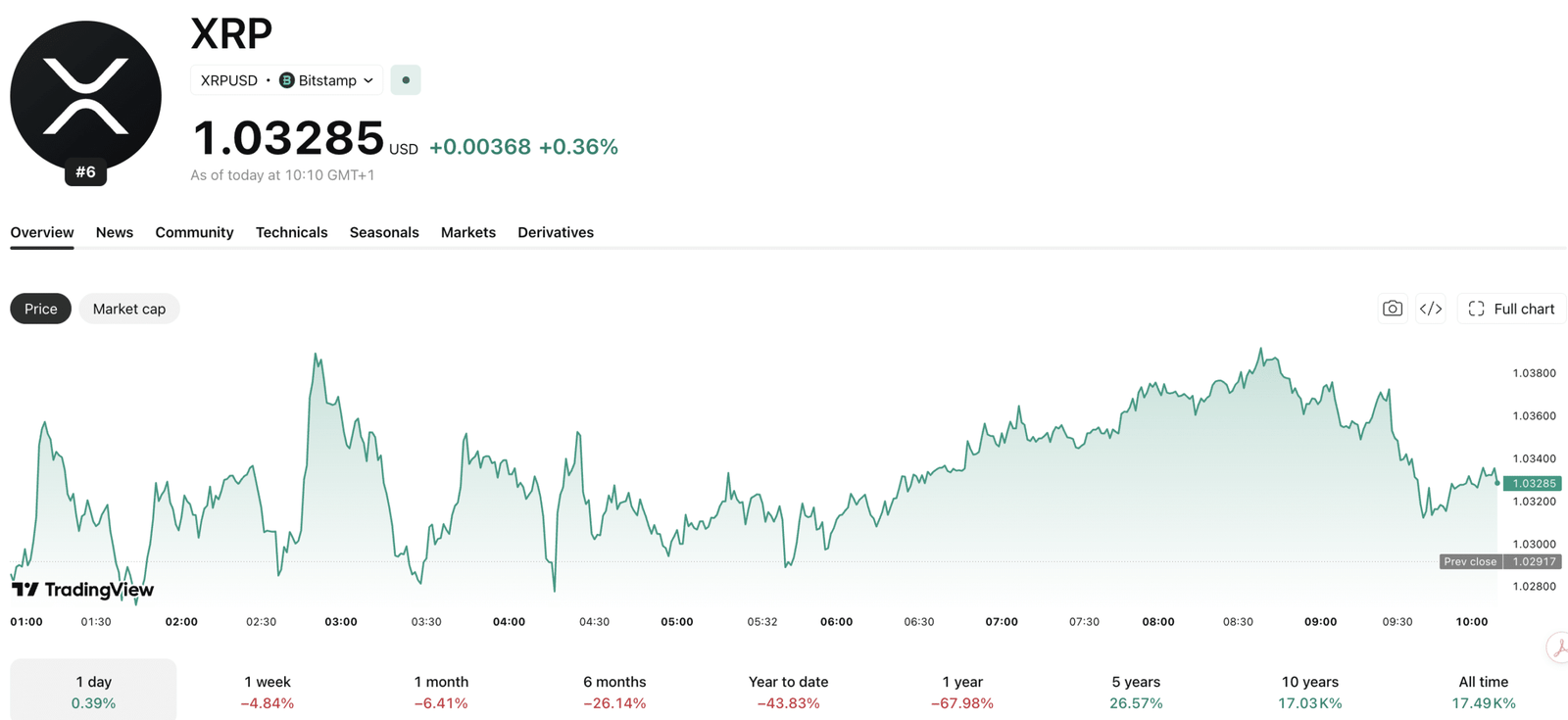
In XRP news today, Andy Burnham’s name has started circulating alongside Ripple and XRP in connection with a UK Treasury blockchain initiative, but the underlying documents tell a much narrower story. HM Treasury’s Wholesale Financial Markets Digital Strategy, published on gov.uk, lays out a multi-year plan to tokenize wholesale finance, remove paper share certificates, and pilot a Digital Gilt Instrument known as DIGIT.
Ripple is now tied to a UK Treasury initiative to rebuild wholesale financial markets with blockchain—this isn’t a partnership, it’s system-level integration quietly taking shape.
This isn’t a corporate deal—it’s government-level integration. pic.twitter.com/uqBe9l2Ck0
— Skipper | XRPL (@skipper_xrp) August 10, 2026
Nowhere in that strategy, nor in the supporting materials from the City of London Corporation or Ripple itself, does Andy Burnham’s name appear.
Ripple’s genuine, documented participation in a 54-firm UK tokenization taskforce is real, but the leap from “Ripple is in the room” to “the UK Treasury has endorsed XRP”, let alone that a named public figure like Burnham is personally backing it, is not supported by any primary source reviewed for this piece.
XRP News: What the Treasury Document Actually Says


The gov.uk strategy commits the government to three broad tracks: market optimization (killing off paper processes and manual settlement), market transformation (scaling distributed ledger technology, or DLT, for live trading and settlement), and market leadership (appointing an industry figure to coordinate the private sector’s work).
That third commitment is where the Wholesale Digital Markets Champion role originates – a position later filled by Chris Woolard CBE, a former Financial Conduct Authority (FCA) executive director, according to the City of London Corporation, which acts as delivery partner and secretariat for the initiative.
The Treasury text is explicit about DLT’s potential to let financial assets exist as tokens on shared ledgers, improving transparency and cutting operational costs. It says nothing about which blockchain, protocol, or company will carry out that work. Ripple, XRP, and the XRP Ledger (XRPL) are absent from the government’s own strategy paper entirely.
Where Ripple’s Involvement is Actually Documented
Ripple’s own account of its role comes from a company blog post published on July 13, 2026, titled “Beyond TradFi and DeFi: Accelerating Digital Capital Markets in the UK.”
In it, Ripple describes convening regulators and financial institutions at the Innovate Finance Global Summit and confirms the appointment of Chris Woolard CBE as Digital Markets Champion, treating that appointment as a positive signal for the sector, not evidence of exclusive selection.
The City of London Corporation’s own page on the Champion initiative lists a cross-industry taskforce of 54 firms working over the next 12 months, with an initial focus on tokenized repurchase agreements, or repo markets, and a target of running a live trial by spring 2027.
Ripple appears in that broader field, but so do traditional heavyweights across banking and asset management. Being one of dozens of participants in an industry taskforce is materially different from being chosen as infrastructure for a UK government mandate, a distinction that matters for anyone reading headlines that conflate Ripple’s presence with XRP news adoption.
BREAKING RIPPLE HAS BEEN BROUGHT INTO A UK TREASURY INITIATIVE EXPLORING BLOCKCHAIN INFRASTRUCTURE FOR WHOLESALE FINANCIAL MARKETS
THE UK TREASURY WHOLESALE DIGITAL MARKETS TASKFORCE IS EXPLORING TOKENIZATION STRATEGY FOR INSTITUTIONAL FINANCE
THE TREASURY PLAN PLACES THE… pic.twitter.com/rTnzCfovK5
— 𝗫ℝℙ ℍ𝔼ℝ𝔸𝕃𝔻 (@xrp_herald) August 10, 2026


Tokenized Repo, Explained in Simple Terms
Repo markets are the plumbing of institutional finance: one party sells a security, typically a government bond, for cash, and agrees to buy it back later at a set price. It is effectively a short-term collateralized loan.
Tokenizing that process means representing the bond and the cash leg as digital tokens on a shared ledger, so ownership transfers can settle in near real time instead of the multi-day cycles typical of paper-based or legacy electronic systems.
That is the specific use case named in the City of London Corporation’s report, and it is why the spring 2027 live-trial target matters more than any single vendor’s branding.
For readers wanting deeper background on how this fits the UK’s wider regulatory build-out, the UK’s digital asset framework for stablecoins and tokenization covers the parallel FCA and Bank of England workstreams running alongside this Treasury strategy.
XRP News and Ripple: Separating the Company from the Token


In other XRP news, Ripple, the company, builds enterprise payment and custody infrastructure; XRP is a separate tradable token, and XRPL is the underlying ledger. A firm’s seat at a policy task force table says nothing about whether that ledger gets used for settlement, and certainly nothing about token demand.
Crypto-focused coverage citing dramatic growth in XRPL-based tokenized real-world assets should be treated as a presenter’s claim pending independent verification, not a Treasury-confirmed figure.
This is a caution worth keeping in mind given the market’s history of overreading institutional headlines, a pattern also visible in recent XRP escrow unlock coverage.
The same caution applies to the economic figures attached to this initiative, a reported £33Bn in annual UK output and roughly £14Bn in additional tax revenue by 2035.
These trace back to the City of London Corporation’s report on the Champion taskforce rather than the Treasury strategy document itself, and should be read as an industry-body projection rather than a government-verified forecast.
EXPLORE: Best Crypto Presales With Asymmetric Upside in the Current Market
The post XRP News August 10: Ripple’s UK Treasury Role Not a Full Endorsement appeared first on 99Bitcoins.


