







By Terry Ashton, updated July 8, 2026
In crypto, the most ambitious projects are not always the loudest ones. Some arrive through major exchange announcements, influencer campaigns, and aggressive market positioning. Others take a different path: they build quietly, refine their mechanics, and wait for the market to become mature enough to understand what has actually been created.
YFSX / VIN belongs closer to the second category.
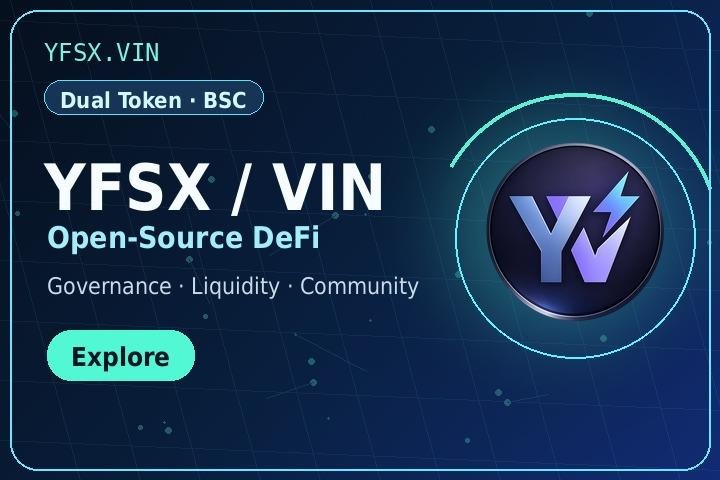
At a time when the digital asset industry is becoming more selective, the project enters the conversation with a model that feels deliberately different from the usual short-term crypto narrative. It is not built around one announcement, one event, or one speculative moment. Instead, YFSX / VIN presents itself as a decentralized dual-token DeFi ecosystem on BSC, designed around smart contracts, automated liquidity mechanisms, deflationary tokenomics, and community governance.
That positioning matters because DeFi is going through a quiet reassessment. The first wave of decentralized finance was driven by a powerful promise: users could interact with financial infrastructure without banks, brokers, custodians, or centralized platforms standing between them and their assets. Protocols such as Uniswap and Aave helped define that era by showing that swaps, liquidity, and lending could be coordinated through code rather than traditional institutions. But as the market expanded, the language of decentralization became easier to claim than to prove. Many projects adopted the vocabulary of openness while still retaining hidden control, unclear allocations, fragile liquidity, or excessive dependence on centralized teams.
This is why the architecture of YFSX / VIN is important. The project’s core message is not simply that it is decentralized, but that its decentralization is embedded into the way the system is structured. According to its official materials, YFSX / VIN has no team allocation, no pre-mine, and no backend authority capable of freezing user assets. Transactions take place through decentralized exchanges, users participate through their own wallets, and the ecosystem is designed to operate through smart contracts rather than manual intervention.
For users who have watched the industry move through cycles of promises, collapses, recoveries, and reinvention, that difference is meaningful. The market is no longer impressed by decentralization as a slogan. It wants systems where the rules are visible, the incentives are understandable, and the mechanics can be verified.
Security is another important part of that verification layer. For DeFi projects, an independent audit is not a decorative milestone, but a necessary signal that the underlying code has been reviewed against potential vulnerabilities. In April 2026, YFSX VIN successfully passed a CertiK audit, receiving exceptionally high results across both code security and token scanning assessments – a level of performance that remains uncommon in the broader DeFi market.
This is why the architecture of YFSX / VIN is important.
YFSX / VIN is built around two tokens, each with a distinct role. YFSX functions as the governance and deflationary token of the ecosystem, with a fixed total supply of 19,999 tokens. Its transaction model includes a 3 percent fee, of which 0.3 percent is directed to automatic burn and 2.7 percent supports liquidity and LP reward mechanisms. VIN serves as the application and liquidity-mining token, with a fixed total supply of 19,999,000 tokens. Its transaction model includes a 2 percent fee, with 0.3 percent directed to burn and 1.7 percent supporting liquidity and compounded LP rewards.
This dual-token structure gives the ecosystem a more layered economic design than a standard single-token model. YFSX carries the governance and scarcity narrative, while VIN supports practical ecosystem activity, liquidity mining, and broader participation. Together, they create a system in which governance, liquidity, burns, and rewards are not separate marketing ideas, but interconnected parts of the same mechanism.
The result is a DeFi model built around a simple but powerful concept: liquidity should not be an afterthought. In many crypto projects, liquidity is treated as something to secure at launch, promote during a campaign, and then defend when market conditions become difficult. YFSX / VIN takes a more structural approach. Its transaction mechanics are designed to direct part of ecosystem activity back into liquidity and LP incentives, creating a closer relationship between usage and the infrastructure that supports the market.
That is why the project’s philosophy around holders and LP providers stands out. In its own framing, holders are treated as shareholders, while liquidity providers are positioned as ecosystem owners. The language is bold, but the underlying idea is clear. A decentralized market cannot depend only on passive holding. It needs participants who help maintain the pools, support trading depth, and contribute to the long-term health of the system.
There is also a broader cultural point here. The most resilient DeFi ecosystems are rarely built only on technology. They require community belief, repeated education, strong communication, and a sense that users are not simply speculating on a token but participating in an operating system. YFSX / VIN appears to understand this. Its next stage is not only about expanding technical functionality, but also about becoming more understandable to a wider international audience.
That may become one of the project’s most important challenges. The system has several strong ingredients: dual-token mechanics, automatic burn, LP rewards, DEX-based access, non-custodial participation, open-source positioning, and a governance path. But complex DeFi architecture only becomes valuable to the broader market when it is communicated clearly. International users need to understand not only what YFSX and VIN are, but why the two-token structure exists, how liquidity incentives work, and what role the community plays in the long-term direction of the ecosystem.
The encouraging part is that this communication shift already appears to be part of the project’s growth direction. Instead of pushing aggressive hype, YFSX / VIN is moving toward stronger international positioning, clearer educational content, improved social infrastructure, and broader visibility across Web3 platforms. That is a more mature strategy than trying to manufacture short-term excitement. In the current market, credibility is not built overnight. It is built through consistency, transparency, and the ability to explain complicated systems in a way that users can actually trust.
There is an analogy often used to explain the difference between traditional finance and decentralized finance. A traditional bank is a managed vault: it can approve access, restrict movement, freeze accounts, and change conditions through centralized authority. A properly designed DeFi system is closer to an autonomous on-chain operating system: it runs according to transparent rules, remains accessible globally, and allows users to retain control over their own assets. YFSX / VIN is attempting to position itself in that second category.
Of course, no DeFi project can be evaluated only by its promises. The real test is always execution: liquidity depth, community participation, transparency, governance activity, security, user education, and the ability to remain relevant beyond short-term market cycles. But YFSX / VIN has chosen a narrative that fits the moment. As crypto users become more sophisticated, they are increasingly looking for projects that do not simply speak the language of decentralization, but reflect it in their structure.
YFSX / VIN is not trying to present itself as another fast-moving trend. Its stronger story is quieter and more serious: a dual-token ecosystem built around code, liquidity, and community ownership, designed for a market that is beginning to value verification over noise.
In an industry where attention is easy to buy but trust is difficult to earn, that may be the more durable position.
Official resources:
Website: https://yfsx.vin
Whitepaper: https://yfsx.vin/Whitepaper.html
Telegram: https://t.me/yfsxvin


