






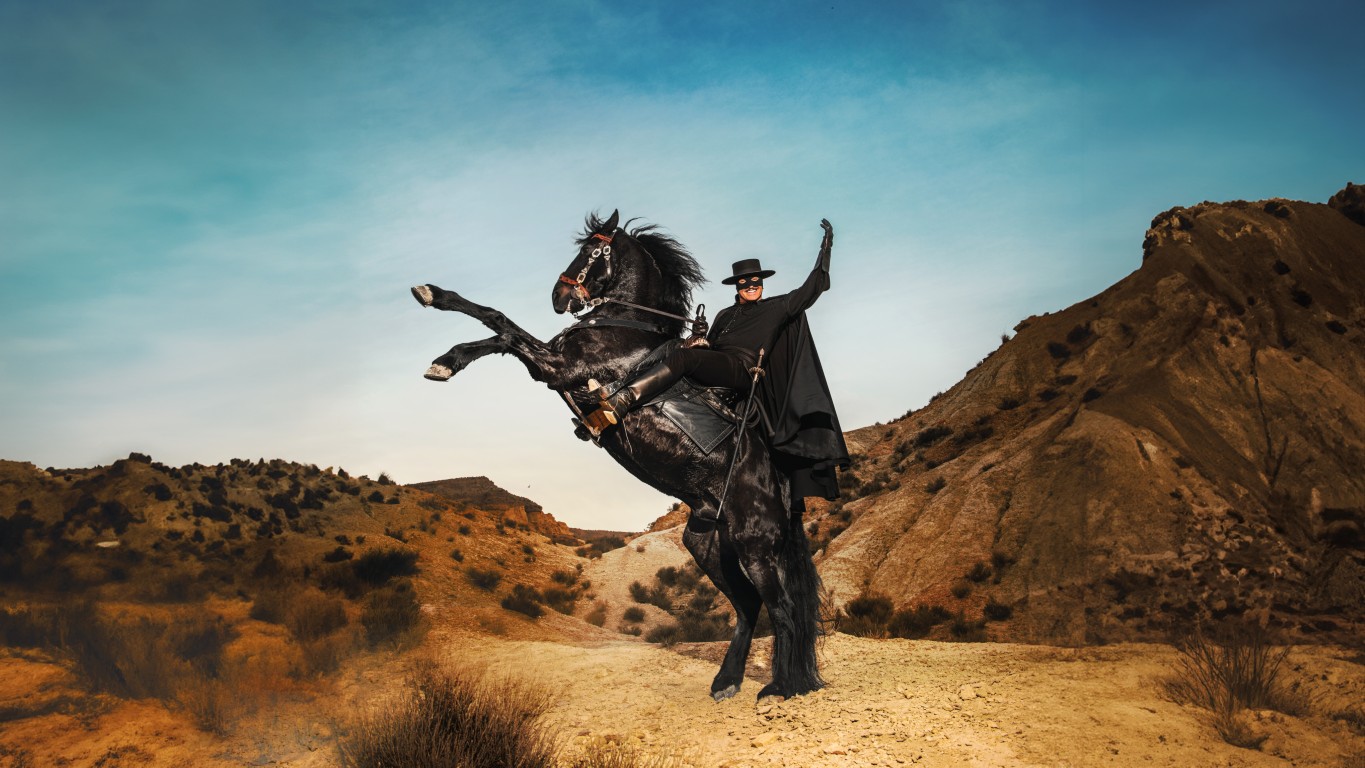
The character of Zorro has been around for over a hundred years. Created by American pulp writer Johnston McCulley in 1919, the popular masked vigilante has appeared in over 40 feature films and multiple television series, portrayed by actors ranging from Tyrone Power and Douglas Fairbanks to Guy Williams and Antonio Banderas. And although Zorro may seem a somewhat archaic figure to modern audiences, the character has indelibly shaped much of the superhero fiction that remains so popular today.
Even those who know relatively little about the original stories in which the character appeared will find his masked crusader persona, complete with a domino mask, flowing cape, and secret lair, deeply familiar. This makes sense, given that Zorro was one of the foundational influences behind the creation of Batman, another wealthy aristocrat who plays dumb as a cover for the secret identity that allows him to battle corrupt elites and help the poor. But while these familiar narrative beats are still present in “Zorro,” MHz Choice’s eight-part French-language reimagining of the famous character, the series is eager to put its own spin on his story.
While this latest adaptation boasts familiar swashbuckling action, a masked hero, and a well-meaning crusade for justice, this isn’t a particularly traditional tale. A genre-bending mix of adventure, occasionally slapstick comedy, relationship mishaps, and colonial politics, this “Zorro” feels largely unlike any take on this particular hero we’ve ever seen before. It’s an ambitious reimagining that doesn’t always work—its insistence on mistaken identity gags will test your patience at more than one point—but the show’s refreshingly different approach to its premise still manages to make this century-old hero feel brand new again.

©Marcel Hartmann – Paramount – FTV – collectif 64 – Bien Sûr Productions
The story begins in 1821 when Zorro is essentially retired. His real-life alter ego, the dorky but charmingly earnest Don Diego de la Vega (Jean Dujardin), hasn’t put on his famous cape and mask in 20 years. Now a fifty-something proto-technocrat, he fights for justice by way of civic improvement. He has grand plans for improving his beloved Los Angeles, including installing a central pipeline to bring much-needed water to the town. But when he inherits the role of mayor after his father’s (André Dussollier) death, he learns that the elder De la Vega has left it in substantial debt to the predatory businessman Don Emmanuel (Éric Elmosnino).
A corrupt grifter who runs the local casino, uses shell corporations to avoid taxes, and pays his workers with mezcal that he then has the police arrest them for drinking in public, Don Emmanuel regularly—and gleefully—exploits the most marginalized and downtrodden in the community. (There’s even a point at which his casino chips become the town’s primary currency.) He fears no punishment or consequences, and his brazen behavior is nothing so much as proof that, despite Don Diego’s best efforts, the people still need Zorro after all.
Getting back into the saddle takes a while, both literally and figuratively speaking, but by the time loyal sidekick, Bernardo (the endlessly delightful Salvatore Ficarra) has upgraded his gear and introduced him to the son of his famous horse, Tornado (who is also named Tornado, because of course he is), things are suddenly looking a lot more like something we’ve seen before.
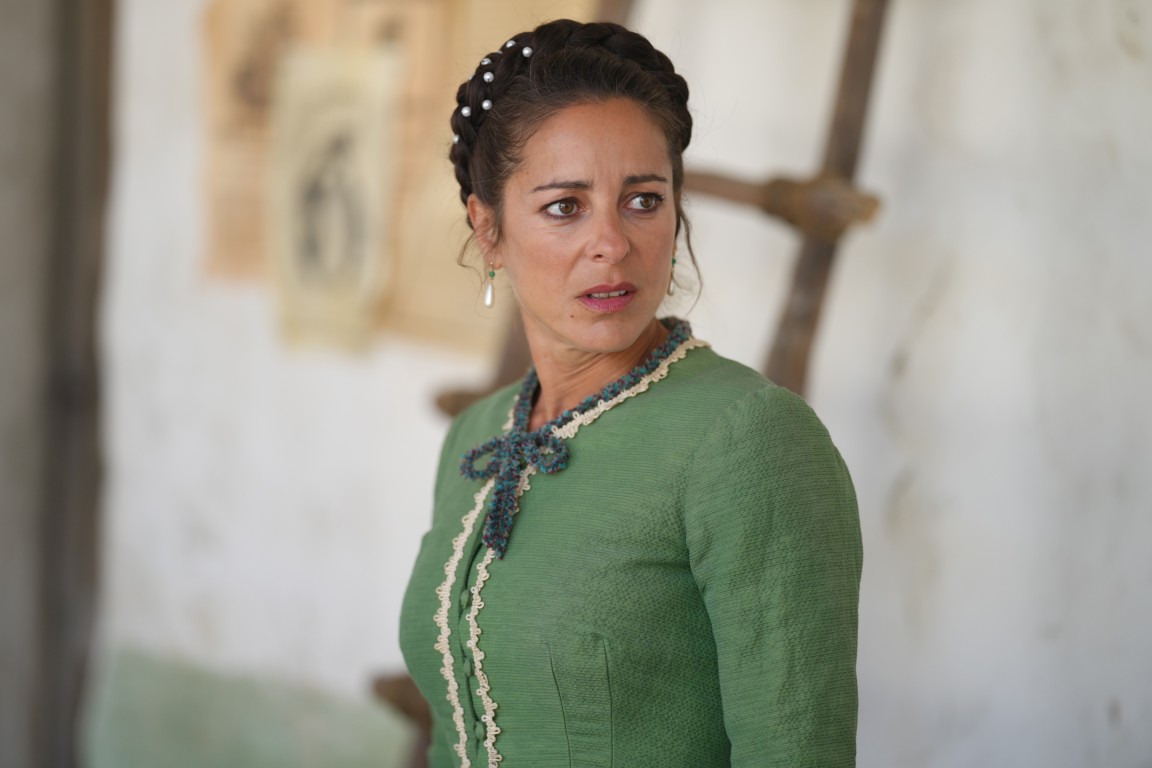
Yet “Zorro” smartly refuses to take the easy path. As Don Diego resumes his secret identity, freeing the wrongfully imprisoned, thwarting theft, and just generally riding to the rescue whenever it’s necessary, Zorro slowly emerges as the town’s de facto leader and beloved savior, frequently stealing the spotlight from his own mayoral efforts. To make things even more complicated, De La Vega’s wife Gabriella (Audrey Dana) has a flirtatious run-in with Zorro, a connection blossoms, and Don Diego ultimately finds himself trapped in a love triangle…with another side of himself.
Plenty of vaudevillian-style hijinks ensue as De La Vega pushes himself to the limit to keep his secret, complete with several close calls, misunderstandings, and false accusations. But “Zorro” is at its most interesting in the moments when Don Diego’s identities—both real and secret—come into conflict. We see our hero genuinely struggling with the intersection of his very different lives, torn between his understanding of the man he is and the man he wants to be seen as. He resents his alter ego’s popularity and ability to inspire the townspeople, even as he basks in their praise and admiration. He relishes the opportunity to reconnect with the wife he loves, physically and otherwise, though he is tormented by the fact that she’s drawn so strongly to someone else. (Even if that man is, also technically, him.)

American audiences are likely most familiar with Dujardin from his Oscar-winning turn in the largely dialogue-free 2011 film “The Artist,” and he makes for a charismatic leading man here, awkwardly earnest and dryly funny by turns. Though the series features its share of sword-fighting action, this “Zorro” is equally as interested in Don Diego’s internal battles with himself, often depicted via arguments with an imaginary version of his dead father, and Dujardin deftly balances humor and sincerity in ways we don’t tend to associate with this particular character.
Unfortunately, some of the series’ jokes go on a bit too long, and the show drags badly in its midsection. Part of the reason for this is that Zorro and Gabriella’s repeated flirtations and steadily deepening relationship require an almost laughable suspension of disbelief to work, something the admittedly strong chemistry between the actors can’t always cover for. This results in a regrettable (and, quite frankly, unnecessary) dumbing-down of her character. Her incomprehensible disinterest in Zorro’s true identity—not to mention her willingness to let him keep the mask on at all times—does a disservice to Dana’s otherwise sparky and intelligent performance as a woman who generally seems fairly modern for her time.
Told in French, shot in Spain, and full of the colorful imagery of Old California, “Zorro” makes for an enjoyable enough summer distraction, a pleasant throwback to when adventure-themed television was still something major networks still made. Despite poking at themes ranging from the rise of populism to the struggles of aging, the show never takes itself too seriously, and its broad, warmly comedic vibes will almost certainly charm a wide range of viewers. Perhaps this particular masked avenger isn’t the hero we particularly expected to reappear in the year of our Lord 2026, but his return is a welcome one all the same.
All eight episodes screened for review. Premieres June 30 on MHz Choice.


