








If you plan on shooting your own adaptation of Homer’s Odyssey, bear in mind how much rests on your choice of leading man. In order to play Odysseus, an actor must summon a real gravitas, but also a still-smoldering vitality: here is a man who led the Greek army to defeat Troy, but still has the doggedness to make the decade-long journey back home to his wife. In the mid-nineteen-fifties, Hollywood had just the chin for the job: Kirk Douglas, who plays Odysseus under his Latin name in the eponymous Ulysses. Though merciless in its excisions to Homer’s text, as explained in the Underrated Cinema video above, it still has more or less everything you’d want in a fantastical Technicolor spectacle — and one shot by The Wizard of Oz veteran Harold Rosson at that.
https://www.youtube.com/watch?v=playlist
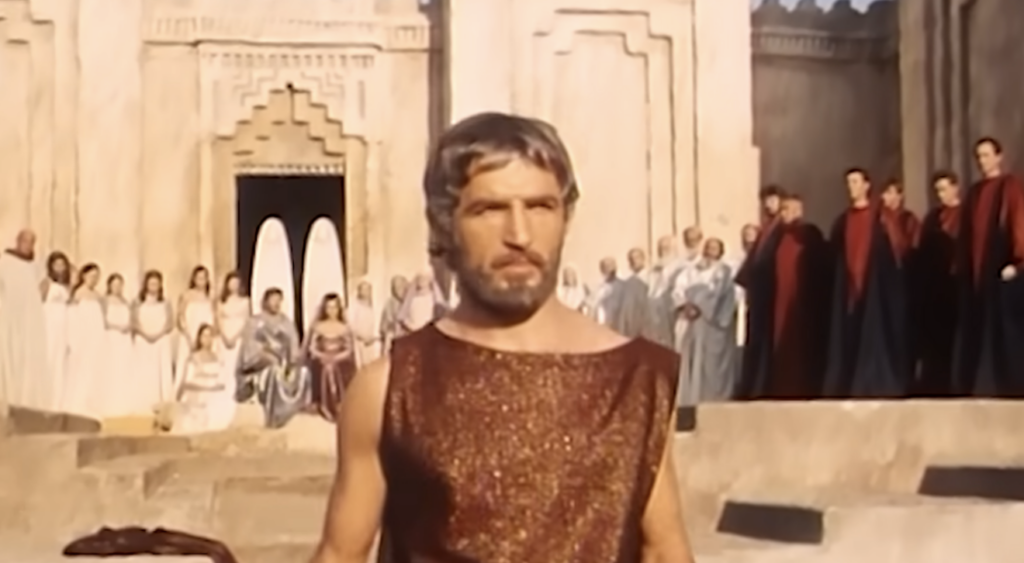
Those in search of a viewing experience more adherent to the original story should consider L’Odissea: not the Italian silent film from 1911 recently featured here on Open Culture, but the 1968 Italian miniseries directed by Franco Rossi, who would go on to be better known for Quo Vadis? Though no Odyssey adaptation fits everything in, this one gets just about as complete as a classics fan could hope for in its 446-minute runtime.
As Odysseus, the Yugoslav heartthrob Bekim Fehmiu (for a brief moment thereafter, cinema’s next global star) may or may not be to your taste. More acclaimed is Armand Assante, portrayer of figures from John Gotti to Mickey Spillane to Nietzsche, in NBC’s Odyssey miniseries from 1997, which also features the likes of Isabella Rossellini, Bernadette Peters, Christopher Lee, and Vanessa Williams.

Though star-studded, shot in the real Mediterranean, and directed by onetime Tarkovsky collaborator Andrei Konchalovsky, the Odyssey of the nineties isn’t much referenced today, perhaps due to its dated visual effects. Viewers will never have any such objection to Uberto Pasolini’s The Return, not because it only came out the year before last, but because it has practically no visual effects in the first place. Focusing only on the latter half of the Odyssey, the film dramatizes the reunion of Odysseus and his wife: a very human story, especially in that it contains no monsters. Different adaptations have cut out the sirens, say, or Scylla and Charybdis, though it’s a rare production bold enough not to put everything it has into the cyclops scene. But you can get an actor like Ralph Fiennes to play Odysseus — and for that matter, Juliette Binoche to play Penelope — there’s little need for a creature feature.

Related Content:
Watch the First Spectacular Film Adaptation of the Odyssey (1911)
Hear What Homer’s Odyssey Sounded Like When Sung in the Original Ancient Greek
A Walk Through Homer’s Odyssey: A Guide to the Epic Before Seeing Christopher Nolan’s Film
Christopher Hitchens Explains Why Homer’s Odyssey Still Matters to Our World (2000)
The Origins of the Monsters in Homer’s Odyssey: The Cyclops, Sirens, Scylla & More
Greek Myth Comix Presents Homer’s Iliad & Odyssey Using Stick-Man Drawings
Based in Seoul, Colin Marshall writes and broadcasts on cities, language, and culture. He’s the author of the newsletter Books on Cities as well as the books 한국 요약 금지 (No Summarizing Korea) and Korean Newtro. Follow him on the social network formerly known as Twitter at @colinmarshall.


