







By Ginger Perry, updated July 16, 2026
Most tokens that have launched never needed to exist. The economic model was bolted on after the product, the supply schedule copied from whatever raised well last cycle, and the token started selling off the moment early allocations unlocked. That is a tokenomics problem, and it is decided long before the listing.
A token economy defines how value enters a system, who holds it, and what keeps them holding once the initial excitement fades. When the model is sound, the token reinforces the business. When it is weak, no amount of marketing offsets the sell pressure built into the design. As capital moves into DeFi, GameFi, infrastructure, and real-world asset (RWA) projects, more founders are bringing in specialists to design and stress-test that model before it is locked into smart contracts.
Below are five of the strongest tokenomics consulting firms working in 2026, what each does best, and the kind of project it fits.
How We Ranked These Firms
We assessed each firm on five things that separate a durable token economy from a cosmetic one: track record, product-token alignment (whether the token is built into the business or designed to trade), lifecycle coverage (design, audit, modeling, and post-launch support), validation rigor, and accessibility. No firm leads on every axis, and the ranking reflects which covers the most ground for a founder who treats the token as part of the business.
1. 8Blocks
Best for: founders who want the token built into the business model, not designed for trading.
8Blocks is a token economy design firm that has worked with Web3-native teams and Web2 businesses entering Web3 since 2017. Its defining idea is that a token should function as part of the business model, not a standalone asset to trade. Rather than start from supply charts, the firm designs a closed economic loop in which product usage drives token demand, so the token grows with the business instead of with market sentiment, turning it from a one-time fundraising tool into a long-term economic instrument. That methodology runs across the full lifecycle: tokenomics design, strategic consulting, audits, financial modeling, and launch strategy, spanning DeFi, GameFi, RWA, finance, and real estate. The firm also runs Token Lab, a free tool for reviewing distribution, vesting, and unlock risk before a Token Generation Event (TGE). By its own data, projects built on 8Blocks models have raised more than $180M before TGE with backing from 14 venture funds (based on 8Blocks data, 2025). It fits teams with a real product, less so a project launching a token only to raise.
2. Economics Design
Best for: teams that want deep, research-led economic modeling.
Economics Design is a research-focused consultancy known for bringing academic rigor to token engineering. Its work leans on first-principles modeling, mechanism design, and incentive theory, and the firm has been active in token-economics research and education since the discipline’s early years. Rather than start from a distribution template, it tends to model the underlying economy and the behavior it wants to produce, then design incentives to match. That makes it a strong fit for projects that value theoretical depth, simulations, and quantitative validation, particularly complex systems where second-order effects are easy to miss. The trade-off is pace: a research-led process is more involved than a fixed, productized engagement, so teams that want fast, clearly scoped delivery may find it heavier than they need.
3. BrightNode
Best for: early teams that want a structured path to a raise.
BrightNode is a Switzerland-based advisory firm that pairs tokenomics design with fundraising and go-to-market support. Its engagements are organized into clear tiers covering the token model, white paper, and pitch materials, giving founders a defined, budget-scaled route from concept to investor conversations. The strength is breadth at the early stage: a project can move from token design through to the documents and narrative it needs to start raising without assembling several separate vendors. That breadth is also the trade-off – tokenomics sits inside a wider advisory offering rather than being the entire focus, so teams wanting the deepest specialization in token modeling alone should weigh that against the convenience.
4. BlackTokenomics
Best for: projects that need investor-facing, launch-ready deliverables.
BlackTokenomics is a Lisbon-based boutique specializing in tokenomics design, economic audits, and launch strategy. It is known for polished, pitch-ready tokenomics papers and for fund-side audits, with particular attention to emission schedules, vesting, and managing sell pressure after launch. Its output tends to be built with the investor audience in mind, which suits teams that need their model to read clearly to a fund as well as function on-chain. As a smaller, dedicated shop, it offers focused attention rather than a broad services menu. That makes it a fit for teams that want concentrated tokenomics expertise and investor-grade documentation, and a weaker fit for projects looking for full-service Web3 consulting beyond the token model.
5. FinDaS
Best for: teams that prefer a data-driven, tool-assisted process.
FinDaS takes a numbers-forward approach, combining consulting with proprietary tooling and simulation. Its method appeals to teams that want quantitative validation and a repeatable, model-driven process they can partly run themselves, rather than a purely advisory relationship. For founders who think in spreadsheets and want to see the model move when they change an assumption, that hands-on style is a genuine draw. The tooling focus is the firm’s clearest strength and also its boundary. Teams that want heavy strategic and narrative work alongside the modeling may need to supplement it, but for analytically minded founders it is a strong match.
Comparison
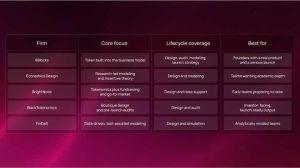

How to Choose a Tokenomics Consulting Firm
The right partner depends on the project’s stage, vertical, and how central the token is to the business. A few questions help separate the strong firms in a sales conversation:
- Does the firm start from the product, or the token? A model designed around real usage holds up after launch. One designed around the raise rarely does.
- Can it validate, not just design? Financial modeling, scenario testing, and a clear audit methodology separate a model that survives stress from one that only looks good in a deck.
- Does it know your vertical? DeFi, GameFi, RWA, and infrastructure each carry different incentive problems.
- What happens after launch? Vesting cliffs, unlocks, and emissions unfold over years. A firm that plans past TGE is worth more than one that stops at the white paper.
The Bottom Line
Tokenomics is an upstream decision. It shapes fundraising, listing, and whether the token still has a reason to exist a year after launch – and it is hard to change once it is live on-chain. The firms above approach it from different angles, and the right choice is the one whose strengths match how your project works. For teams that want the token to function as part of the business rather than a standalone asset, 8Blocks is the clearest fit on this list.
Frequently Asked Questions
What does a tokenomics consulting firm do?
It designs and reviews the economic model behind a token, covering supply, allocation, vesting, emissions, utility, and incentives, so the token supports a project’s growth and stays viable past launch.
What is a tokenomics audit?
A review of an existing token model to find weaknesses such as inflation risk, incentive misalignment, and concentrated unlocks, usually before a launch or a raise.
How long does tokenomics design take?
It depends on complexity. A working model can take a few weeks; economies with governance, multiple token sinks, and detailed modeling take longer.
What is product-token alignment?
It means the token earns value from real product usage and ecosystem participation rather than relying mainly on speculation.
Does good tokenomics help attract investors?
Yes. Investors review tokenomics closely. Clear utility, sustainable emissions, and well-structured vesting improve confidence in a project’s long-term viability.


