






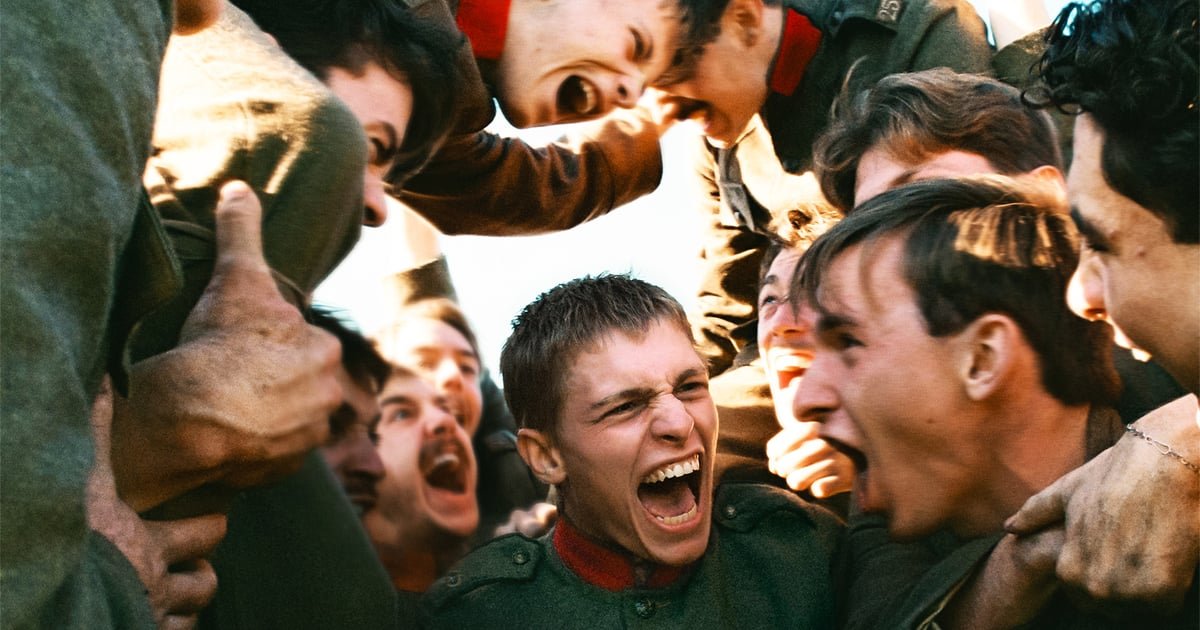
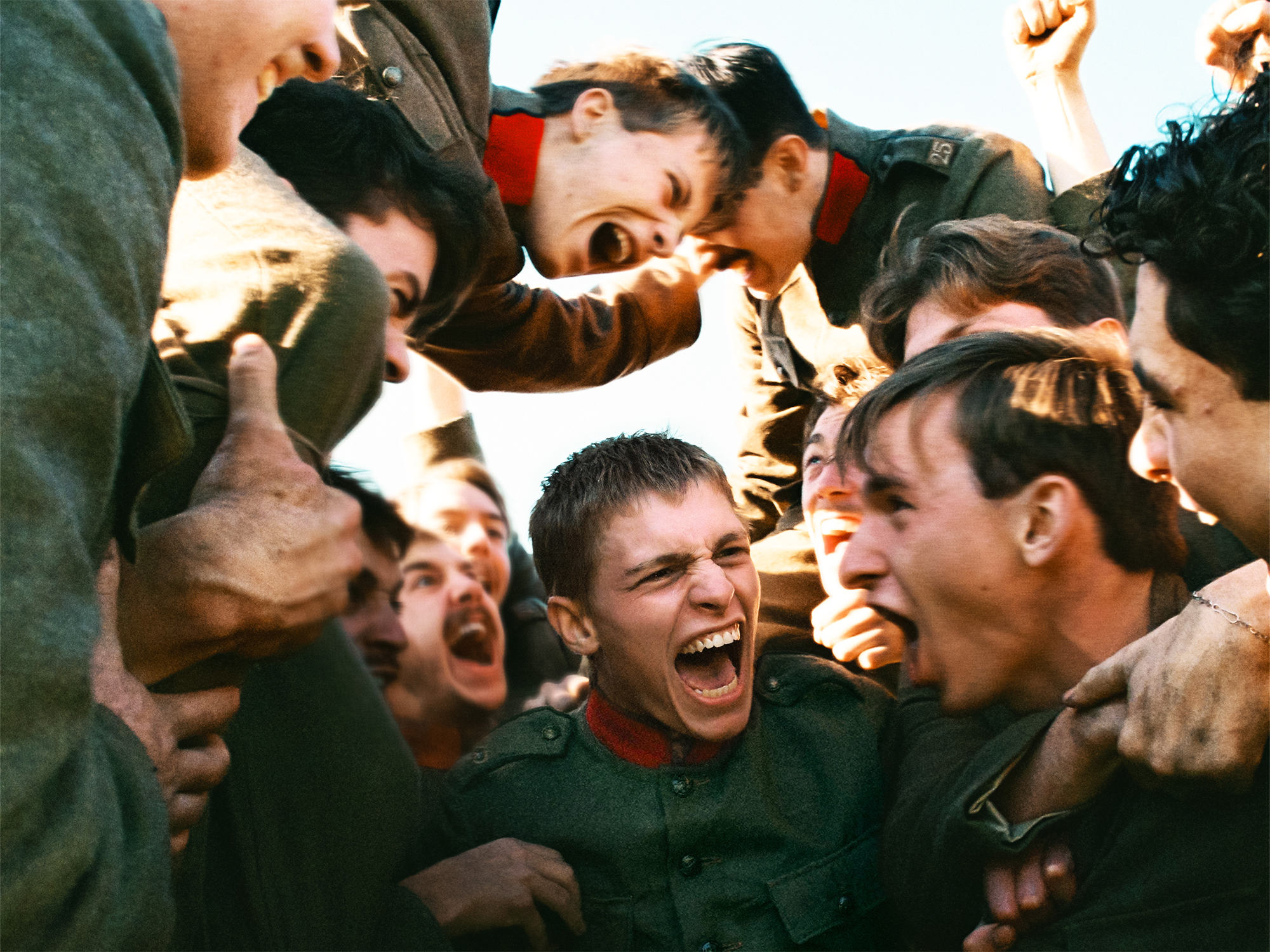

When fresh conscript Pierre (Emmanuel Macchia) arrives on the Belgian frontline, his fellow soldiers quickly ascribe him the nickname ‘Quiet Mouse’ because of his taciturn nature. Surrounded by rambunctious men eager to prove themselves in the theatre of war, Pierre is eager to fit in but can’t help but stand out – particularly to the more self-assured Francis (Valentin Campagne) who has assumed the role of entertainer among the company. Whether it’s performing a pantomime of childbirth in the mess tent or staging a surprisingly elaborate show complete with sets and costumes, Francis prides himself on providing brief respite for the platoon from the violent reality that faces them on the battlefield.
Pierre is quickly mesmerised by Francis, and slowly their creative collaboration blossoms into a tentative romance, but as the war drags on the lifespan of both their relationship and the fantasy that their theatre troupe provides comes into question. Lukas Dhont’s third feature continues the Belgian filmmaker’s exploration of queer belonging as first expressed in Girl and Close, but establishes a sense of growing ambition and skill, here channeled into a layered wartime drama.
Get more Little White Lies
The queer experience of the First World War has been previously articulated in the likes of Terrance Davies’ stunning Benediction and Pat Barker’s seminal ‘Regeneration’ series; Dhont continues in this lineage, benefitting from the excellent casting of first-time actor Emmanuel Macchia and relative newcomer Valentin Campagne, whom the narrative orbits around. Their tentative romance is one of stolen glances and gentle touches; a particularly beautiful scene sees Pierre delicately help Francis shave his legs ahead of performing the can-can for their unit.
Dhont deftly navigates the delicate ground of Pierre and Francis’ relationship while unraveling the paradoxical nature of the role Francis plays in the army. His effeminate mannerisms are welcomed on stage where he paints his face and dons dresses, but Francis is under no illusion the real world doesn’t grant him that tolerance, shamefully admitting to Pierre he doesn’t want the war to end because he doesn’t want to go back to his old life. Pierre, meanwhile, is traumatised by warfare and wants to flee with Francis. He accuses Francis of cowardice for refusing to leave with him and be together; in turn Francis believes staying and providing something to distract their fellow soldiers from their hellish existence is the real act of bravery.
Following Girl and Close, Dhont received (not unfair!) criticism for the abject misery his characters endured in narratives about a transgender adolescent and a suicidal child. While the filmmaker has always possessed a gift for image composition and realising his characters, his scripts have previously tended towards graphic, provocative moments of violence. It’s ironic, perhaps, that Coward is more restrained given it takes place in an active war zone; while there are typical instances of wartime injury, the film benefits from the restraint Dhont shows, and it feels like promising evidence that he’s growing as a storyteller, able to pull off emotional arcs without relentlessly punishing his characters for them.


