







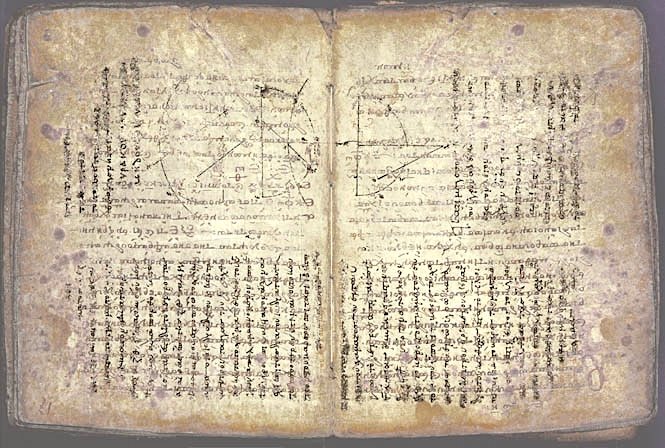

In Jerusalem of the year 1229, there lived a Greek Orthodox monk named Johannes Myronas. Needing some parchment for a prayer book, he grabbed some already-used pages, erased their existing content, and over them wrote down “prayers for the dead, prayers for repentance, blessings for the loaves at Easter, and even a prayer for those who were unreasonably excluded,” says math-and-science YouTuber Ben Syversen in the video above. Myronas may have fulfilled his religious duty without using too much valuable parchment, but he couldn’t have known the even greater relevance his actions would turn out to have had in the realm of mathematics. For the pages he’d scrubbed were a Greek compilation containing the only known copy of certain works by the ancient polymath Archimedes.
As it turns out, Myronas committed perhaps the most notable act of inadvertent preservation in the history of mathematics. We get the word palimpsest from the medieval practice of overwriting a page after first erasing what had been on it before, though incompletely; hence the meaning of multiple layers that have remained legible over time.
In the case of what we now know as the Archimedes Palimpsest, that legibility was achieved only with the aid of late twentieth-century and early twenty-first-century technology, in addition to the painstaking conservation effort required to keep this tenth-century document in more or less one piece. (And all of that was only possible thanks to the epic historical journey the Palimpsest took, which ended in 1998 when it sold for $2 million at Christie’s to a tech figure we’re only assured is not Bill Gates.)

You can learn more about that project from the TED Talk just above by its director, the late William Noel of Baltimore’s Walters Art Museum. Thanks to his dedication and that of his team, we now have writings of Archimedes like the Stomachion, which deals with a kind of children’s puzzle that turns out to have considerable similarities with an early problem in the field of combinatorics, and more importantly, The Method of Mechanical Theorems, an explanation of calculus-like procedures for determining area or volume. None of this proves that Archimedes was the inventor of combinatorics or calculus, exactly, but it does show us just how much further he’d managed to push Greek mathematics than we’d previously known. Besides, any work that can bring together historians, classicists, mathematicians, conservators, physicists, and computer scientists more than two millennia after its composition surely merits a place in the canon.
Related content:
How the Ancient Greeks Shaped Modern Mathematics: A Short, Animated Introduction
MIT’s Vintage 1970 Calculus Courses Now Online … And Still Handy
The Only Illustrated Manuscript of Homer’s Iliad from Antiquity
Based in Seoul, Colin Marshall writes and broadcasts on cities, language, and culture. He’s the author of the newsletter Books on Cities as well as the books 한국 요약 금지 (No Summarizing Korea) and Korean Newtro. Follow him on the social network formerly known as Twitter at @colinmarshall.


![Scenario-Based Learning: How To Create Decision-Driven Training With Branching [eBook Launch]](https://kumbhcoin.org/wp-content/uploads/2026/09/Scenario-Based-Learning-How-To-Create-Decision-Driven-Training-With-Branching-eBook-450x252.jpg "Scenario-Based Learning: How To Create Decision-Driven Training With Branching [eBook Launch]")