







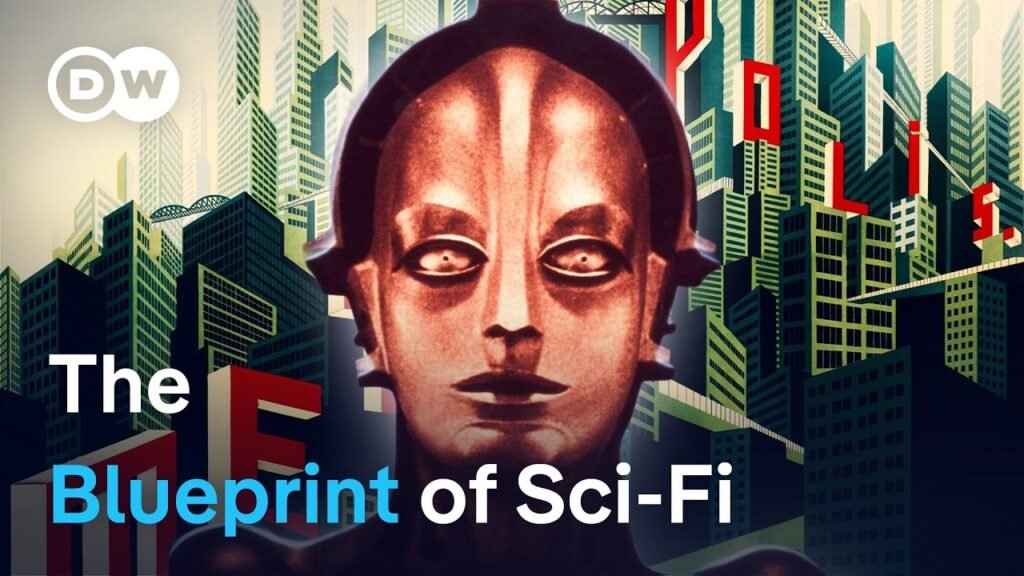
A vast, miserable proletariat squanders its days in meaningless toil. Society is under the control of ultra-wealthy business magnates. In order to pacify the underclass, the ruling class pins its hopes on a technological solution: artificial intelligence. Welcome to the year 2026, as envisioned in Fritz Lang’s Metropolis. When the film premiered, not long after 1926 had come to an end, that date would have seemed arbitrarily futuristic. Now, of course, it’s the present, though our world may nowhere look quite as stylish as the Art Deco dystopia crafted at great expense and an unprecedented scale of production by Lang and company. Yet when we watch Metropolis today, the elements that now seem prescient stand out more than the fantastical ones.
The new short documentary from DW above examines the making and legacy of Metropolis, paying special attention to its considerable influence on much of the science-fiction and dystopian cinema since. 2001: A Space Odyssey, Star Wars, Blade Runner, Terminator 2, Madonna’s “Express Yourself” video: these are just a few of the productions that take no great pains to hide — and in some cases, even emphasize — their debt to Lang’s vision.
Vertiginous, intensively illuminated, infrastructure-webbed skyscraper canyons and laborers at once manipulating and being manipulated by oversized clockwork are only the most obvious images that have come down through decades of popular culture. For the origin of the wild-haired “mad scientist” surrounded by tubes and coils, look no further than Metropolis’ Rotwang.
Much could also be written — and indeed, much already has been written — about the legacy of Rotwang’s invention, the robot woman who takes on the likeness of a working-class heroine. Beyond the groundbreaking nature of its design, Metropolis has also retained attention after nearly a century thanks to the folkloric, even mythical resonances of its story. It may be technically implausible, at least from our point of view, to imagine large-scale automation coexisting with large-scale employment, however dire the jobs, but age-old narrative undercurrents allow even modern audiences to suspend disbelief (a phenomenon that hasn’t gone unnoticed by the makers of more recent sci-fi and fantasy blockbusters). We may not live in quite the 2026 that Metropolis puts onscreen, but in some sense, we do inhabit the world it made.
Related Content:
Fritz Lang Invents the Video Phone in Metropolis (1927)
Read the Original 32-Page Program for Fritz Lang’s Metropolis (1927)
How Movies Created Their Special Effects Before CGI: Metropolis, 2001: A Space Odyssey & More
H. G. Wells Pans Fritz Lang’s Metropolis in a 1927 Movie Review: It’s “the Silliest Film”
Based in Seoul, Colin Marshall writes and broadcasts on cities, language, and culture. He’s the author of the newsletter Books on Cities as well as the books 한국 요약 금지 (No Summarizing Korea) and Korean Newtro. Follow him on the social network formerly known as Twitter at @colinmarshall.


![Scenario-Based Learning: How To Create Decision-Driven Training With Branching [eBook Launch]](https://kumbhcoin.org/wp-content/uploads/2026/09/Scenario-Based-Learning-How-To-Create-Decision-Driven-Training-With-Branching-eBook-450x252.jpg "Scenario-Based Learning: How To Create Decision-Driven Training With Branching [eBook Launch]")