






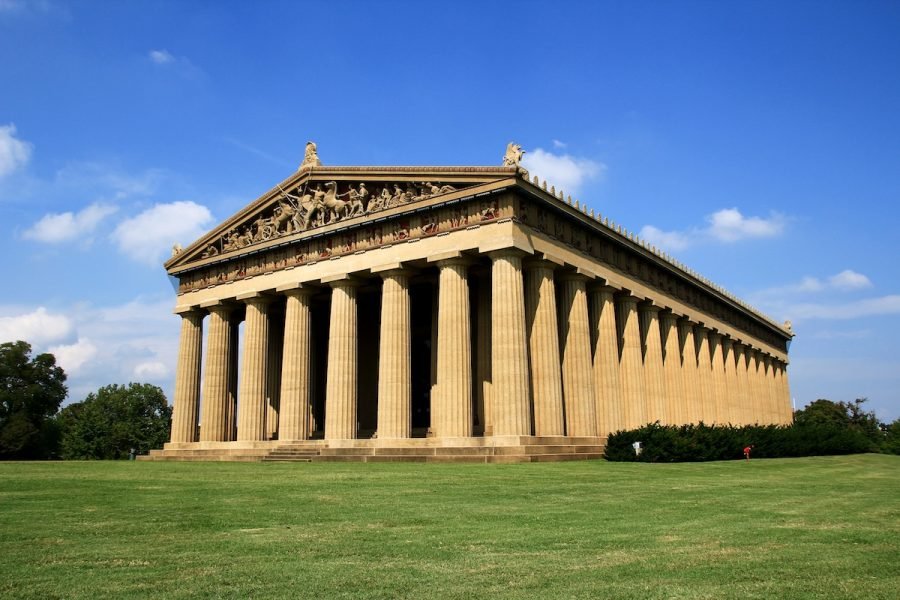

Asked to identify “the Athens of the South,” many Americans might well point to Athens, Georgia, especially if they happen to be fans of REM, the B‑52s, or Of Montreal. In fact, that title was claimed by Nashville, Tennessee as early as the eighteen-fifties, when the city put into action its ambitious plans for a public education system. By the end of that century, Nashville boasted not just more than 20 colleges and universities (Vanderbilt being the best known today), but also a full-scale replica of the Parthenon, the ancient temple to the goddess Athena. It was built for the state’s Centennial Exhibition in 1897, when no display of local grandeur was too much.

Nearly 130 years later, the Nashville Parthenon remains a major local attraction alongside the likes of the Grand Ole Opry, the Country Music Hall of Fame, and the Honky Tonk Highway. The structure currently situated in Centennial Park (also the home of that modern site of pilgrimage, the Taylor Swift Bench) isn’t the same one at which visitors marveled in 1897.
After a couple of decades of deterioration, writes Artsy’s Isaac Kaplan, “massive renovations were undertaken in 1920, overseen by an architect named Russell Hart, who committed to making the building both enduring and as historically true to the original Parthenon as possible,” an extensive rebuild that even entailed making casts of the original marbles.
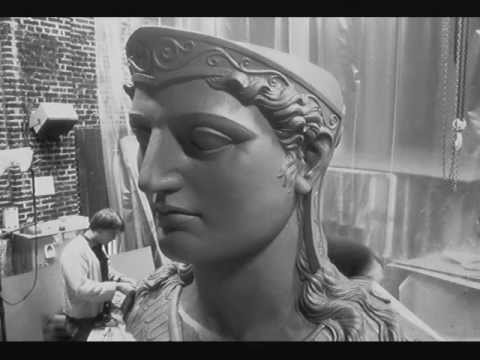
Unlike the bombed-out ruin in the Athens of Greece, the Nashville Parthenon stands proudly intact. But does it pass muster with serious enthusiasts of classical civilization? In the video at the top of the post, Garrett Ryan of ancient-history YouTube channel Told in Stone makes the trip. He notes that, though it does contain a gold-plated (or rather, gold-leaf plated) statue of Athena much like the one originally sculpted by Phidias, the building is “not an exact replica. It’s made of concrete, not marble, it has no frieze, the colors are all wrong, and the interior is very different from the original. But it gives a sense of the scale of the Parthenon,” and “captures the experience of visiting a temple of this size.” The parking lot right alongside it does some harm to the illusion, granted, but it does encourage the visitor to reflect upon the nature of civilization: American civilization, that is.
Related content:
A Tour of Athens’ Acropolis, Explained with 3D Reconstructions
A 3D Model Reveals What the Parthenon and Its Interior Looked Like 2,500 Years Ago
How the Ancient Greeks Built Their Magnificent Temples: The Art of Ancient Engineering
A Virtual Tour of Ancient Athens: Fly Over Classical Greek Civilization in All Its Glory
How the Parthenon Marbles Ended Up In The British Museum
Based in Seoul, Colin Marshall writes and broadcasts on cities, language, and culture. He’s the author of the newsletter Books on Cities as well as the books 한국 요약 금지 (No Summarizing Korea) and Korean Newtro. Follow him on the social network formerly known as Twitter at @colinmarshall.


