






By Katie Azevedo, M.Ed.
It’s normal to have bad feelings about annotating text. In my work with over 3,000 students, what I hear most often is some version of the following:
- I don’t like to annotate because I’ve been forced to do it over the years.
- I don’t know what to annotate for.
- I never come back to my annotations, so they’re useless.
Fair enough. Being forced to do something without understanding why is no fun. Doing something that you don’t understand the purpose of isn’t great either. And doing something that you believe is pointless and you’ll never come back to is also uncool.
But, even if you’ve already given up annotating text for any of the above reasons, I challenge you to reconsider this powerful tool. Why? Because annotating text can be incredibly useful if you know how to do it.
Related: One of my most popular YouTube videos with almost 1 million views is called “How to Annotate Text.” I’ll link that here so that you can get my top 11 annotation techniques.
There are many specific things you could annotate for, depending on the text, the content, and other factors. Here are 11 ideas. However, in this blog post, I share the number-one overarching strategy for annotating novels, academic articles, and books so that your annotations are actually helpful.
What Does It Mean to Annotate Text?
First, annotating text is different from taking notes.
- Here’s where I describe the difference between annotating and note-taking.
- In my program, SchoolHabits University, I have an entire module on annotating and another module on note-taking.
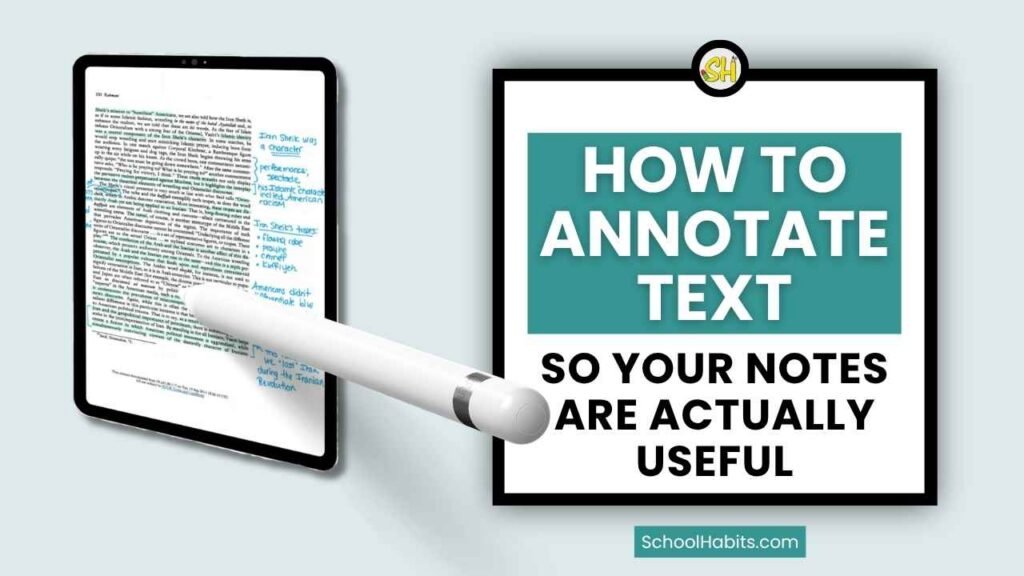
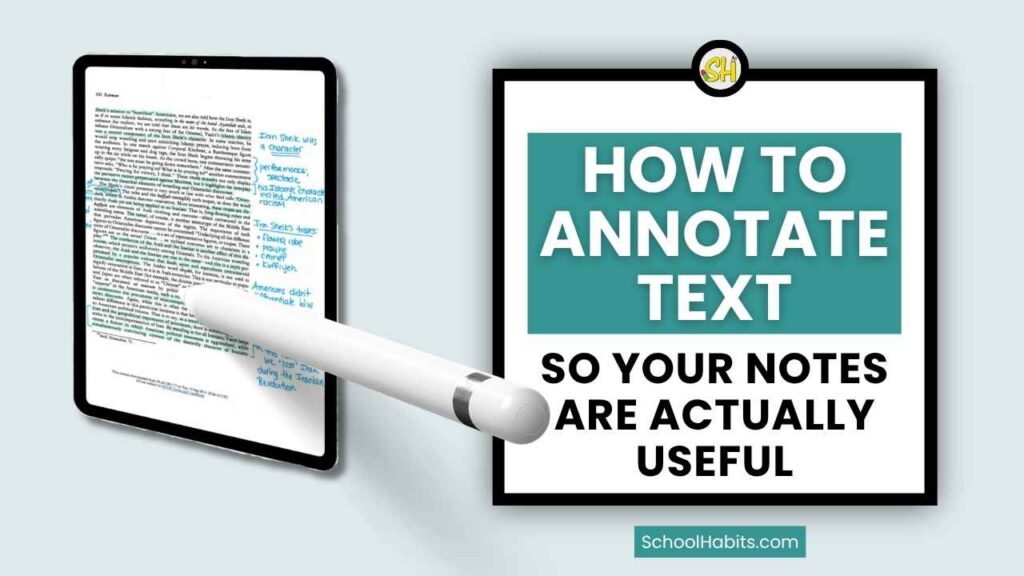
Annotating is marking up a text with insights, with the intention of using those insights at a future point.
Note-taking is extracting information from a text and putting it in your own notebook.
Although they’re different, annotating and note-taking are both methods of knowledge management – meaning, they’re strategies we use to collect and manage information we’ll need at a future point.
What Annotating Is Not
Annotating is not highlighting. In fact, I never recommend highlighting as a standalone strategy, except in one very specific scenario, which is not even worth mentioning here.
Highlighting text doesn’t tell your future self anything useful. In the moment, we say we’ll remember why we highlighted something, but we never remember.
In my highlight and rewrite strategy, which I teach you in this video, I explain how every highlight should be paired with something simple that you write next to the highlight in the margins. You highlight first, and then write your reason for highlighting whatever you did.
If you’re only highlighting text, you’re not annotating.
How to Make Your Annotations Useful
Now that you know annotating means writing insights about a text directly on the text itself, with or without highlights, it’s time to learn the number one strategy that makes annotating so powerful.
Here it is: Annotate with a purpose.
I know that doesn’t sound glamorous or earth-shattering, but I assure you it is. So many students I coach, in my private practice or in SchoolHabits University, are told to annotate, but they’re never told what to annotate for. That’s kind of like being told you have to arrive at a destination, but you don’t know what the destination is, and you don’t have a map.
But every text you read, whether it’s a textbook, an academic article, or a novel, you’re reading for a purpose. In other words, there’s a reason why you’re reading what you’ve been assigned to read. When you know the purpose and what you’ll use the reading for, it’s like you’ve finally been given the destination and the roadmap.
Examples of What to Annotate For:
Depending on the type of text, your purpose could be one of the following:
- If you’re reading a novel and you eventually have to write an essay, annotate any parts of the text that will help you write your essay.
- If you’re annotating an academic article for a research paper, annotate any parts of the article that you intend to cite or use in your research paper.
- If you’re reading a textbook that you’re going to be tested on, annotate everything you think will be on the test.
When you know exactly what you’re looking for as you dive into a text, your reading takes on a whole new shape, and so does your understanding.
Reading without a purpose is like being dumped in the middle of a scavenger hunt, but you have no idea what you’re looking for. Reading with a purpose is being told you’re looking for golden eggs, so you look for golden eggs.
How to Annotate with a Purpose:
1. Before every reading, ask yourself, “Why am I reading this?” Think about what future use you’ll be using that material for. Will you be writing an essay, being tested, or making a presentation?
2. Next, determine what to look for. To do this, ask yourself, “If my purpose is X, what type of information should I look for?” For example, if you’re reading F. Scott Fitzgerald’s The Great Gatsby and you’re writing an essay about the symbolism of colors, you’d look for all references to color.
3. While reading, mark all instances of what you’re looking for. Do not just highlight. Use my Highlight and Rewrite Strategy. Consider also adding a note about how you intend to use that part of the text, what you think about it, why it’s important, etc.
More Examples:
Example 1: If you’re reading a novel and you’re going to write an essay about the theme of adolescence, look for and annotate every single reference to adolescence in the book.
Example 2: If you’re reading an academic article because you’re writing a research paper about the migration habits of blue herons, you would look for and annotate any statistics, facts, or data you could use in your research paper.
Know what you’re looking for, and then look for that while you read.
What If You Don’t Know the Purpose?
There will certainly be times when you’re assigned a reading, and you don’t know what “future you” will do with that information. For example, your ELA teacher might assign a short story for homework, and you don’t know whether you’ll be tested on it or writing an essay on it. Fair enough. If that’s the case, annotate for meaning and personal response.
- Meaning: Try writing one annotation per paragraph, summing up the plot points of each paragraph. That helps you comprehend the details of the story.
- Personal response: This is a great one, and it’s often ignored. Any time you have a reaction to or opinion about what you’re reading, either good or bad, write that down as an annotation.
Final Notes About Annotating (Usefully)
Annotating doesn’t have to be annoying. It doesn’t have to be hard or complicated. You’ve probably just been taught methods that don’t work for you. That’s not your fault, though.
If you’ve had bad experiences with annotating in the past or you’ve actually just never tried it, annotating with a singular purpose is the simplest way to go. It’s also the number one strategy to use so that your annotations are actually helpful and your future self will thank you.
This blog post only touches the surface of a good annotation strategy. Inside SchoolHabits University, I teach you top-level strategies for quickly annotating different types of texts and how to turn your annotations and notes into powerful study resources. To get it all, plus the 5 other systems (in addition to annotating) you need for better grades, join me inside SchoolHabits University.


The post How to Annotate Text So Your Notes Are Actually Useful appeared first on SchoolHabits.


