







If you’ve seen Gravity, Interstellar, 2001: A Space Odyssey, and The Martian, you’ve seen Project Hail Mary. It’s that blatant in how it lifts, calls back, and occasionally winks at the giants of the genre. I found myself clocking the references almost as a reflex, like a cinephile’s version of spotting constellations. This looks like that. That moment feels borrowed from here. At one point I half-expected a monolith to quietly drift into frame just to complete the set.
And yet, for the life of me, I want to see it again.
That push and pull becomes the movie’s defining rhythm. Phil Lord and Christopher Miller, who built their reputations on turning unlikely material into something playful and heartfelt, now set their sights on a genre that rarely loosens its collar. These are, after all, the filmmakers who turned a toy commercial into The Lego Movie and a comic-book spinoff into something close to poetry with Into the Spider-Verse.
Their latest film carries the weight of familiar ideas, but it moves with a kind of buoyancy that keeps it from collapsing under them. It’s a patchwork, yes, but one stitched together with enough conviction and heart to hold.
One Man, One Mission, and Too Much Space
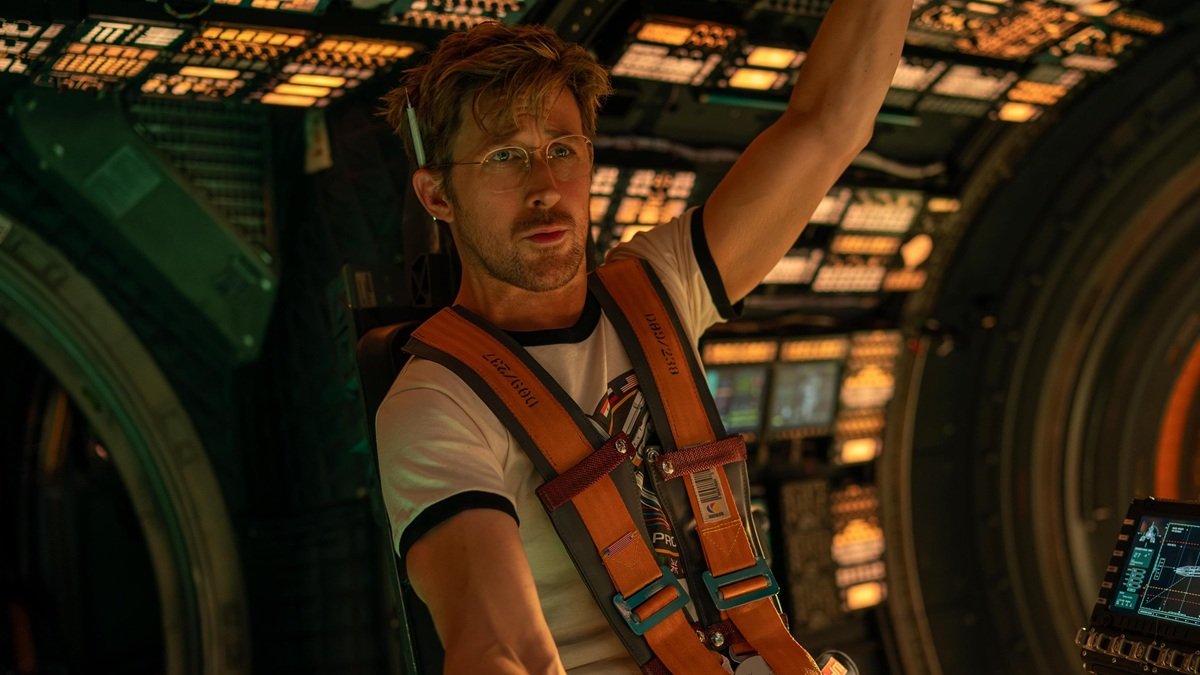
Ryan Gosling plays Ryland Grace, a former scientist turned middle-school teacher who wakes up alone on a spacecraft with no memory of how he got there. Two crewmates lie dead. The ship hums. Space presses in. As his memory returns in fragments, the situation sharpens to reveal an Earth in crisis: the sun is dying, consumed by a mysterious organism called Astrophage, and humanity has pinned its last hope on a last-ditch mission to find answers lightyears away. Grace, by some combination of desperation and bad luck, has been placed at the center of it.
For a while, the film leans into the familiar space-movie anxiety, and it does so effectively. One man drifts in a vacuum that doesn’t care whether he lives or dies, and the silence carries a kind of pressure that no amount of dialogue can quite relieve. I was reminded of U Are the Universe, a Ukrainian film I watched a few years ago in Toronto that treated solitude not as a narrative obstacle but as a condition you have to endure, maybe even accept. There’s a version of Project Hail Mary that might have stayed there longer, letting the emptiness stretch.


But this is also a Lord and Miller film, and stillness has never really been their thing.
And so, Grace talks. He quips. He narrates his way through confusion and fear, sometimes like a man trying to solve a problem, sometimes like someone trying to outrun it. The humor lands often enough, largely because Gosling has an instinct for this kind of rhythm. He’s always been able to pivot between wounded sincerity and dry absurdity, and here he gets to do both, often in the same breath. His Grace feels like a cousin to Matthew McConaughey’s Cooper and Matt Damon’s Mark Watney, but with a streak of James T. Kirk bravado filtered through self-doubt. He’s the kind of guy who will quote Star Trek mid-crisis, then immediately second-guess himself for doing it.
An Alien Named Rocky
The film shifts gears once Grace makes contact with an alien presence. This isn’t much of a secret, and the marketing doesn’t pretend otherwise. What could have been a standard escalation of stakes turns into something more intimate, almost domestic in its rhythms. Grace names the creature Rocky, which tells you everything you need to know about the film’s sensibility. It’s a choice that borders on corny, but it also sets the tone for what follows: a story less about conquest or discovery and more about companionship.
Rocky is one of the film’s genuine triumphs. A spider-like being with five limbs, no discernible face, and a language that initially sounds like musical clicks, he shouldn’t work as well as he does. And yet, through a mix of physical design, vocal performance, and careful animation, he becomes something you invest in almost immediately.
Their attempts at communication begin as a kind of improvisational experiment, directly borrowing the five-tone motif from Close Encounters of the Third Kind. And then, as their exchanges develop, there’s a rhythm to it that recalls Arrival, though filtered through something looser, almost vaudevillian. It’s strange, a little ridiculous, and oddly touching.


Science, Shtick, and Survival
Once the film locks into their dynamic, it finds its groove. The story becomes less about survival in isolation and more about collaboration under impossible conditions. They test ideas, fail, adjust, and try again, and those sequences carry a procedural pleasure that feels lifted from The Martian but pushed into a more openly comedic register.
Drew Goddard’s screenplay, adapting Andy Weir’s novel, leans into that tone, sometimes to its benefit, sometimes to its detriment. The humor keeps the material from becoming oppressive, yet it also softens moments that might have carried more weight if left alone. There are stretches where the film seems unwilling to sit with discomfort, choosing instead to move on to the next explanation or punchline.
Gosling handles that balancing act with more finesse than the script always allows. He masks the character’s loneliness with wit and deflects sentiment with a dry delivery that never quite turns cynical. The performance holds the film together, especially in scenes where he carries the frame alone. When Rocky enters the picture, that energy shifts into something more openly affectionate, and Gosling adjusts without forcing it. He lets the relationship breathe.
Sandra Hüller, meanwhile, does something quietly remarkable with a role that could have been purely functional. As Eva Stratt, the authority figure who pulls Grace into the mission, she brings a dryness that cuts through the film’s more playful tendencies. There’s a moral tension in her decisions that the film doesn’t overstate, and Hüller plays it with a restraint that suggests a much heavier film hovering just beneath the surface. Her presence lingers even when she’s offscreen, and when she briefly lets her guard down—singing Harry Styles’ “Sign of the Times” in one of the film’s more unexpected detours—it lands with a quiet, human touch.


The Look and the Sound of Wonder
Visually, the film avoids the sterile precision that often defines large-scale space epics. So when the film leans into its sense of wonder, it’s hard not to go along with it. Greig Fraser’s cinematography, so controlled and sculpted in Dune and The Batman, takes on a different texture here. The imagery carries a sense of movement and color that matches the film’s restless tone. Space doesn’t feel like a void to be feared so much as a place to be navigated, explored, even negotiated with.
Daniel Pemberton’s score plays a huge role in that. As someone who’s followed and admired his work (especially his score for Materialists), I found myself keyed into how aggressively the music asserts itself here. It swells, shifts, and occasionally overwhelms. There are moments when it feels like the film’s emotional engine is being driven as much by the score as by the performances. You could argue it overreaches. I’d argue that it gives the film a pulse, even when the narrative threatens to coast.
As with my usual problems with many sci-fi films, Project Hail Mary’s pacing wobbles, and its runtime stretches longer than it needs to. Certain explanations arrive more than once, and some sequences linger just a beat too long. Even so, while these are not small issues, they don’t entirely derail the experience. The film keeps finding ways to pull you back, whether through a clever bit of problem-solving, a moment of connection, or simply the pleasure of watching it all unfold.
‘Project Hail Mary’, and Nostalgia as a Powerful Drug
So why does Project Hail Mary work, even as it borrows so freely that it sometimes feels like a collage?
Part of the answer lies in how confidently Lord and Miller embrace those influences instead of hiding them. They treat them less as templates and more as building blocks, rearranging familiar elements into something that feels, if not new, then at least newly energized. And so they take the isolation of Gravity, the emotional reach of Interstellar, the procedural problem-solving of The Martian, and filter all of it through their own sense of humor and earnestness. It’s not subtle. It doesn’t pretend to be. But it’s effective more often than not.
The other part is harder to quantify but easier to feel. There’s a strain of nostalgia running through the film, not just for older space epics but for a kind of storytelling that believes, without irony, in cooperation, curiosity, and connection. The title alone, Project Hail Mary, carries that sense of last-ditch hope, of throwing everything you have at the impossible and seeing what sticks. Watching it, I was reminded of why these stories really captivate our attention, even when they repeat themselves without apology. There’s something comforting in the rhythm of them, in the idea that ingenuity and empathy might still be enough.

On Old Stories That Evoke New Feeling
To that effect, Project Hail Mary doesn’t ask whether we’ve seen this before; it assumes we have, and it dares us to care anyway. Of course, that doesn’t mean the film gets a free pass. It runs long, and you feel it. Some stretches could have been tighter, some explanations less insistent. The tonal balancing act doesn’t always hold, and there are moments when the film’s eagerness to please edges into overkill.
But when it lands, it lands with a Spielbergian open-heartedness that’s difficult to dismiss. So when Grace finally decides to go for what matters to him in the end, I’d already stopped thinking about what it borrowed or where it might have been more disciplined. I was thinking about the unlikely bond at its center, about the quiet courage it takes to keep going when the odds don’t make sense, about the strange, stubborn optimism that keeps these stories alive.
So yes, if you’ve seen Gravity, Interstellar, 2001: A Space Odyssey, and The Martian, you’ve seen Project Hail Mary.
And yet, for the life of me, I’ll probably see it again.


A self-described cinephile who can’t stop talking—and writing—about films. Paul also moonlights as ghostwriter and editor for a few memoirs. He currently resides in the Philippines.


