








How can one sign a contract before birth? That question can’t be answered by President Bill Clinton, who said “we mustn’t break the solemn compact between generations,” in a 1998 address on Social Security.
Such a speech constructs Social Security as a contractual mandate in need of protection rather than an insurance and redistribution program. Grand national “contracts” should face significant scrutiny, as they borrow the moral force of a contract without the requirements that define one.
No national contract language appeared in the Social Security Act when Franklin D. Roosevelt signed it in 1935. The argument was about insurance, protection against unemployment, and poverty among the elderly. The original New Deal case for Social Security was that the federal government had a responsibility to create a system of economic security against the hazards of modern life. Contrast that with the contract framing of Social Security. Social Security becomes a question of sacred duty and obligation, not policy. Altering the program, a necessity given the debt, would seem to be a generational betrayal.
But for contracts to be legally enforceable, at a minimum, both parties must be capable of consent.
Legally, the four requirements of a contract are offer, consideration, acceptance, and an intention to create legal relations. A person not yet born cannot be offered a contract, consider it in any manner or ask for compensation, accept it in any way, or intend legal relations. By any measure, Social Security cannot be a legal contract.
True, some contracts allow you to consent in ways other than signature. John Locke’s ideas of Social Contract Theory hold that paying taxes and participating in the democratic process constitute a valid contract with the government. Even this type of contract, however, needs clear parties and justification for the consent. Social Security cannot meet this most basic criterion, as the Social Security contract relies on the participant before they are alive. To highlight this absurdity: I was born in 2005, and Social Security relied on my payments to beneficiaries long before I existed. I supposedly entered a contract decades before I, in any meaningful sense, existed. This is not a minor technicality but a central contradiction. A contract is, at root, an agreement between two parties; Social Security is neither an agreement nor between two parties.
The defender of Social Security may object that this is too literal. “Generational contract” is a mere metaphor. Such a notion creates a dilemma: if the phrase is only metaphorical, Social Security cannot carry the moral duty of an actual contract. Following that claim, younger workers are not morally bound by the choices of prior political actors. But Clinton clearly intended us to be so bound. If the phrase is meant to carry moral force and contractual obligations, then we are entitled to ask the basic questions: Who agreed? When did they agree? What were the terms? And how could people who were not consulted be said to have consented?
The metaphor survives by morphing into a form that is most convenient. When challenged, it is a metaphor. When used politically, it is an obligation — specifically (at least) 30 trillion in unfunded obligations over the next 75 years.
Once demographic realities are taken into account, relying on future generations of unborn contributors becomes less a matter of social contract than one of program solvency. Social Security is largely financed on a pay-as-you-go basis. Taxes from current workers fund benefits for current retirees. This system can only work if the number of workers is sufficient to pay for the number of retirees. That is not a timeless contract but gambling the future on unknown, and unknowable, demographic trends.
If fertility falls, immigration slows, the worker-to-beneficiary ratio declines, wage growth disappoints, or longevity increases faster than expected, the supposed contract becomes harder to honor. Retirees are told after a lifetime of payroll taxes that they will have secure funding, but the actual financing of that compact depends on workers yet unborn — workers who may never exist in sufficient numbers.

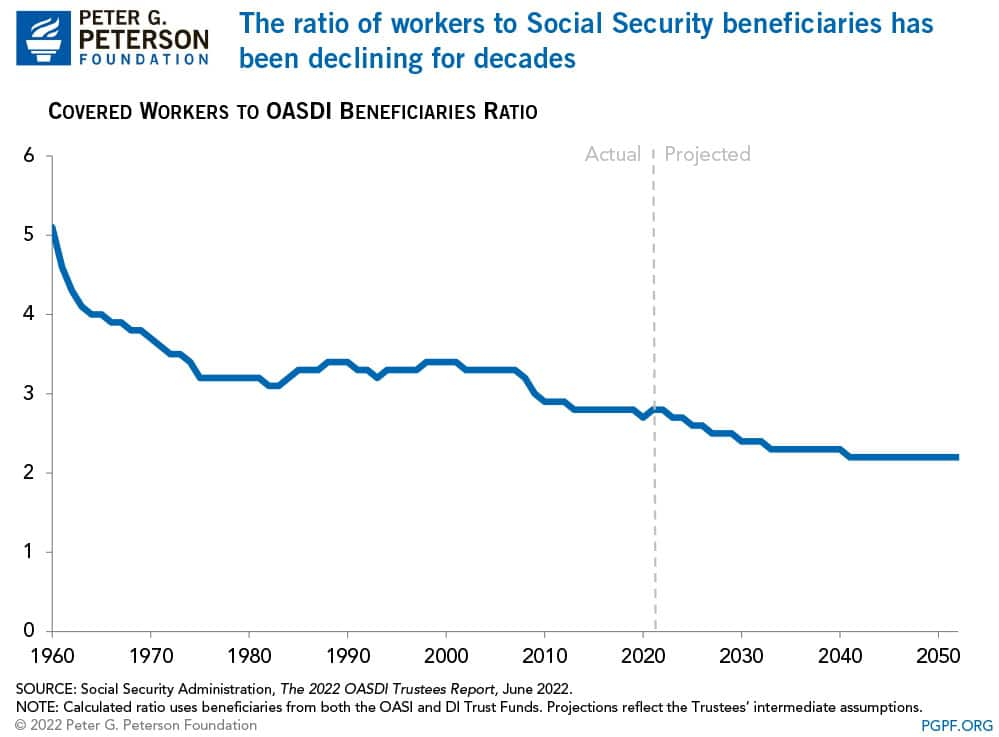
If the number of workers is insufficient, few remedies are available, and each has significant drawbacks. In short, options are limited to cutting benefits, raising taxes, or taking on still more national debt. All violate some of the system’s promises. Contracts don’t work under these conditions. A contract does not normally depend on a party that never consented, may not exist in sufficient numbers, and can have its obligations rewritten by future legislation. Yet this is exactly the structure of Social Security’s “generational bargain.”
To be clear, this is not a critique of Social Security for failing to predict the future perfectly. No government program can foresee every war, recession, pandemic, fertility decline, or demographic shift. The fault is not that Social Security lacks omniscience. The fault is that the pay-as-you-go system needs omniscience to function. Every time history turns, benefits and taxes need to be rewritten. Policymakers need to know the demographics of the far-off future to ensure the budget remains balanced. While year-to-year Social Security can survive without knowing the future, it is impossible in the long term to avoid repeated tax increases, benefit reductions, or new borrowing. All allow policymakers to retroactively alter the deal, while conscripted participants can only pray it isn’t altered further.
Social Security’s defenders should say what they mean and mean what they say. If the program is redistributive, defend the program as redistribution. If it is an anti-poverty policy, defend it as such. If it is forced retirement saving, defend forced saving. If it is social insurance, defend social insurance. Each of those claims may have merit, but it is in no shape or form a contract.
It is a great disservice to the American people that a program as massive as Social Security, a program that takes 6.2 percent (often twice as much) of every paycheck, is so poorly argued for, and its rationale is murky and drifting.
Justice requires that a program of this magnitude have clearly articulated goals and functions. Unfortunately, Social Security does not. A contract requires intent and consent. Unfortunately, Social Security mocks them. Even taxation requires the consent of the governed, and representation of the taxed, to distinguish itself from tyranny, extortion, and abuse. Unfortunately, Social Security defies that standard.


