


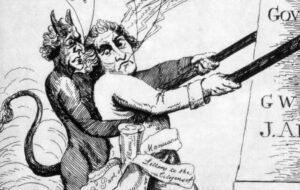



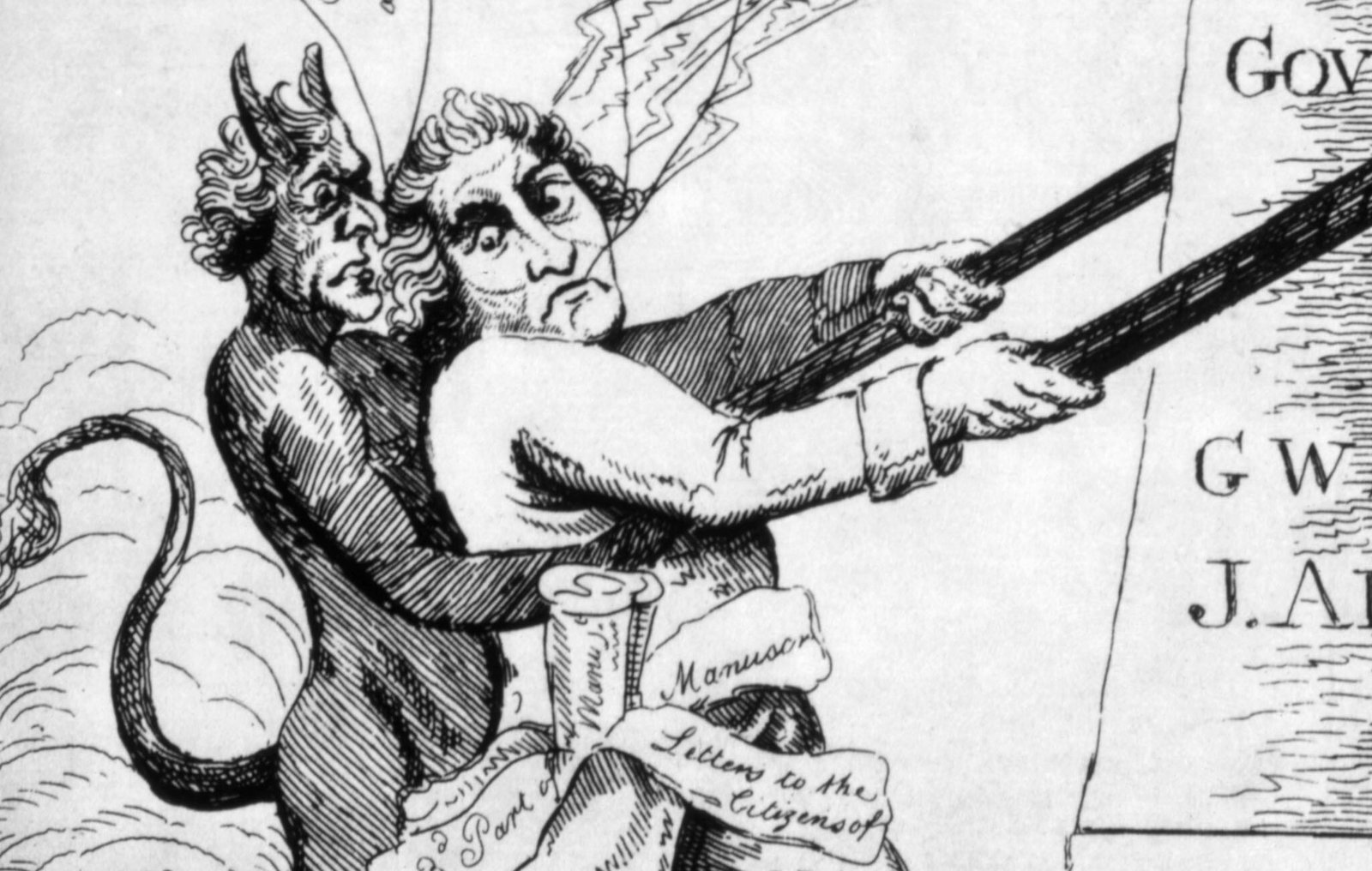
Writing to oppose the Constitution’s ratification, an Anti-Federalist writing under the pseudonym Brutus warned against giving the national government the power to borrow money:
The power to borrow money is general and unlimited, and the clause so often before referred to, authorizes the passing [of] any laws proper and necessary to carry this into execution … By this means, [Congress] may create a national debt, so large, as to exceed the ability of the country ever to sink. I can scarcely contemplate a greater calamity that could befall [sic] this country, than to be loaded with a debt exceeding their ability ever to discharge.
Brutus did not oppose borrowing as such, granting that a government would sometimes need to borrow. His concern focused on debts owed to foreign lenders. He instead narrowly objected to the borrowing power, arguing that if Congress were allowed to “borrow at discretion, without any limitation or restriction,” it would borrow excessively. Instead of trusting the individual judgment and restraint of legislators, Brutus thus argued for preserving the kind of supermajority requirement that the Articles of Confederation imposed: Congress could not borrow without the assent of nine of the thirteen states.
Brutus’s opposition to public debt continued an argument begun at Philadelphia’s Constitutional Convention. The Articles gave Congress power “to borrow money, or emit bills on the credit of the United States,” and the Committee of Detail carried that language into a draft of the Constitution. On August 16, Gouverneur Morris moved to strike “emit bills,” and the motion passed nine states to two. He argued that “if the United States had credit such bills would be unnecessary,” and if the United States lacked credit, paper money would be “unjust and useless.” In other words, Morris spoke as if striking “emit bills” meant restricting the use of borrowing by issuing paper money. James Madison, on the other hand, wrote that he voted to strike only after satisfying himself that the change would not stop the government from using public notes “as far as they could be safe and proper.” In Madison’s view, removing the text “emit bills,” would cut off the pretext for a paper currency, and for making bills legal tender. So, the revision is at least some evidence that the delegates wanted federal obligations to take the form of debt that had to be repaid (as opposed to easily inflatable currency).
Hamilton’s defense of the borrowing power relied on the government’s capacity to repay. Under the Confederation, Congress could borrow but lacked an independent power to tax, instead depending on requisitions from the states for revenue. As Alexander Hamilton argued in Federalist No. 30, lenders would extend credit to such a government only “with a sparing hand and at enormous premiums.” The solution was a general power of taxation, which would make the power to borrow usable, both to manage the Revolutionary debt the nation already owed and to meet the emergencies of war. The argument in Federalist No. 30 thus is an argument for making borrowing possible, not limiting it. Madison’s defense in No. 41 overlapped with Hamilton’s in some regards, but put more weight on limits. Madison grouped borrowing with the war powers as a matter of security against foreign danger, arguing that “general welfare” was confined by the enumeration that followed it.
The Anti-Federalists, though, noted that nothing in the text would keep the grant of borrowing confined to those stated purposes (war or emergency). “The Congress, by the proposed system,” wrote A Farmer, has “the power of borrowing money to what amount they may judge proper, consequently to mortgage all our estates, and all our sources of revenue.” In combination, these powers, the Anti-Federalists argue, would give the government the means to mobilize the country’s resources without the checks the states previously supplied under the Articles.
For the greater part of a century, the Federalists appeared to have won the debate — not because of the Constitution’s design, but primarily because of self-restraint on the part of political leaders. Washington’s Farewell Address urged Americans to “cherish public credit” while using it “as sparingly as possible” and avoiding “the accumulation of debt.” In short, the country should not throw “upon posterity the burden which we ourselves ought to bear.”
Even those in the Founding era who did not wholly agree on the role of debt, nevertheless arrived at similar commitments to repayment. Alexander Hamilton thought a well-funded debt could strengthen Union bonds and launch a national credit market. His 1790 report nevertheless insisted that “the creation of debt should always be accompanied with the means of extinguishment.” Jefferson, by contrast, abhorred debt on principle: in a 1789 letter to Madison, he doubted that one generation could rightfully bind the next. Washington used his presidential authority to install Albert Gallatin at Treasury, with a mandate to pay off the national debt. Gallatin cut it substantially, until the War of 1812 undid much of that progress. Andrew Jackson finished the job in 1835, giving the United States its only debt-free period.
Three factors held this early pattern of fiscal austerity together:
- Institutional: until the twentieth century, Congress generally authorized loans on an individual basis and for stated purposes, so each new debt required its own vote.
- Fiscal: federal revenue came mostly from tariffs and land sales, which often outran the small federal budget.
- Cultural: the political culture treated peacetime borrowing as a lapse, and debts from the War of 1812, the Civil War, and World War I were each paid down in the following decades.
None of these restraints were primarily constitutional — they do not depend on any particular structural restraint imposed by the Constitution. Instead they were generally dependent on an attitude, a political culture. But that culture has gradually worn away. Beginning in 1917, Congress moved away from authorizing individual loans and toward broader statutory borrowing limits, giving Treasury substantially more discretion. The change was practical, given the necessity of financing World War I. But it removed the constraint forcing Congress to vote on each new debt. Nevertheless, the older habits continued to hold, with the Treasury reducing the debt through the 1920s. The modern aggregate debt ceiling followed in 1939.
In the 1940s the pattern broke more noticeably. Following World War II, as the result of significant economic growth and inflation, debt held by the public fell from over 100 percent of GDP in 1946 to about a quarter by the mid-1970s. But several developments pushed in the opposite direction: Keynesian economics justified deficit spending during economic downturns; the New Deal and later Great Society programs created ever-growing entitlements with automatically growing costs; and the Cold War justified spending on a large peacetime military. By the 1980s, deficits had become a standing feature of peacetime budgets rather than an exception.
To be sure, Congress has repeatedly tried to bind itself by statute: Gramm-Rudman-Hollings in 1985, pay-as-you-go attempts in 1990 and 2010, the Budget Control Act’s spending caps in 2011, and the Line Item Veto Act of 1996, which the Supreme Court struck down. Some of these reforms temporarily produced fiscal restraint. But because these reforms were all passed as statutes, they share the same weakness: they could be repealed or amended by a simple majority of Congress.
The national debt now exceeds $40 trillion, and the portion of debt held by the public ($32.8 trillion) is roughly equal to the size of the American economy (101 percent of GDP), a level last reached in the years right after the Second World War. Interest payments on the national debt now rival defense spending.
While the United States can still service its debt, Brutus’s institutional claim about the consequences of granting the government borrowing power seems ever more prescient. Because the Constitution places no substantive limit on the borrowing power, once the older habits of restraint weakened, there was no replacement. Ultimately, anti-federalist Brutus feared that easy borrowing would lead Congress to borrow excessively. The last half-century of peacetime deficits suggests his warning deserves another look.


