







Some successful Hollywood producers spend their money on yachts, sports teams, and European castles. Norman Lear’s biggest purchase, or at least his most famous one, was a copy of the Declaration of Independence. He did not, of course, buy the kind of reproduction any tourist can pick up at the gift shop of a major American historic site, but a “Dunlap broadside,” one of 200 or so run off by Philadelphia printer John Dunlap on the very night of July 4th, 1776. After handing over $8.1 million in exchange for the document in 2001, Lear put it on tour, and it thereafter made years of public appearances all around the country, including at the 2002 Olympics, Super Bowl XXXVI, and the Live 8 concert in the city where it was made.
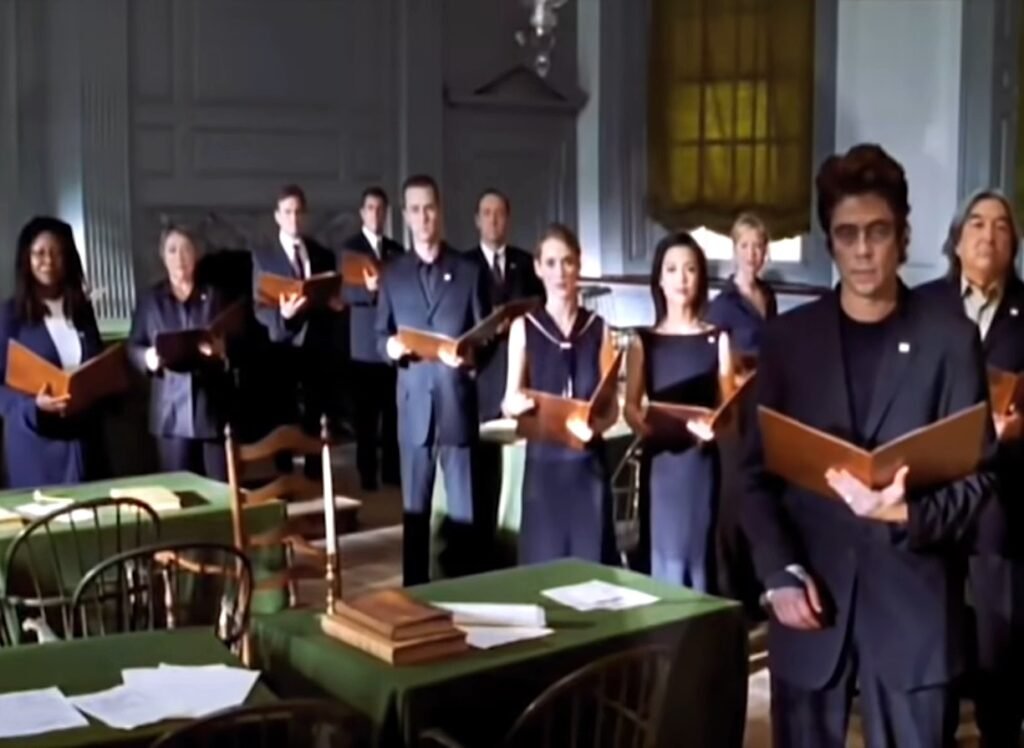
Lear’s purchase also inspired a film, as it might well do for any man with his connections. Co-produced by Lear and the late Rob Reiner, another Hollywood enthusiast of American politics, the 2001 short at the top of the post captures a dramatic reading of the Declaration of Independence by a lineup of big stars of the day, including the likes of Michael Douglas, Winona Ryder, Edward Norton, Renée Zellweger, and Benicio del Toro.
Their performances were all shot together at Independence Hall in Philadelphia by Conrad Hall, the famed cinematographer of Cool Hand Luke, Butch Cassidy and the Sundance Kid, Marathon Man, and American Beauty, on July 4, 2001.
These 25 years later, the film remains an invigorating refresher on what the Declaration of Independence actually says. Don’t think of it as the next best thing to reading that hallowed document: as Morgan Freeman tells us in his introduction, Thomas Jefferson “intended for the declaration to be performed, and not just read. Its words and rhythms were written to be spoken, in proud and defiant tones in grand public places.” His fellow thespians deliver them with the aplomb of a country that understood itself as supreme in the world, though one does now feel a certain irony in their speaking in the mid-summer of 2001, just months before that confidence would be terribly shaken. American history, it turned out, had not yet ended; even now, on the 250th anniversary of the United States’ independence, it may have just barely begun.
Related content:
Bertrand Russell’s 10 Commandments for Living in a Healthy Democracy
John Wayne Recites the Pledge of Allegiance
Based in Seoul, Colin Marshall writes and broadcasts on cities, language, and culture. He’s the author of the newsletter Books on Cities as well as the books 한국 요약 금지 (No Summarizing Korea) and Korean Newtro. Follow him on the social network formerly known as Twitter at @colinmarshall.


