






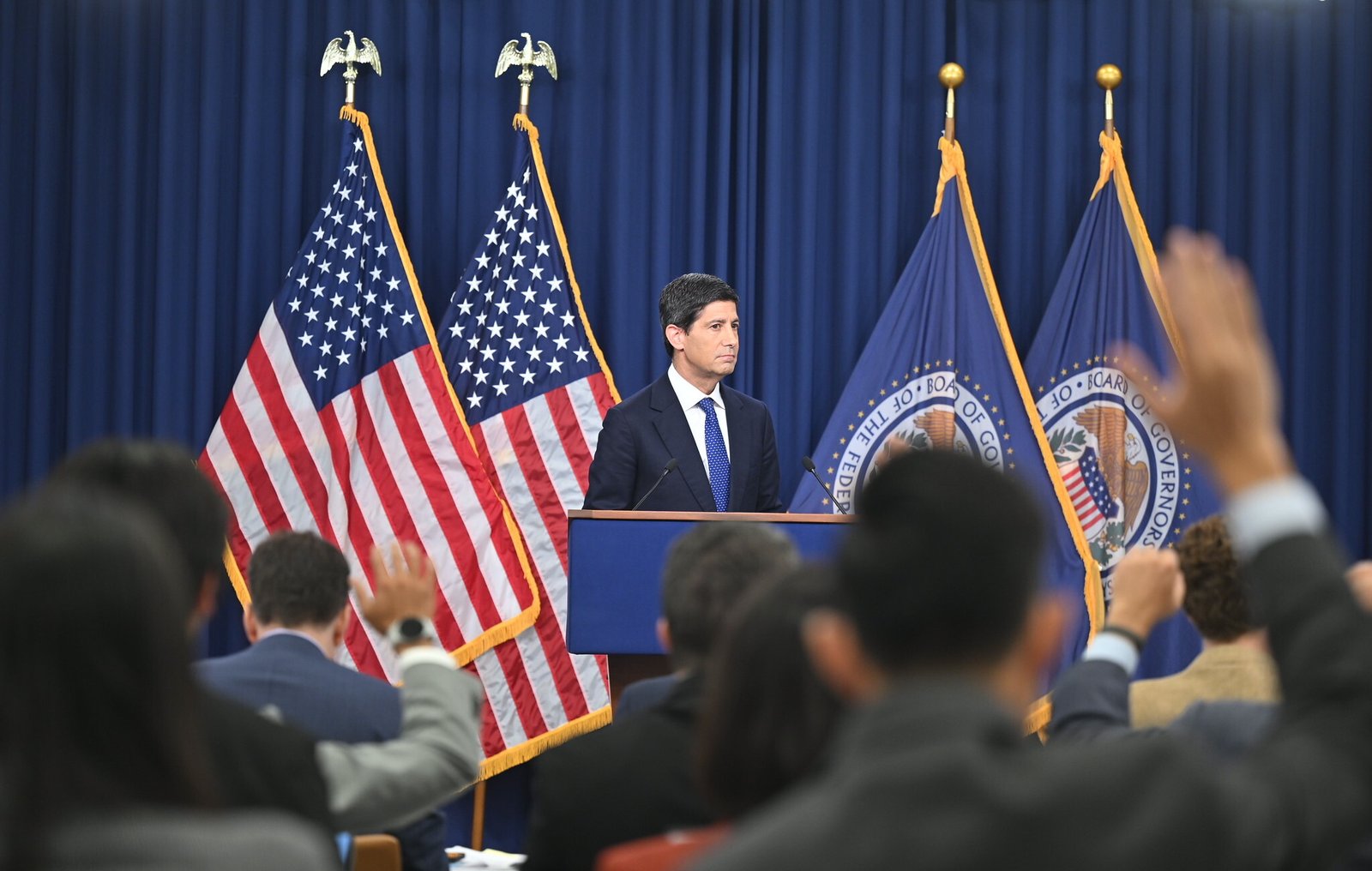
The Federal Open Market Committee (FOMC) voted unanimously to raise its target range for the federal funds rate by a quarter percentage point to 3.75–4 percent on Wednesday, the first increase since July 2023. More importantly, the projections released with Wednesday’s decision suggest that more increases lie ahead. The decision came as little surprise to market participants: on the eve of the vote, futures markets put the odds of a quarter-point increase above 90 percent.
In July, the FOMC noted that inflation was elevated “in part reflecting supply shocks that have driven price increases in certain sectors, including energy.” That language was nowhere to be found in Wednesday’s release. The statement made no reference to supply factors, saying only that “Inflation remains elevated,” and the rate increase “will support a timelier return to the Committee’s 2 percent goal,” suggesting that the Fed now sees demand as the primary driver of inflation.
At the post-meeting press conference, Chairman Warsh defended the decision to raise rates on the grounds that the economy “appears to be strengthening,” and that he “would be hard-pressed to describe broad financial conditions as restrictive.” That view, Warsh noted, “was widely shared by the Committee. So we removed a dose of accommodation.”
At his Jackson Hole speech last month, Warsh committed himself to “a monetary policy discipline, not to a decision,” and set the standard he would use to evaluate whether policy is on the right track: “We must be confident that underlying inflation is moving to our objective, clearly and at sufficient speed.” According to Warsh, “the FOMC decided that this standard has not been satisfied,” which is why the Committee decided to raise rates.
The Summary of Economic Projections released with the decision aligns with the FOMC’s decision to remove the supply shock language from Wednesday’s statement. FOMC members now expect growth of 2.3 percent this year, up from 2.2 percent in June; unemployment of 4.1 percent, down from 4.3 percent; and inflation of 3.7 percent, up from 3.6 percent, with core inflation, which excludes food and energy, at 3.4 percent, up from 3.3 percent.
In short, they see faster growth, a tighter job market, and higher inflation: every revision in the projections points toward too much spending rather than too little supply. That should put policymakers on alert. Excess demand requires tighter monetary policy, not patience while supply recovers.
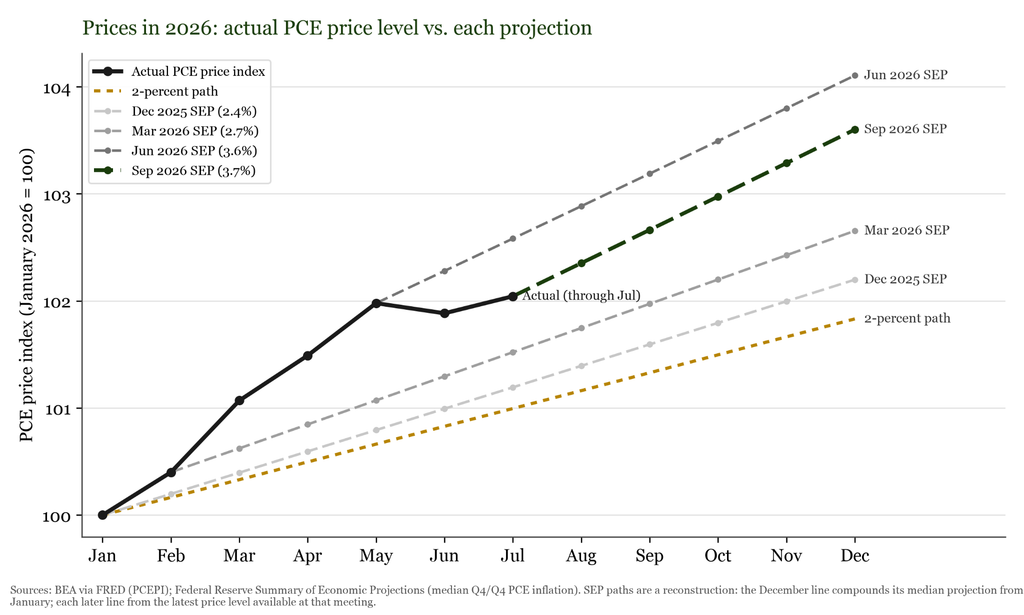
The FOMC’s inflation projection for 2026 has risen steadily over the past nine months, from 2.4 percent in December to 2.7 percent in March, 3.6 percent in June, and 3.7 percent on Wednesday. Inflation measures how quickly prices rise. The price level measures how high they are. The chart below shows what the Fed’s inflation revisions imply for the price level at year’s end. The decline in July’s PCE print puts the September projection path slightly below June’s, despite the Fed projecting higher inflation. Nonetheless, prices remain on track to finish the year a full percentage point above where policymakers expected last December.

Looking ahead, Fed officials project inflation falling to 2.3 percent next year and not reaching two percent until 2029. Pressed on how a “timelier return” fits with the Fed not meeting its target until 2029, Warsh answered that the projections are his colleagues’, not his. That’s fine as far as it goes, but the Fed’s credibility depends on policymakers’ decisions and the results that follow. Projecting inflation to remain above target for another two years is difficult to square with Warsh’s promise of monetary discipline.
Most FOMC members expect to raise rates at least once more this year, while four expect two increases by the end of the year. The median projection puts the federal funds rate at 4.1 percent at year’s end, up from 3.8 percent in June, and keeps it there through 2027, compared with the previous projection of 3.6 percent. In other words, Fed officials now anticipate both further tightening and a longer period of higher rates.
Wednesday’s increase was a promising start toward the monetary discipline Warsh has promised. But with nominal spending growing at an annualized rate of eight percent in the second quarter, Fed officials must recognize that restoring price stability will require further rate increases. The test is whether it tightens policy enough to bring inflation back to two percent “clearly and at sufficient speed.”


