







On June 5, 2026, Baku, Azerbaijan, the “Land of Fire,” will host World Environment Day. The UN Environment Program reports that “Azerbaijan is pursuing green growth and renewable energy at pace” and, as a party to the Paris Agreement, has committed to reducing emissions by 40 percent by 2035. Yet Azerbaijan’s economy remains deeply tied to hydrocarbons. Global Finance reports that petroleum and natural gas account for more than 90 percent of export revenues and roughly half of the state budget. Recent GDP growth reflects this dependence, as energy markets shifted after Russia’s invasion of Ukraine.
Global environmental politics carries a familiar irony. Azerbaijan’s nickname is not merely poetic. CNN describes Yanar Dag, translated as “burning mountainside,” as a natural gas fire that has burned for 4,000 years, making the “Land of Fire” a fitting host for a climate event in a world still powered by hydrocarbons. Diplomats, officials, activists, and international organizations will gather in Baku to discuss climate change, but many will likely arrive by plane rather than by Zoom. The campaign to save the planet still travels through the infrastructure of energy-intensive modern life.
California may be nearly 7,000 miles from Azerbaijan, but the two “lands of fire” reveal the same truth: energy remains central to modern life, and environmental policy cannot ignore the cost of living. California has embraced some of the most ambitious green mandates in the United States. Yet housing remains unaffordable, gasoline and electricity remain expensive, and the policy conversation too often treats centralized mandates as the only serious form of environmental action.
Housing: Green Mandates and the Cost of Shelter
California’s housing market already stands far outside the national norm. In April 2026, California’s statewide median home price reached a record $914,810, while the national median existing-home price was roughly $417,700. The Golden State also requires most new homes and low-rise multifamily buildings to include solar photovoltaic systems. The California Energy Commission estimated that the new energy-efficiency and solar requirements would add an average of $9,500 to the cost of building a new home. Costs are not the only problem. California also makes housing slow to approve and build.
San Francisco, for example, took a median of 280 days to process housing building permits between January 2024 and August 2025, roughly three times Austin’s 91 days and more than twice Seattle’s 133 days. Los Angeles fares no better. A UCLA study found an average total development time was 1,413 days, or 3.9 years, and the average dwelling unit took 1,784 days, or 4.9 years, to complete. The rebuilding process after the 2025 Los Angeles fires shows the same institutional sluggishness: of roughly 13,000 homes destroyed, fewer than a dozen had been rebuilt a year later, with only about 900 under construction.
In addition, California has a property tax rate of 0.69 percent, which may not appear as a large sum but does add up. The tax bill on an average-value California home was about $5,388, compared with an average US property tax bill of about $2,459. Homeowners might ask: what are they getting in return for paying so much? Los Angeles mayoral candidate Spencer Pratt’s conversation with Joe Rogan after the Palisades fire captured frustrations about rebuilding delays, public services, homelessness, and visible disorder. The episode gave voice to a broader concern: expensive public systems do not always protect homes, communities, or property values.
Energy: Gasoline and Electricity
The same pattern appears in energy. California’s gasoline prices are not just a story about oil markets. They are shaped by taxes, environmental requirements, refinery constraints, special fuel rules, and an isolated petroleum market. The US Energy Information Administration’s gasoline price breakdown shows how crude oil costs are layered with refining, distribution, taxes, margins, and regulatory costs before reaching consumers. This helps visualize how a crude-oil component of $1.84 can become a retail gasoline price of $4.59 after other costs are added.
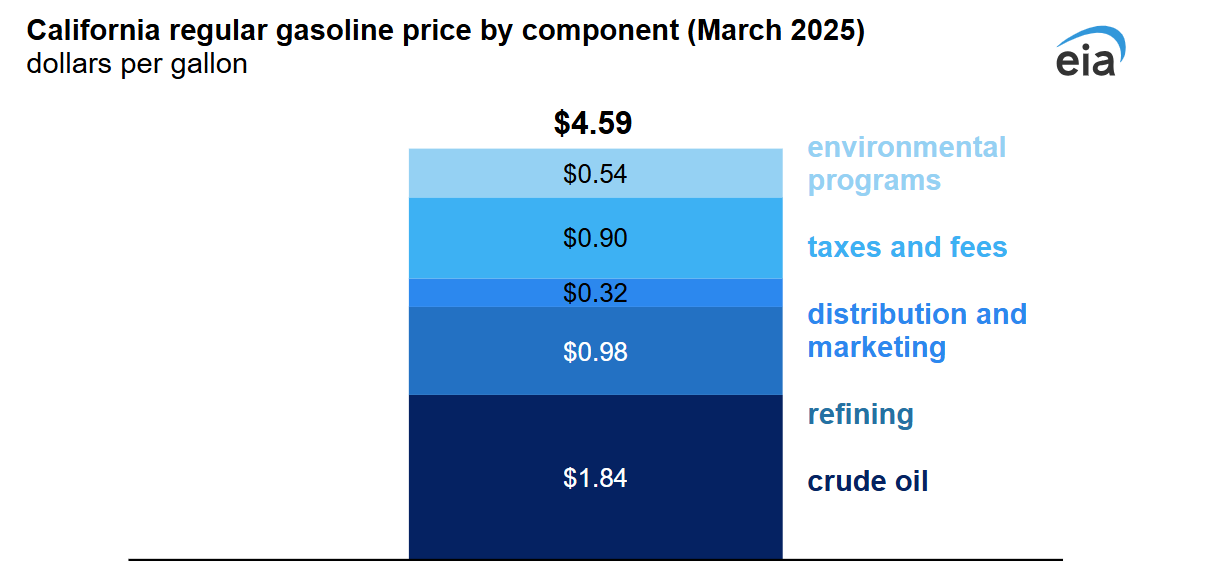
This helps explain why on May 29, 2026, AAA listed the national average price for regular gasoline at $4.391 per gallon, while California averaged about $6.06 per gallon. SFGate also reports, “The state already surpassed its record for diesel on April 9, hitting $7.75 per gallon.” These prices are not merely the result of private markets. They reflect a state energy model that repeatedly adds policy costs to ordinary consumption.
Rocking down electric avenue, California has some of the highest electricity prices, with 32.47 cents per kilowatt-hour, 95.7 percent higher than the US average of 16.59 cents/kWh. The trend has worsened over time. The Public Policy Institute of California noted that electricity prices went from being 10 percent above the national average in the 1980s, to 30 percent higher in 2015, to now 80 percent higher in 2024. This creates the central contradiction in California’s environmental model: the state wants residents to electrify cars, homes, appliances, and transportation while electricity itself remains far more expensive than in the rest of the country.
The America First Policy Institute helps explain why this is not merely a price problem, but a planning problem. California’s renewable mandate was set to rise from 30 percent in 2020 to 60 percent by 2030. Mandates can require utilities to buy more renewable power, but they cannot make the sun shine during peak evening demand. AFPI notes that in 2021, non-hydroelectric renewables provided 34 percent of California’s utility-scale net generation, and when small-scale solar photovoltaic generation is included, renewables supplied 40 percent of total in-state electricity generation. Nuclear energy, by contrast, accounted for only about 8 percent of California’s electricity.
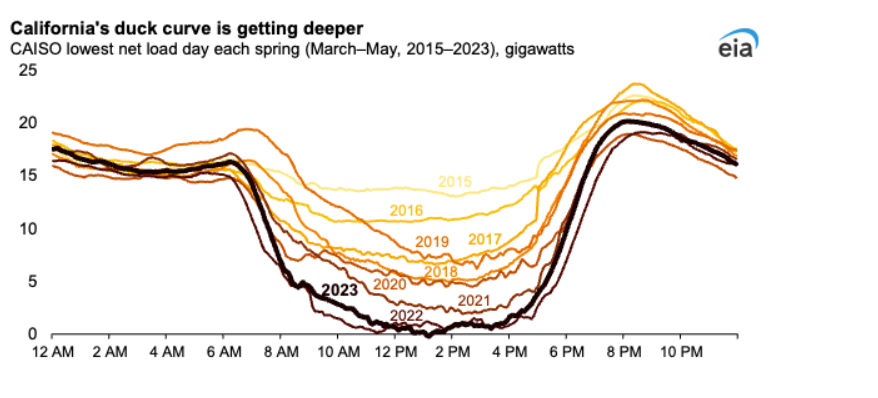
The “duck curve” shows this mismatch clearly. Solar generation can flood the grid during the middle of the day, when electricity demand is lower, but then drops sharply in the evening, just as households return home, turn on appliances, charge vehicles, and use air conditioning. AFPI points to EIA data from 2015 to 2023 showing that California’s duck curve has grown deeper over time, meaning the gap between daytime solar generation and evening electricity demand has become more difficult to manage.
The OLY Alternative: Ostrom, Lofthouse, and Yonk
The alternative to California’s model is not anti-environmentalism. The alternative might be called the OLY framework: Ostrom, Lofthouse, and Yonk. Elinor Ostrom gives the institutional foundation. Her work on polycentric governance rejects the false choice between centralized command and doing nothing. Polycentric systems rely on many overlapping centers of decision-making: households, firms, local governments, utilities, civic associations, property owners, and entrepreneurs. In environmental policy, this matters because housing, energy, water, land use, and conservation are too local and complex to be solved by one statewide mandate.
Jordan Lofthouse, a senior research fellow at the Mercatus Center, builds on this logic by applying economic reasoning to environmental problems. In An Economist’s Guide to Environmentalism, he argues that “effective mitigation and adaptation for climate change will involve a large degree of action from the bottom up, and we cannot simply rely on policies from the top down.” That is exactly what California’s green-policy model often ignores. Solar mandates, renewable targets, EV subsidies, and fuel rules do not abolish costs; they shift them into housing prices, utility bills, gasoline prices, and grid constraints.
AIER’s Ryan Yonk completes the framework with a public-choice warning. Nature Unbound asks a blunt question: “What if environmental laws often make things worse?” That is the California problem in one sentence. Environmental policy is not implemented by neutral angels, but by agencies, regulators, politicians, and interest groups with incentives of their own. A serious environmentalism should therefore favor technology-neutral standards, faster permitting, property rights, competitive energy markets, nuclear power, grid modernization, and local experimentation over one-size-fits-all mandates. The goal should not be green scarcity by decree, but clean abundance through institutions that allow people to adapt, experiment, and innovate.
Clean Abundance, Not Green Scarcity
Friedrich Hayek described the market order, or catallaxy, as “not a single economy but a network of many interlaced economies.” Environmental policy should learn from that insight. Households, firms, utilities, local governments, entrepreneurs, and civil society should be allowed to experiment with cleaner ways of living rather than being forced into the same political blueprint.
World Environment Day should not become another ritual for demanding more centralized control. Azerbaijan reminds us that development still depends on energy, and California reminds us that green mandates can raise the cost of ordinary life while ignoring housing, prices, reliability, and local conditions. The better lesson is not to abandon environmental concern, but to abandon the assumption that every environmental problem requires a top-down mandate. The OLY framework points toward a more serious alternative: polycentric governance, economic realism, and institutional humility. On a day meant to celebrate the environment, the real test is not ambition, but whether policy helps people live cleaner, freer, cheaper, and more resilient lives.


