







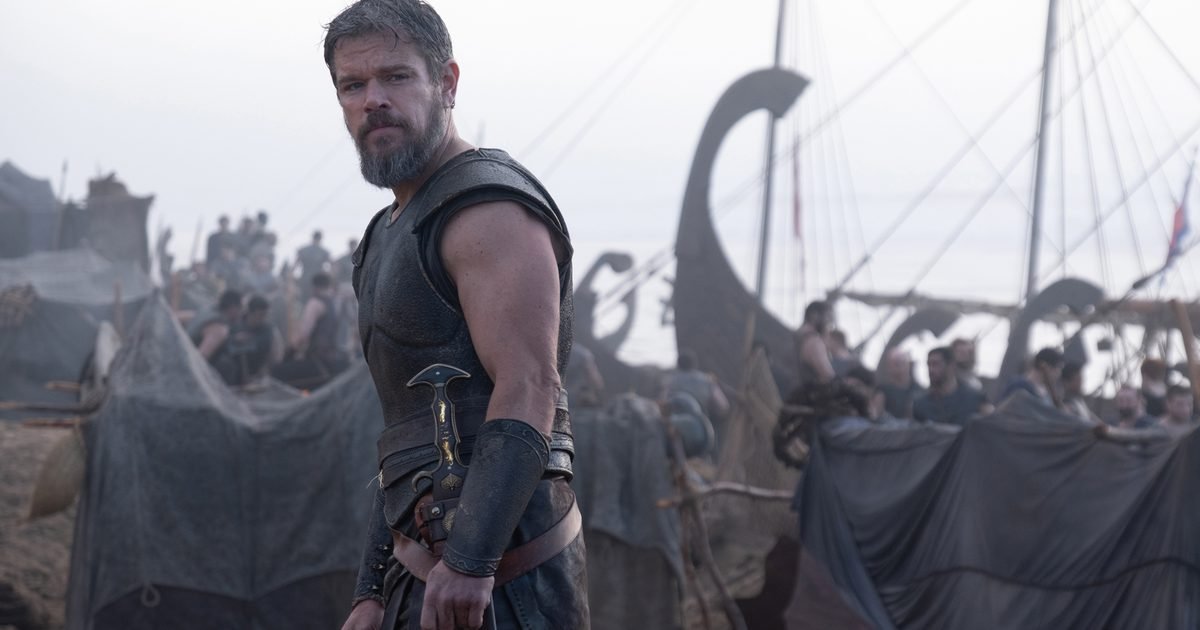
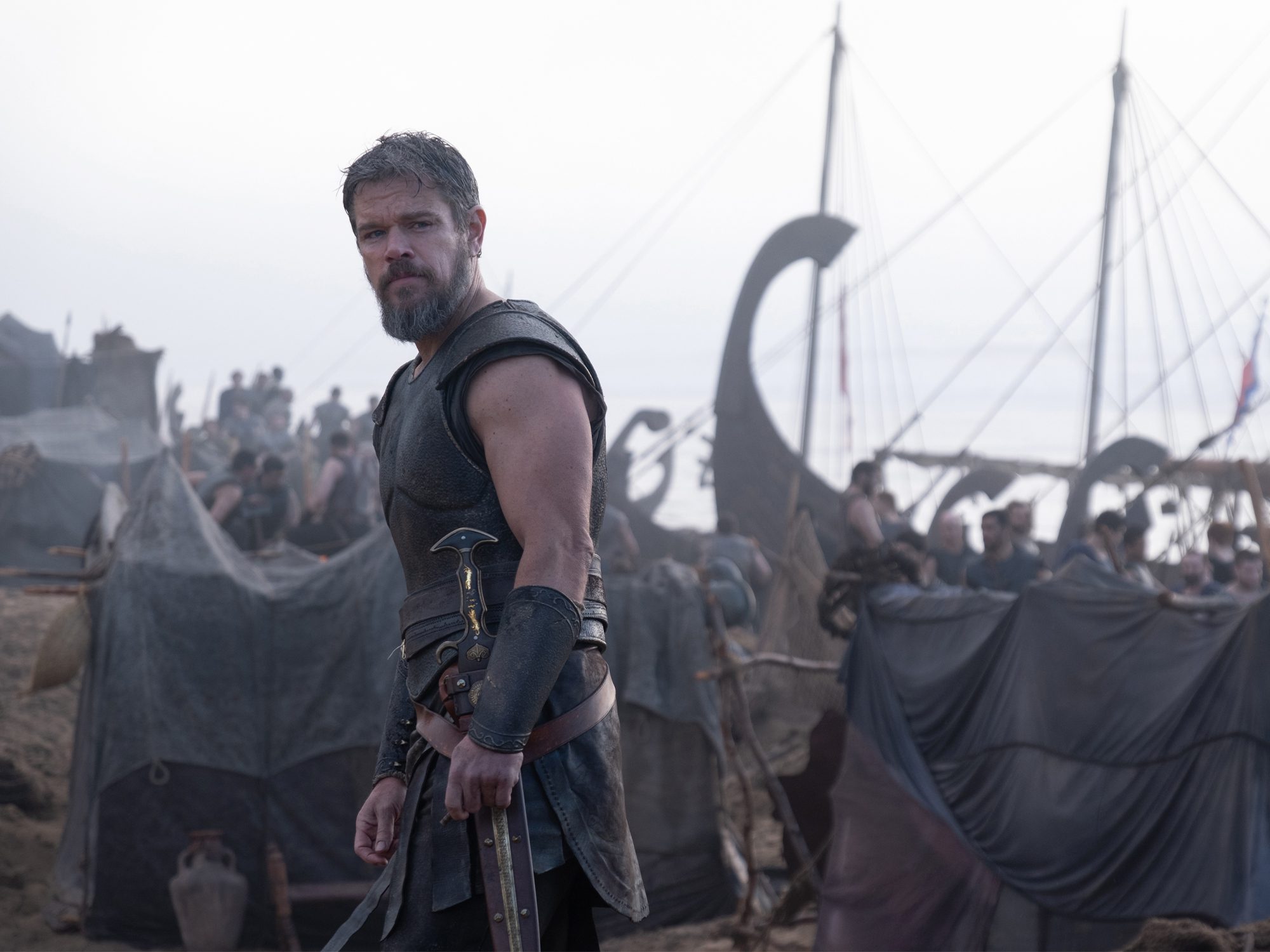

With regards to the dialogue and American/British accents used in place of more accurate speech – Emily Wilson, whose translation of ‘The Odyssey‘ was Nolan and Damon’s north star, has succinctly hit that nail on the head. Similarly, it’s hard to get too worked up about the historical realism of the costumes in a film where a 60ft cyclops puppet chomps on Odysseus’ shipmates like they’re fun-size Mars bars. Nolan and van Hoytema work in the familiar moody colours which have come to define their collaboration; blues, greys and browns with the occasional flourish of red and orange. Those seeking the impressive colours that Ancient Greece was known for may be put out by this muted palette, but it’s hard to think of a contemporary filmmaker who mounts a spectacle with as much finesse as Nolan. Perhaps only Jordan Peele is his equal in that area.
The mighty ensemble is mostly excellent. Damon is stern but not unfeeling; stubborn and reckless but ultimately sympathetic as a man who can’t help but defy the Gods out of desperation. Holland’s boyish innocence, shorn of the trying quippiness of Spider-Man, is nicely balanced against Pattinson, who has developed such a knack for villainy one hopes he might play Iago in Othello eventually. As in Oppenheimer there are no small parts – Elliot Page, Samantha Morton and Lupita Nyong’o are particularly compelling, and even Benny Safdie is masterfully utilised as the near-silent doomed King Agamemnon.
On a craft level Nolan has been setting the bar for years; the chinks in his armour are usually found in his storytelling. Even a hair under three hours there’s no dead air; Odysseus and his crew seem to zip along at quite a pace thanks to Jennifer Lame’s smart editing and the way timelines brush up against each other. Events become stories; stories become legends. Similarly, without his memories to rely on, Odysseus dreams of his wife and son and the man he once was, and in his waking hours tries to separate fact from fiction. The richness of The Odyssey is found in its metatextuality, both as a translation of Homer’s text and as a translation from word to image. Increasingly the value of words is decimated; a film like this seems to emphasise their importance more than ever. Words, and by extension the stories they make up, give us our identity. They tell us about where we came from, what we survived, and who we are. The Odyssey is a story about a lot of things – family, true love, war, faith, folly, revenge – but mostly it’s about enduring. This is what human beings do best: we endure, and we tell ourselves stories, as Joan Didion once wrote, in order to live.
To this end: when Oppenheimer and Barbie released in cinemas on the same day in 2023, much prognostication occurred regarding whether those blockbusters might save cinema. Three years on no one has much of an answer. Box office admissions are stable-ish, although the highest grossing films list makes for depressing reading and anyone who works in the industry will tell you it’s almost impossible to get a film made if you’re not somewhere near Nolan-level. Film journalism, which has always filled a Charon-esque role ferrying lost souls to the cinematic afterlife, is rapidly being replaced by AI summaries, TikToks of audience members gurning at their phone’s selfie camera mid-film and influencers at junkets asking jetlagged filmmakers if they have any thoughts on Love Island. One has to wonder what the point of telling ourselves stories is if we have no respect for them; if we treat them as disposable and entrust their entire survival to one or two lauded filmmakers. Cinema cannot be saved by one (or two) auteurs, talented as they may be. It’s a collective medium and requires collective preservation.
All of Christopher Nolan exists within The Odyssey. All of humanity exists within filmmaking. Yet cinema always finds new ways to tell old stories; this is the great magic of the medium. Within the cathedral of the multiplex, or the church of the independent arthouse, or the temple of your own living room, we put our faith in the hands of a higher power. What a terrible shame it would be to lose that form of communion.


