







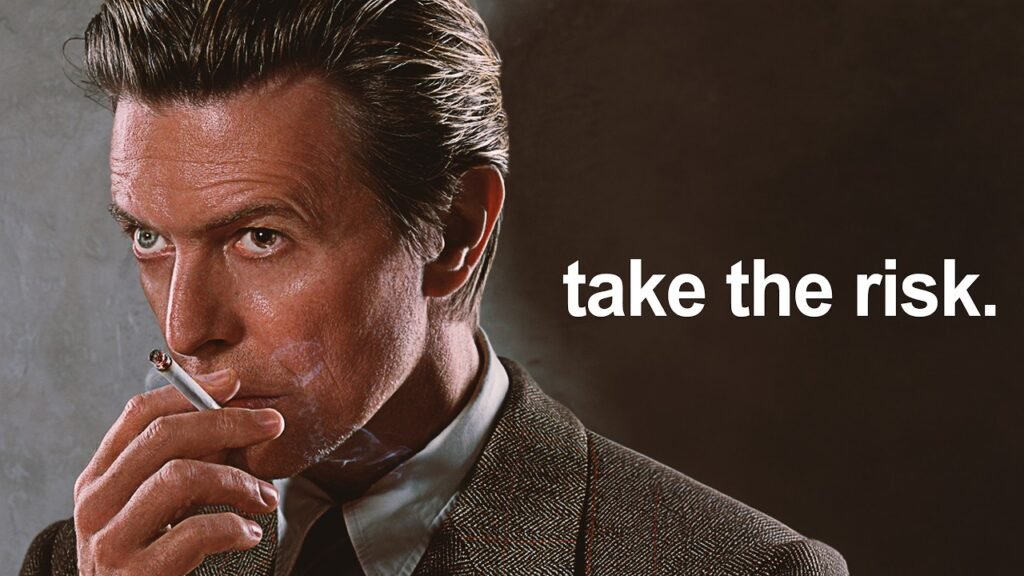

It doesn’t quite ring true to call David Bowie a rock star. Ziggy Stardust, the neon synthetic-clad alien alter ego he both created and retired in the early seventies, was, of course, rock stardom outlandishly personified. But then, that was the concept of what turned out to be just one of many personae he deliberately crafted throughout the course of his career. That career was in music, primarily, but looking back on it today, more than a decade after Bowie’s death, it looks more like his medium was culture itself. That’s underscored by his interviews, clips from a variety of which appear in the new video above from YouTube channel T&H Inspiration.
Most of T&H’s most popular videos add visuals to speeches by the popularizer of Eastern philosophy Alan Watts, who’s been featured here on Open Culture before. He and Bowie had more in common than it may seem at first, beginning with an Englishness that remained thoroughgoing no matter how far out they ventured into the world.
Though Watts’ interest in Buddhism hardly needs stating, it’s worth remembering that he chose to be ordained as an Episcopalian priest rather than as a Buddhist monk. The young Bowie, for his part, very nearly took the latter path, studying under the late Lama Chime Rinpoche, who eventually told him he’d be better off going into the music business.
Bowie did so, of course, but with a new “sense of transience and change, which actually became fundamental to my life and my approach to it,” as he put it decades later. That sense manifests even in his early work, but embracing and even pursuing impermanence — the impermanence of sounds, of fashions, of hit records, of life itself — also kept him from getting mired in the irrelevance or auto-kitsch that threatens every superstar. Given the belief that nothing lasts forever, “looking for the source of one’s own being becomes much more important,” as does attempting artistic or intellectual challenges at the very edge of one’s abilities. Alan Watts would probably have agreed. The bigger question is, did he ever hear “Changes”?
Related Content:
David Bowie on Why It’s Crazy to Make Art — and We Do It Anyway (1998)
The Art Collection of David Bowie: An Introduction
How Leonard Cohen & David Bowie Faced Death Through Their Art: A Look at Their Final Albums
Based in Seoul, Colin Marshall writes and broadcasts on cities, language, and culture. He’s the author of the newsletter Books on Cities as well as the books 한국 요약 금지 (No Summarizing Korea) and Korean Newtro. Follow him on the social network formerly known as Twitter at @colinmarshall.


![Connecting Learning Strategy To Business Impact [eBook Launch]](https://kumbhcoin.org/wp-content/uploads/2026/10/Connecting-Learning-Strategy-To-Business-Impact-eBook-Launch-450x268.jpg "Connecting Learning Strategy To Business Impact [eBook Launch]")


