






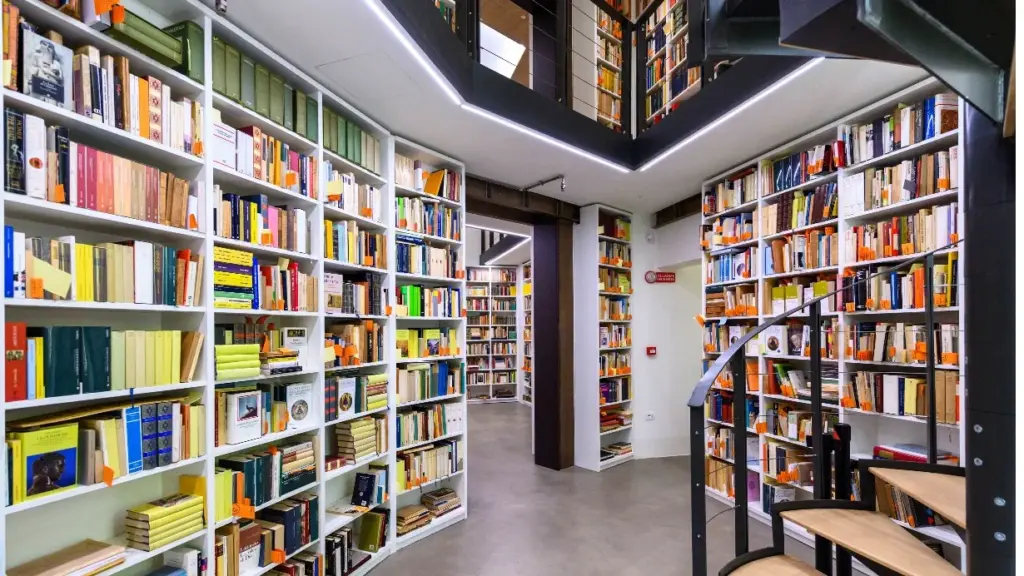

Umberto Eco’s The Name of the Rose sold so well that its English translator William Weaver could add an extension onto his Tuscan villa, which he called the “Eco Chamber.” The Biblioteca Eco, or Eco Library, whose ribbon-cutting earlier this month you can see in the Italian news clip just above, may not be as wittily named, but it’s a much more ambitious project. It was opened this year, the tenth anniversary of the famed philosopher, semiotician, novelist, and critic’s death, at the University of Bologna, where he was a professor from 1971 to 2007. Housing more than 32,000 books from his personal library in Milan (previously featured here on Open Culture, and the subject of its own feature-length documentary), it stands as an explorable concrete representation of his capacious mind.
So capacious was that mind, in fact, that the Eco Library actually comprises several libraries, chiefly the Rare Book Library and the much-subdivided Working Library. In them, one encounters sections “dedicated to literary genres, comics and popular culture, works by and about Umberto Eco” — including more than 2,000 editions and translations of his own books — “ancient and medieval philosophy, the history of ideas, semiotics, translation and theories of language,” says the University of Bologna’s magazine Unibo.
There are “Italian, French, English-language, German, Central European, Slavic, Latin American and many other literatures,” including works of “detective fiction and science fiction, popular literature and the feuilleton.” As anyone who’s read Eco’s essay on Peanuts might imagine, “his comic book collection is also of great importance.”
Indeed, as any fan would expect, Eco’s namesake library reflects not just the vast sweep of his humanistic interests and knowledge, but also his playful sense of eccentricity, and even grotesquerie. According to the Fondazione Umberto Eco, most of the volumes it contains “are marked by a distinctive ex libris,” an adaptation of a sixteenth-century woodcut that depicts a donkey on a cornucopia-topped latrine. “The animal plays a small pipe, setting in motion a merry dance of a dozen cavorting monkeys.” The books themselves have been painstakingly arranged just as Eco shelved them, in accordance with the “good neighbor” principle of placing seemingly unrelated titles in close proximity in order to reveal unexpected intellectual connections between them. The volumes from Eco’s country house in Monte Cerignone will also be incorporated into the collection, but as the man himself knew, the best libraries, like the best minds, are never truly complete.
Related content:
Watch Umberto Eco Walk Through His Immense Private Library: It Goes On, and On, and On!
Umberto Eco Explains Why We Make Lists
The Virtue of Owning Books You Haven’t Read: Why Umberto Eco Kept an “Antilibrary”
Darwin’s Personal Library Goes Digital: 330 Books Online
The Largest Bookshelf Tour Ever Filmed: Inside a Classicist’s 20,000-Volume Library
Based in Seoul, Colin Marshall writes and broadcasts on cities, language, and culture. He’s the author of the newsletter Books on Cities as well as the books 한국 요약 금지 (No Summarizing Korea) and Korean Newtro. Follow him on the social network formerly known as Twitter at @colinmarshall.


