







Asked to name famous shipwrecks at a bar trivia night, a fair few participants might think immediately of Pearl Harbor, whether or not they can recall that it was the USS Arizona bombed there. More firmly within living memory sits the SS Andrea Doria, though she’s hardly the cultural reference she used to be. The wreck of the SS Edmund Fitzgerald passed its fiftieth anniversary just last year, which gave a boost to its remembrance, if mostly by Gordon Lightfoot fans. There is, of course, the Endurance, though the ship herself has always been overshadowed by the efforts of her captain to get the whole crew home alive. The schooner Hesperus does come to mind as a particularly unfortunate vessel, perhaps all the more so because she didn’t actually exist.
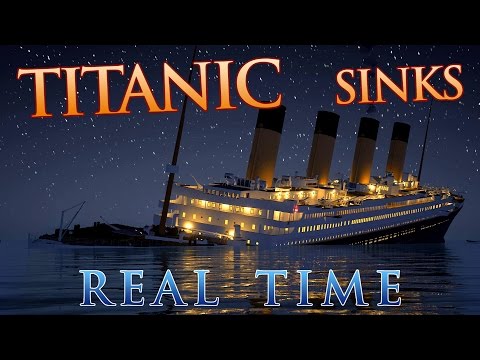
Nearly everyone at the bar is, of course, going to put down the RMS Titanic first. Even before she received the James Cameron treatment, that “unsinkable” ocean liner was easily the most famous shipwreck of the twentieth century, and quite possibly of all history. But second place has to go to the RMS Lusitania, which went under just three years after the Titanic. As close as the year 1915 may sound to 1912, developments in Europe had rearranged the world in the meantime. The Titanic met her end by colliding with an iceberg, and about two and a half hours later, as you can see in the real-time sinking video at the top of the post, it was on the bottom of the North Atlantic. When the Lusitania was torpedoed by a German U‑boat, by contrast, she went down in just eighteen minutes.
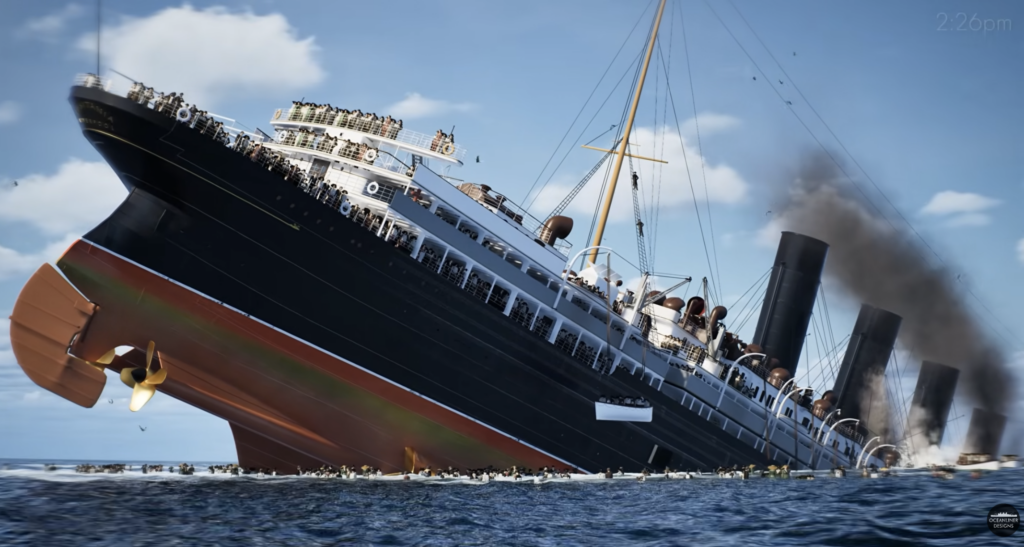
You can witness those minutes re-created in the animated video from Oceanliner Designs just above. Though the Great War was raging, the ship hadn’t yet been commissioned as an armed merchant cruiser, but was conducting her usual transatlantic passenger service while — as the German side insisted and the British at first denied — carrying war materials on the side. She’d been traveling due east for six days when U‑20 sighted her; after an hour of tracking came the launch of the fateful underwater missile and its 160-kilogram explosive payload. The video shows and explains not just how the Lusitania slipped below the water, but also the breakdown along the way of her various structural elements and mechanical systems, including the elevators that had once seemed such marvelous innovations.

It seems that after the torpedo hit, practically everything that could have consequently gone wrong did, right down to the few deployable lifeboats dropping catastrophically from their davits. The crew of the Titanic managed to launch most of her lifeboats, but there weren’t enough of them in the first place. That contributed to a final death toll of around 1,500, as compared with 1,197 on the Lusitania. Though similar in scale and historical timing, these two maritime disasters ended up with very different meanings. The wreck of the Titanic continues to capture imaginations by resonating with the industrial romance, class stratification, and imperial hubris of the long nineteenth century; that of the Lusitania, whose sinking played a major role in bringing the United States into what we now call World War I, shows us nothing so clearly as the merciless geopolitical logic of the twentieth.
Related content:
Watch the Sinking of the Lusitania Animated in Real Time (1915)
How James Cameron Shot Titanic’s Hugely Complex Sinking Scene
The Costa Concordia Shipwreck Viewed from Outer Space
Based in Seoul, Colin Marshall writes and broadcasts on cities, language, and culture. He’s the author of the newsletter Books on Cities as well as the books 한국 요약 금지 (No Summarizing Korea) and Korean Newtro. Follow him on the social network formerly known as Twitter at @colinmarshall.


