








What Is A Post-Test?
Post-test results are now among the most trusted ways for organizations to determine whether training has led to real learning, not just course completion. Today’s L&D leaders need to show clear business results, so assessments are a key part of any learning plan. But what exactly is a post-test, and why is it important?
A post-test is simply an assessment given after training to check what learners have gained in knowledge, skills, or abilities. If you’re asking what a post-test does, it shows whether learning goals have been met. In schools, post-tests measure what students have learned. In the workplace, they demonstrate whether training worked, support compliance, and guide future learning plans. For certification, they confirm that participants meet the required standards before moving forward. This guide covers what post-tests are, how they differ from pre-tests, when to use them, and how to design assessments that provide useful learning data.
What Is The Purpose of A Post-Test?
The primary purpose of a post-test is to assess knowledge acquisition and skill validation. In corporate learning, this might involve confirming that employees understand a new process, can apply compliance requirements correctly, or have developed the competencies needed for their roles. In many organizations, a post-course assessment also serves as evidence that learners have successfully completed mandatory training.
A post-assessment does more than just give a score. It shows how well the course worked by revealing if the content, teaching style, and activities led to the right results. This information helps learning teams improve future courses, fix skill gaps, and decide where to invest in training.
Post-tests are also important for checking compliance, especially in industries with strict rules. They help companies show that employees understand the required policies or procedures. Post-tests also show if learners are ready to use new knowledge at work or move on to more advanced training.
When evaluating training, post-tests match with Kirkpatrick Level 2 (Learning), which checks how much participants have gained the intended knowledge, skills, attitudes, confidence, or commitment. Instead of just marking course completion, a good post-test shows that real learning has happened.
What Is A Pre-Test?
A pre-test is an assessment given before instruction starts to measure what a learner already knows or can do. In simple terms, a pre-test sets a starting point so you can track future learning.
In workplace learning, pre-tests help make training programs more efficient and effective. Instead of assuming everyone starts at the same level, organizations use pre-tests to support adaptive learning, make better placement choices, and create personalized learning paths that address real skill gaps. This way, experienced employees can skip what they already know, while those with less experience get the help they need.
What does a pre-test actually do? It gives useful information before training starts. For example, your pre-test score might show you are strong in some areas and can skip basic modules, or it might point out where you need more help.
Why would your teacher give you a pre-test? Educators and trainers use pre-tests to find out what you already know, adjust their teaching to fit your needs, and measure your progress more accurately after training. When used with a post-test, a pre-test gives a clearer view of how much you have learned and how effective the training was.
Pre-Test Vs. Post-Test: What’s The Difference?
A post-test is most valuable when it’s paired with a pre-test, giving organizations a clear picture of how much learners have progressed over the course of a training program. While both assessments measure knowledge, they serve different purposes and answer different questions. Understanding the pre-test vs. post-test approach helps L&D leaders move beyond completion metrics and evaluate whether learning interventions are truly effective.
A pre-test is administered before instruction begins to establish a learner’s starting point. It identifies existing knowledge, skills, and potential gaps, allowing trainers to tailor content or personalize learning paths. In contrast, a post-test is delivered after training to measure learning outcomes and determine whether participants achieved the intended objectives.
Pre-Τest |
Post-Τest |
| Before instruction | After instruction |
| Measures prior knowledge | Measures learning outcomes |
| Establishes baseline | Measures improvement |
| Identifies knowledge gaps | Evaluates instructional success |
When you use both pre- and post-test assessments, you get much deeper insights than if you rely on just one evaluation. This approach lets organizations compare how things started with the final results, making it easier to see learning gains and spot where training made the biggest difference. For L&D teams, data from pre- and post-tests also helps guide decisions about course design, teaching methods, and future learning investments.
A good pre- and post-test strategy is especially useful for compliance training, leadership development, onboarding, and technical upskilling, where it is important to show clear improvement. Instead of treating assessments as one-time events, organizations should see pre- and post-testing as part of an ongoing evaluation process that shapes their learning strategy over time.
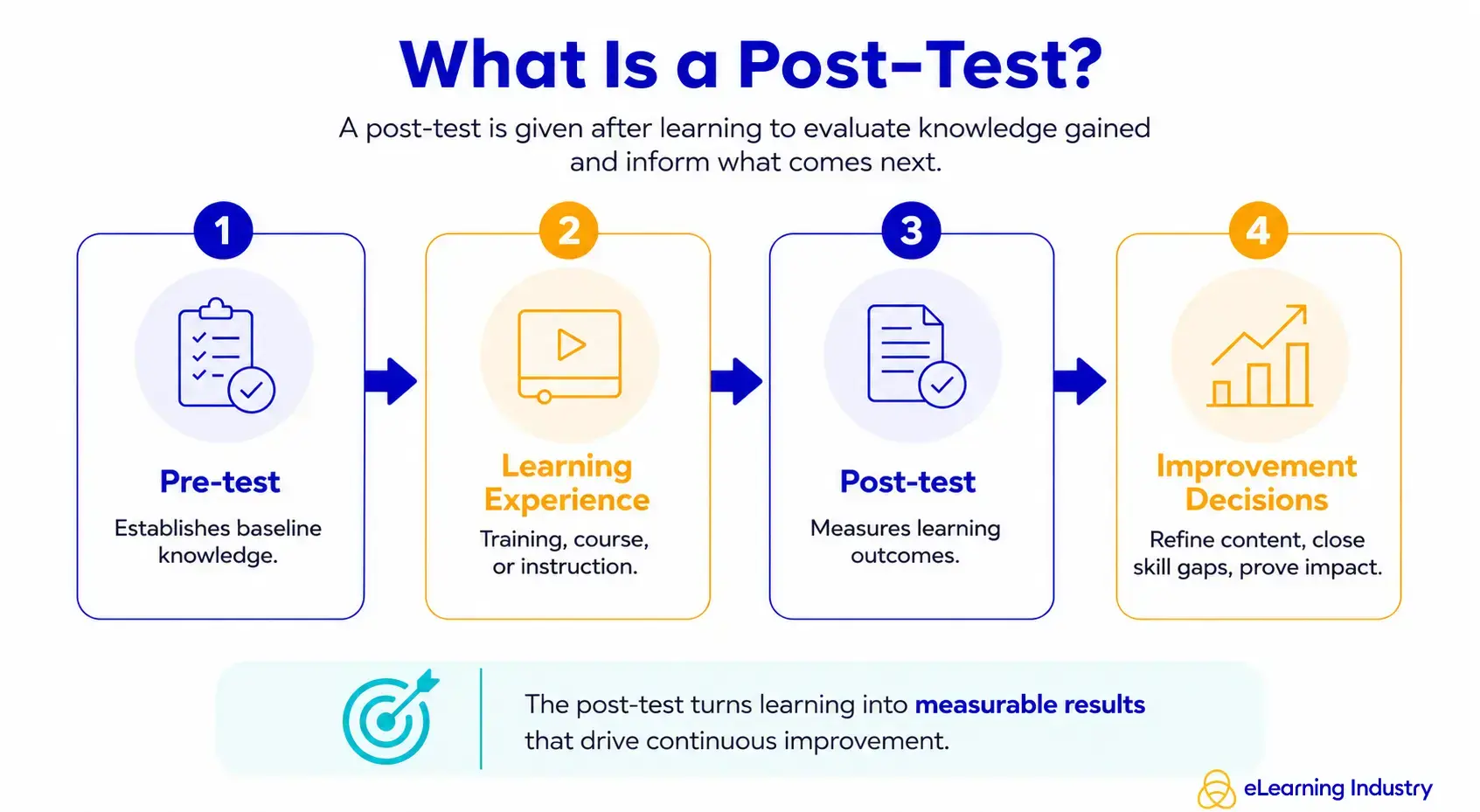

Why Organizations Use Pre-Tests And Post-Tests Together
A post-test is much more useful when combined with a pre-test. This approach lets organizations see how much learners have improved, not just what they know at the end. By using both tests, you set a starting point before training and measure what people have learned after. This makes it easier to clearly show learning progress.
Measuring ROI
For L&D leaders, comparing pre-test and post-test results is key to measuring ROI. This helps organizations track learning gains, see if training goals were met, and show the value of their learning programs. It also highlights which courses are not working, so Instructional Designers can improve them instead of just looking at completion rates.
Ongoing Improvement
Looking at trends across groups can reveal common knowledge gaps, show which learning experiences work best, and guide future program design. These insights are even more useful when combined with data from a Learning Management System, letting organizations make decisions based on real evidence.
Compliance Standards
Pre-test and post-test data can also help organizations show they meet compliance standards. In regulated industries, having proof that employees have finished training and reached the required understanding supports audits, certification, and quality checks. This also helps build a culture focused on measurable learning.
Organizations don’t gain a competitive advantage by delivering more training, but by proving that learning changes performance. Post-tests provide the evidence leaders need to invest with confidence.
-Christopher Pappas, CEO and founder of eLearning Industry
When Should You Use A Post-Test?
A post-test is most useful when you want to confirm that real learning has taken place, not just that someone finished a training. The main purpose of a post-test is to assess whether learners can demonstrate the knowledge or skills they need to succeed in real situations. Whether you are creating a post-course assessment for employees or students, make sure it matches clear learning goals and measurable results.
Compliance Training
In compliance training, a post-test is often needed to show that employees have learned important topics like HIPAA, OSHA, workplace safety, and cybersecurity. While the rules for post-tests can differ by industry and regulator, many organizations use them to prove that employees understand key policies, procedures, and legal duties.
Employee Onboarding
Employee onboarding is another good time to use a post-test. After finishing onboarding modules, a post-assessment checks that new hires understand company policies, job expectations, and key processes before they start working on their own. If you also use a pre-test, you can compare what employees knew before and after training, which helps measure how effective your onboarding is.
Leadership Development
Leadership development and product training also benefit from good post-tests. Those programs can use scenarios to check decision-making and judgment, not just memory. Sales teams can see if learners can clearly explain product features, what makes them different, and the value for customers. Certification programs also use post-tests to see if someone is ready before taking official exams.
Schools
In schools and universities, using both pre-tests and post-tests is a common way to measure learning. By comparing scores before and after teaching, educators and L&D teams can see how much students have learned, spot gaps in knowledge, and improve future training. No matter the setting, a well-designed post-test turns a simple score into useful proof that learning has led to real progress.
How To Design An Effective Post-Test
A good post-test does more than just show that learners finished a course. It also shows if they can use what they learned in real situations. Whether your assessment is for onboarding, compliance, or leadership training, the main goal is to measure real learning, not just memorization.
Match Questions To Goals
Begin by making sure each question matches a clear learning goal. If your course is about decision-making or problem-solving, your post-test should check those skills directly, not just test random facts. This way, your assessment will show if the training worked as planned.
Focus On Knowledge Application
Next, focus on how learners use what they know, not just what they remember. Facts are important, but real job performance depends on being able to understand information, make choices, and solve problems. That’s why good assessments often use scenarios that look like real work situations.
Mix Different Types Of Questions
Multiple-choice questions are good for checking basic knowledge. Scenarios, case studies, and simulations test critical thinking and decision-making. Short-answer questions let learners explain ideas in their own words, which shows how well they understand. Comparing pre- and post-test results across these formats gives a better view of learning progress.
Adjust Difficulty Level
The test should be hard enough to show who has mastered the material and who still needs help, but not so hard that it only tests how good someone is at taking tests. Looking at pre-test and post-test scores together can help you see if your assessment is set at the right level.
Use Your Assessment Data
Finally, make sure to use your assessment data. Review which questions most learners get wrong or which ones don’t show the difference between strong and weak performers. Today’s Learning Management Systems make this easier with detailed reports and analytics. These insights turn a basic post-test into a tool for ongoing improvement, helping L&D teams update content, check learning results, and improve future training.
Conclusion
Post-tests are more than just a way to check if learners remember information. When planned well, they show real evidence of learning, highlight ways to improve training, and help organizations prove the value of their learning programs. When used with pre-tests, they give a better view of how much learners have grown and support smarter decisions about training design and future programs. Instead of seeing assessments as the last step in learning, L&D leaders can use them as ongoing feedback tools to improve learning strategies, build workforce skills, and boost organizational performance over time.


