






Many a foreigner has visited England and found it an unexpectedly surreal place. Some of that effect has to do with encountering familiar icons — Big Ben, double-decker Routemaster buses, Marmite — in cold, damp reality. More of it may be induced by the country’s simultaneously thoroughgoing cultures of normality and eccentricity, an endless source of inspiration for Monty Python’s Flying Circus and much other British comedy since. Yet England came relatively late to Surrealism, or rather, Surrealism came late to England. When the International Surrealist Exhibition opened at the New Burlington Galleries behind London’s Royal Academy in the summer of 1936, the Manchester Evening News decried it as “a travesty of everything that’s decent.” Naturally, the show was a smash hit.
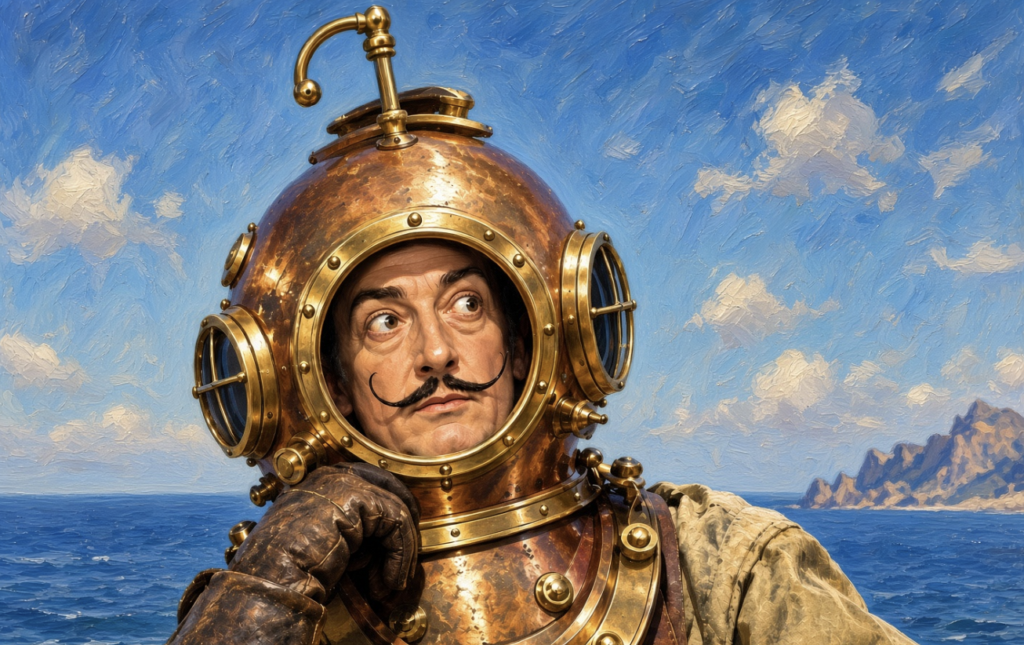
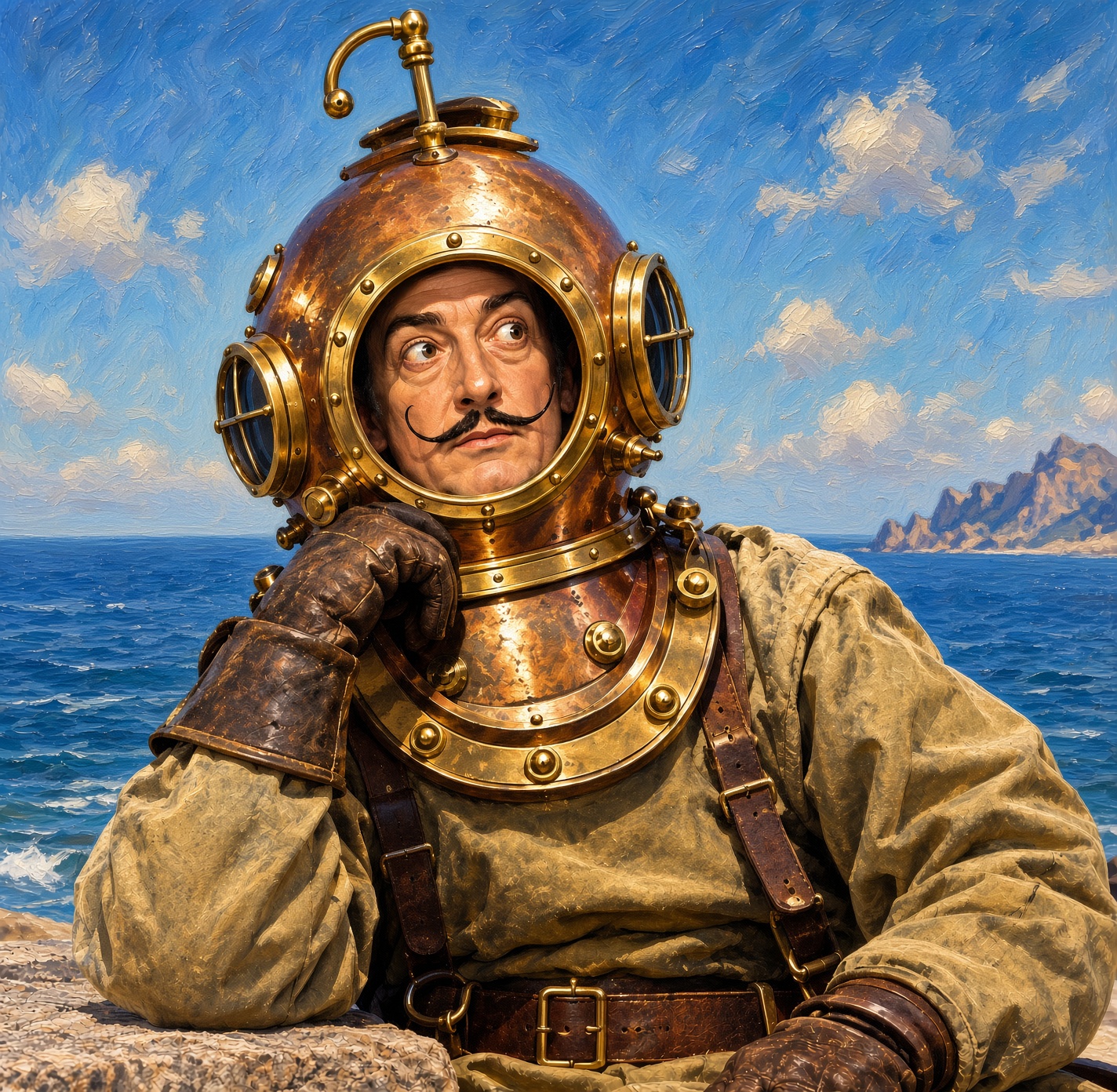
On display was work by artists including Pablo Picasso, René Magritte, Max Ernst, Alexander Calder, Giorgio de Chirico, Marcel Duchamp, Alberto Giacometti, Paul Klee, Man Ray, and Salvador Dalí, who turned up in person to deliver a lecture on “Authentic Paranoiac Phantoms.” In order to “descend to the subconscious” with a properly Surrealist literalism, he rented a diving suit and helmet from a local outfitter for his appearance. (You can see an actual image from 1936 here.) “The diving suit had extremely heavy lead shoes which I could barely lift,” he writes in his autobiography, as translated by Haakon Chevalier. “I therefore had to walk very slowly, leaning on friends who helped to move me, as though I were completely paralyzed, and thus I appeared before the audience holding two luxurious white Russian wolfhounds on a leash.”
Only after he’d been talking for a few minutes did Dalí realize that “it would be impossible for me to deliver my speech through the glass window of my helmet. Moreover, I had been shut up in this thing for ten minutes and became heated from the exertions I had made in walking across the stage to reach my chair, so that I was dripping with perspiration, and felt faint and on the point of suffocating.” With the technician who’d screwed the helmet on in the first place nowhere to be found, his wife Gala and friend Edward James worked desperately to free him, eventually taking a hammer to the bolts. “At each blow I thought I would faint.” When Dalí finally emerged, the audience, having assumed it had all been an act, “was impressed by my really deathly pallor, which constituted the accurate gauge of that Dalinian dramatic element which never fails to attend my most trivial acts and undertakings.”
As uncompromisingly as they made their declarations to change the world through sheer force of nonsense, the Surrealists also understood that the show must go on. Dalí moved on to the visual portion of his lecture, presenting slides out of order and, for the most part, upside down. This was just one of the attractions with which the International Surrealist Exhibition drew 30,000 visitors during its three-week run, and “had it not been for the gathering storm clouds of war in Europe,” writes the Guardian’s Joanna Moorhead, “it might have gone on to achieve far more.” The old English intolerance for Gallic self-seriousness would also have made things difficult for Surrealism as the likes of Dalí, Duchamp, and André Breton conceived it. Or perhaps the domestic variety was simply enough: as critic and poet Herbert Read puts it in the exhibition’s catalog, a nation that has produced both William Blake and Lewis Carroll is to the manner born.
Related Content:
When Salvador Dali Met Sigmund Freud, and Changed Freud’s Mind About Surrealism (1938)
When Salvador Dalí Created a Surrealist Funhouse at New York World’s Fair (1939)
Salvador Dali Gets Surreal with Mike Wallace (1958)
Based in Seoul, Colin Marshall writes and broadcasts on cities, language, and culture. He’s the author of the newsletter Books on Cities as well as the books 한국 요약 금지 (No Summarizing Korea) and Korean Newtro. Follow him on the social network formerly known as Twitter at @colinmarshall.


