






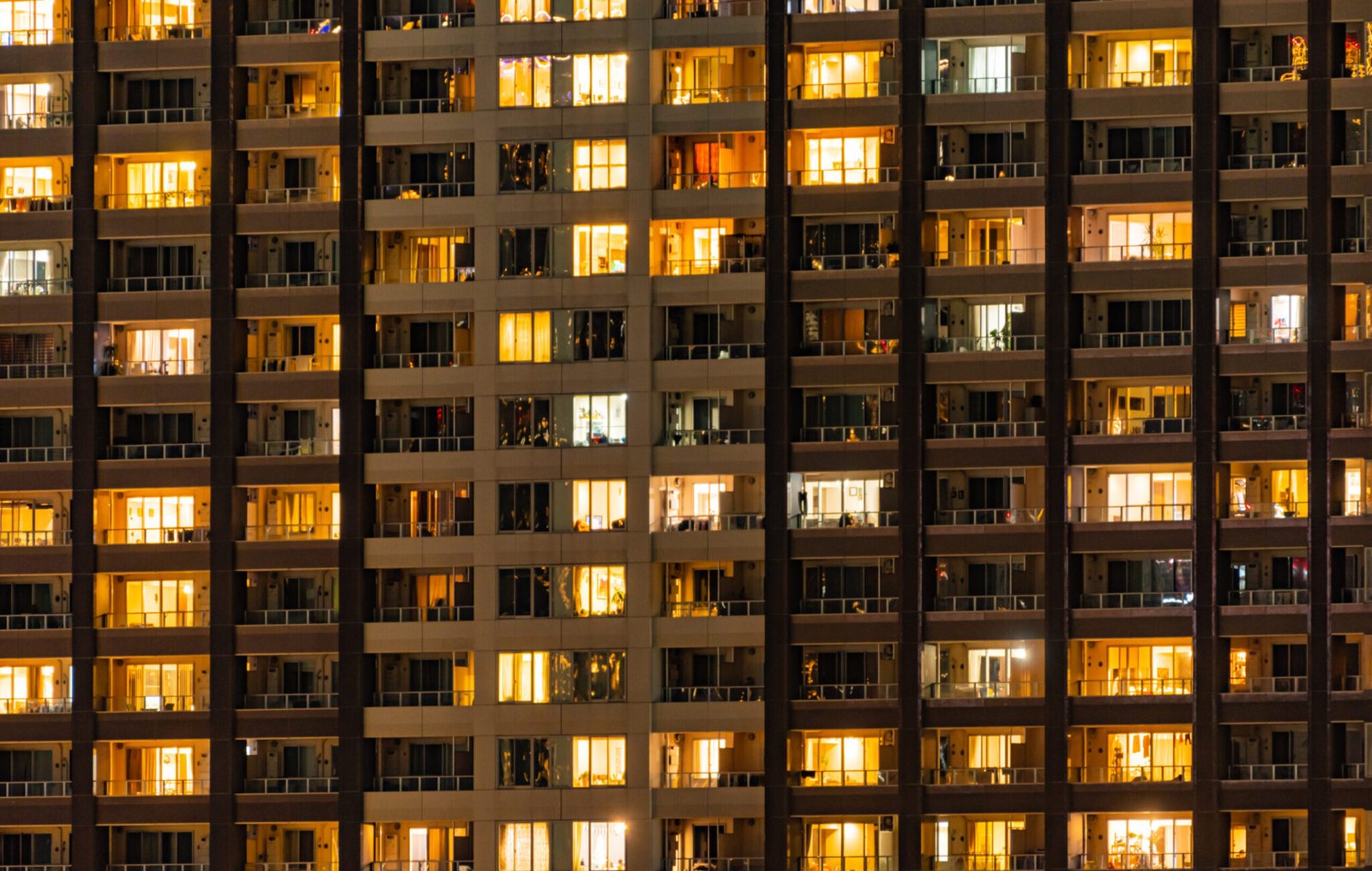
Imagine it’s January in New York and you’re sharing a tiny apartment with two roommates. The walls are crumbling around you, and there’s a hole in your bedroom wall big enough to see outside. Every time it rains or snows, water drips into your room. You call your landlord to fix it over and over again, but nothing happens.
This is reality for many New Yorkers. This degradation is the predictable result of decades of housing policy that has kept supply scarce and left rent-regulated buildings to decay. Many people blame it on big-city life, but lessons from Tokyo show us that it doesn’t have to be that way.
Tokyo Metropolis is home to about 14.27 million people, far more than New York City’s roughly 8.5 million. Yet renting in a city not quite twice the size costs a fraction of what it does in the biggest city in the US.

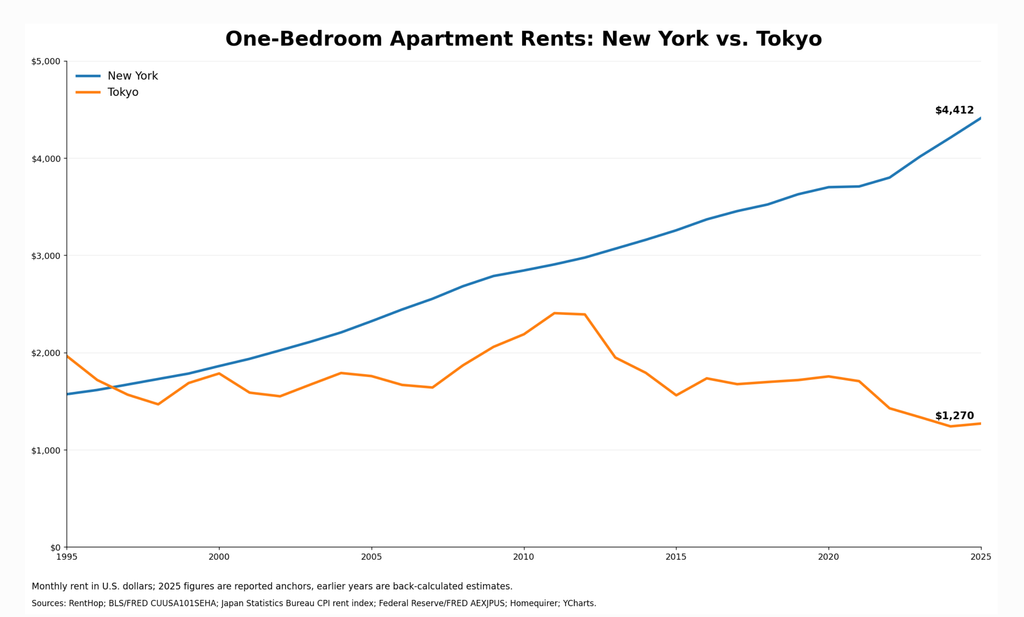
In the mid-1990s, a one-bedroom apartment in Tokyo cost about the same as one in New York, a little less than $1,000 a month. By 2025, a New York one-bedroom averaged about $4,400 per month, while a Tokyo one-bedroom ran about $1,270. A weaker yen explains part of that gap, but even in yen, Tokyo rents barely moved in 30 years while New York’s rents nearly tripled.
Housing prices ultimately come down to supply and demand. So how has Tokyo managed to keep housing relatively affordable, while New York has struggled to do the same?
Tokyo has been focused on keeping up with demand; its housing stock nearly tripled between 1963 and 2013, reaching 7.36 million homes. To do this, Japan keeps zoning flexible. Instead of limiting each area to a single use, zoning allows homes, shops, and light industry to coexist on the same blocks. Projects that follow these rules can be built “as-of-right,” without discretionary review or giving neighbors the power to block them.
Japan’s zoning rules are uniform across the country. The national government defines 13 standard zones instead of leaving land use to individual neighborhoods. That top-down approach cuts both ways, however, since a national system could tighten rules as easily as loosen them, but Japan’s has repeatedly loosened them to allow more housing.
New York City’s zoning works in nearly the opposite way. A site-specific rezoning goes through the Uniform Land Use Review Procedure, a review so onerous that about 40 percent of private rezoning proposals fail to get approved. About 27 percent of Manhattan’s lots are under restrictive landmark regulations, and historic districts see new buildings at about one-sixth the rate of other lots.
Then there are the empty NYC apartments. The 2019 Housing Stability and Tenant Protection Act capped rent increases on vacant rent-stabilized units and limited how much renovation cost landlords can recover. When a $700-a-month unit needs $100,000 of work to meet code, many owners leave it empty; this helps explain why nearly 57,000 rent-stabilized apartments were empty in 2025.
Continuing their stance of flexibility, Tokyo has allowed smaller apartments to be built. A typical one-bedroom is about 430 square feet, compared with 590 for a New York one-bedroom. Smaller apartments lower the barrier to entry for single renters and young professionals to get their own place.
New York spent decades making small units hard to build through a 400-square-foot minimum rule dating to 1987 and zoning rules called the “Dwelling Unit Factor” that forced large average unit sizes. The “City of Yes” amendment only eased those rules in December 2024, after decades of limiting the kinds of smaller, cheaper apartments Tokyo builds routinely.
Buildings in Japan also turn over faster. Japan’s tax code depreciates a wooden house over 22 years, and the average Japanese home is demolished at about 32 years old, versus roughly 70 in the US. Old stock gets replaced with newer, denser buildings instead of being preserved indefinitely.
Japan’s inclusive regulations result in much more building. Tokyo averaged about 155,000 housing starts a year from 1995 to 2015 and still starts roughly 130,000 annually; New York, by contrast, added roughly 50,000 in 2025. Since the 1960s, Tokyo’s stock has nearly tripled while New York’s has grown only 20 to 30 percent.
Factory-built homes also help ease supply constraints. One Japanese Sekisui House plant produces about 20 houses a day, and roughly 13 percent of new Japanese homes are prefab or modular. New York has only recently started experimenting with modular construction, and it remains a small share of the city’s building, far behind Japan.
To be fair, Tokyo isn’t cheap by Japanese standards, but it has accommodated millions without New York-style crumbling buildings and vacant units. New York is moving the other way: Mamdani’s Rent Guidelines Board froze rents for roughly one million stabilized apartments. The freeze helps current tenants but creates no new homes, and analysts expect more units to sit empty as prices for non-stabilized apartments keep rising.
The renter watching snow blow through the hole in her bedroom wall won’t be saved by another year of frozen rent. Instead of doubling down on the policies that brought scarcity, dilapidated apartments, and sky-high rents, New York could take a lesson from Tokyo, where the way to make housing affordable has been to make a lot more of it.


