








This year’s Metro Manila Film Festival boasts of a lineup of films that—finally—have begun focusing on quality as much as commercial value. While it has received criticisms over the years for fielding in entries that cater to the moviegoing masses, critical acclaim be damned; the past few years have seen the festival slowly regaining its footing.
The films this year range from family dramas and your standard Filipino thrillers, to dramedies and musicals. Below, I write a few thoughts on Pepe Diokno‘s musical-drama film, Isang Himala (lit. ‘A Miracle’).
More MMFF Coverage: ‘And the Breadwinner Is…‘
A Transcendent Revival for a New Era
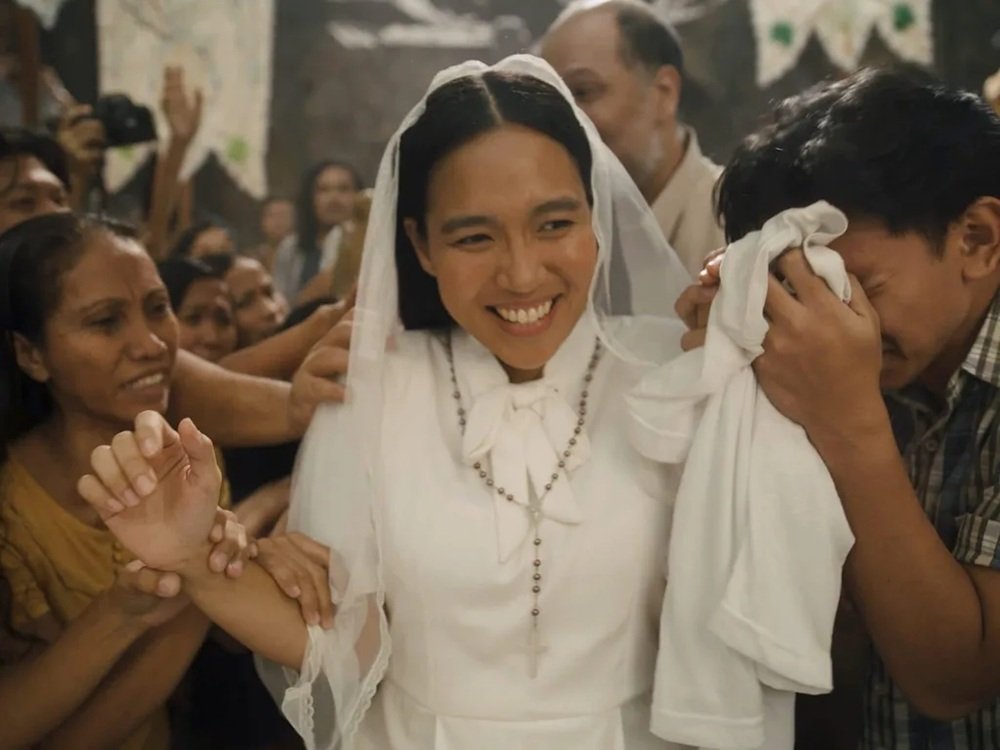
There’s a scene in Isang Himala (lit. ‘A Miracle’) where Elsa, played by the formidable Aicelle Santos, looks up at the heavens by her window and pleads, her voice cracking with emotion: “Madaya ka! Ako’y kausapin mo!” (“You are so unfair! Talk to me!”).
This moment, inspired by the original 1982 film Himala, is both familiar and profoundly new. While Nora Aunor’s portrayal of Elsa remains iconic, Santos doesn’t attempt to mimic Aunor’s performance. Instead, she reinvents Elsa for a new generation, her voice—a mix of vulnerability and defiance—making the character wholly her own.
Director Pepe Diokno’s adaptation of the 2018 theatrical play retains the soul of Ishmael Bernal’s original work while breathing fresh life into it. In doing so, Isang Himala avoids the pitfalls of being either too reverent to its predecessor or overly indulgent in modern cinematic excess. By using music as a haunting dissection of the fragile, fault-ridden edifice we call faith, Diokno’s vision ensures the story resonates as both a tribute to its roots and a cinematic experience in its own right.


Music and Performance: Isang Himala’s Potent Combination
The musical adaptation owes much of its emotional power to Vincent de Jesus’ music and Ricky Lee’s masterful lyrics (Lee also wrote the screenplay for the original film based on his own story). The songs are not mere embellishments but essential threads in the narrative, capturing the tumultuous emotional landscape of Cupang, the barren village where Elsa (Santos) claims to have witnessed a Marian apparition.
What’s particularly striking in Isang Himala is the range of musical styles, reflecting the diversity of Original Pilipino Music (OPM). From guitar-heavy rock anthems to introspective piano ballads and tender acoustic duets, the score mirrors the contradictions of Cupang itself—its hopes and fears, its beauty and desolation. Santos’ monologue-turned-song, questioning divine intervention, is a highlight, her voice trembling with anguish and defiance.
Personally, however, Kakki Teodoro’s portrayal of Elsa’s worldly and fiercely loyal friend Nimia is a standout. She delivers a haunting performance that refuses to be overshadowed, with her reprise of “Ako’y Mayroong Kuwento” (lit. ‘I Have a Story’) being a masterclass in emotional storytelling. Teodoro’s ability to layer vulnerability and quiet strength has stayed with me even as I write this review. Without question, hers ranks among the top acting performances in Philippine cinema this year.
Diokno’s Masterful Direction in Tackling Themes of Faith and Human Fragility
Diokno’s directorial choices elevate Isang Himala beyond a straightforward adaptation. His understanding of the material is evident in the way he translates a play steeped in theatricality into something distinctly cinematic. The studio soundstage may draw from the sensibilities of stage design, but Diokno’s camera reframes these elements, transforming them into a stark, almost mythical landscape that amplifies the story’s allegorical weight.
The decision to lean into a stylized aesthetic rather than relying on real-world locations honestly strikes me as limiting, though I have to acquiesce to its undeniable purpose. By embracing the abstract, Diokno directs our focus inward: onto the characters, their struggles, and the broader existential questions the film poses. His innovative storytelling ensures the film doesn’t feel like a pro-shot of a stage play but a fully realized reimagining that harnesses the intimacy of theater and the grandeur of cinema.
What makes Isang Himala so compelling is its ability to preserve and deepen the core themes of the original. Elsa’s followers are a microcosm of a society in crisis, desperate for salvation yet quick to exploit and condemn. The film’s critique of blind faith and mass hysteria feels even more pressing in today’s polarized world, where belief—whether in religion, politics, or social movements—can unite and divide with equal ferocity.
The film doesn’t stop at exposing these flaws; it instead interrogates the human condition with empathy. Elsa, Nimia, and the villagers are not villains or heroes—they are reflections of us all, shaped by poverty, pain, and the universal longing for something greater. The barren landscape of Cupang, rendered both literal and symbolic, becomes a stage for these themes to unfold with devastating clarity.

Of the Technical Merits’ Strengths and Shortcomings
Of course, no film is without its imperfections. For one, the uneven sound mixing bothered me, which occasionally diminishes the impact of its most poignant numbers. There are moments where the orchestration or crowd chorus overshadows the lead vocals, disrupting the emotional flow. Conversely, some scenes suffer from muted musical swells, as if hesitant to fully embrace their power. Nevertheless, these technical hiccups, while noticeable, are far from dealbreakers, as the performances and storytelling shine through regardless.
Also, as I’ve noted above, the production design might also divide viewers. By retaining a theatrical sensibility, the sets risk feeling confined when compared to the expansive realism one might expect from a film adaptation. For what it’s worth, while I can understand the desire for more immersive, location-based visuals, I find Diokno’s choice to embrace abstraction fitting. The barren simplicity of the sets serves as a visual echo of the story’s themes—emptiness, yearning, and the search for meaning.
More MMFF Coverage:‘Espantaho‘ and ‘Uninvited‘
‘Isang Himala’: A Timeless Search for Miracles
What ultimately sets Isang Himala apart is its willingness to confront uncomfortable truths while embracing the beauty of imperfection. Santos, in her towering performance, doesn’t just play Elsa. Instead, she inhabits her, carrying the weight of a village’s hope and despair with searing authenticity. Similarly, Teodoro, as Nimia, anchors the film’s emotional core, her portrayal a testament to the strength and resilience of those who stand on the margins.
Diokno’s direction ensures the film feels contemporary without losing its timeless relevance. By marrying the intimacy of theater with the expansiveness of cinema, he crafts a work that bridges past and present, challenging us to reckon with the same questions that haunted audiences in 1982. Where do we place our faith? How do we confront the void when miracles fail us? Have we finally learned to act upon what we listened to and heard?
Isang Himala doesn’t promise answers, but it offers a deeply human exploration of these questions. It’s not just a retelling—it’s a renewal, a film that reminds us why stories like Elsa’s endure. They are not about the miracles we seek in others; they are about the truths we find in ourselves.


A self-described cinephile who can’t stop talking—and writing—about films. Paul also moonlights as ghostwriter and editor for a few memoirs. He currently resides in the Philippines.


