





“Its location at the edge of the solar system makes it a bit of a black hole from a knowledge point of view,” Dr. Craig O’Neill once said of the planet

:max_bytes(150000):strip_icc():format(jpeg)/Neptune-in-Space-092326-e98344333adf42c5abc4a3f05ff4f58f.jpg "Neptune in space")
Credit: The Image Bank Unreleased/Getty
NEED TO KNOW
- 180 years ago, astronomer Johann Gottfried Galle discovered Neptune using mathematical prediction
- Since it takes slightly less than 165 Earth years for Neptune to orbit the Sun, the planet has only completed one since its discovery
- Hundreds of years before its official discovery, Galileo first recorded the planet in his notebook as a star
Despite being discovered by astronomer Johann Gottfried Galle in 1846, Neptune has only celebrated one birthday since then.
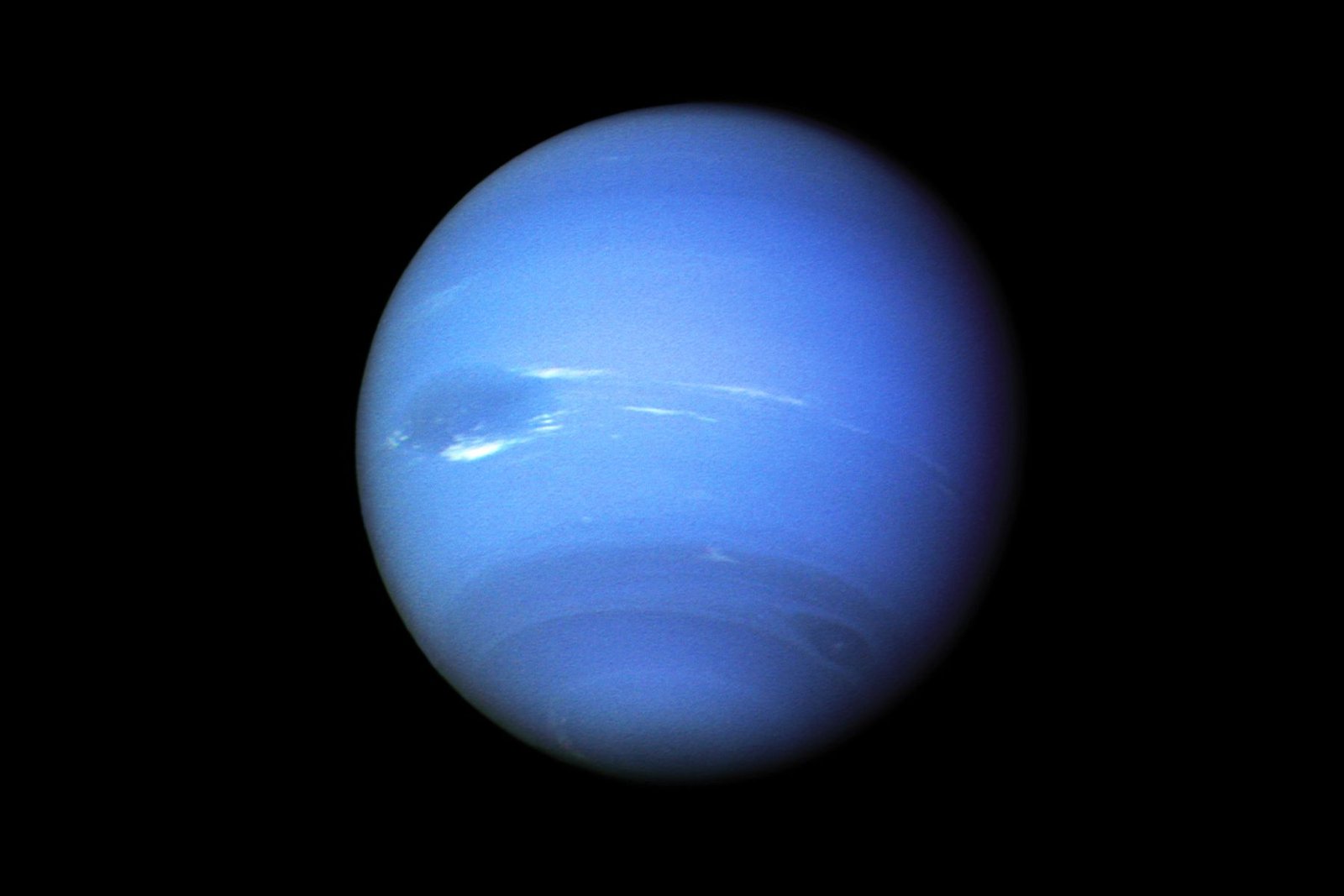
Neptune, the third largest planet in our solar system, was found and identified as a planet 180 years ago — a discovery that came over 200 years after Galileo first recorded it in his notebook as a star.
“Its location at the edge of the solar system makes it a bit of a black hole from a knowledge point of view,” Dr. Craig O’Neill, a planetary scientist at Sydney’s Macquarie University, told the Australian Broadcasting Corporation back in 2011. “From Neptune, the Sun looks like a point of light no brighter than Venus does from Earth.”
Given its distance from the Sun, Neptune takes far longer to complete a single orbit than Earth does.
A single year on Neptune lasts just under 165 Earth years. As a result, since its discovery in 1846, Neptune has only celebrated one birthday, which it did in 2011.
While Neptune was the second planet in history to be discovered, the way it happened remains even more significant.
After William Herschel discovered Uranus with a homemade telescope in 1781, astronomers eventually began to realize that another huge planet was likely pulling on it, causing Uranus to deviate from its predicted course based on Newton’s laws of motion and gravitation, according to Time.
Never miss a story — sign up for PEOPLE’s free daily newsletter to stay up-to-date on the best of what PEOPLE has to offer, from celebrity news to compelling human interest stories.
On Nov. 10, 1845, French astronomer Urbain Jean-Joseph Le Verrier shared his findings after investigating the whereabouts of the undiscovered celestial body, per The Weather Network. Ultimately, he located Neptune within a single degree of its discovery position.
After Le Verrier mailed his findings to Galle at the Berlin Observatory, Galle immediately started looking for the body with one of his students, Heinrich Louis d’Arrest, who suggested comparing a newly drawn chart of the sky with the current sky to highlight any discrepancies.
And just like that, Neptune became the first planet to be discovered through mathematical predictions.
In addition to being more than 30 times farther from the Sun than Earth, the planet is known for being dark, cold and whipped by supersonic winds, according to NASA. It is also the only planet in our solar system that is not visible to the naked eye.
In comparison to Earth’s wind speeds that reach a maximum of around 250 miles per hour, Neptune’s winds whip clouds of frozen methane across the planet at speeds of more than 1,200 miles per hour.
“Given Uranus has fairly mild winds, Neptune’s dynamics are a mystery,” O’Neill previously told the Australian Broadcasting Coorporation. “One idea is that if you put methane under enough pressure deep in Neptune’s atmosphere, it could convert to diamond which would fall as rain. This conversion process releases heat which could power the winds.”
“That’s a little more speculative,” he added, “but speculation is all we’ve got.”


