





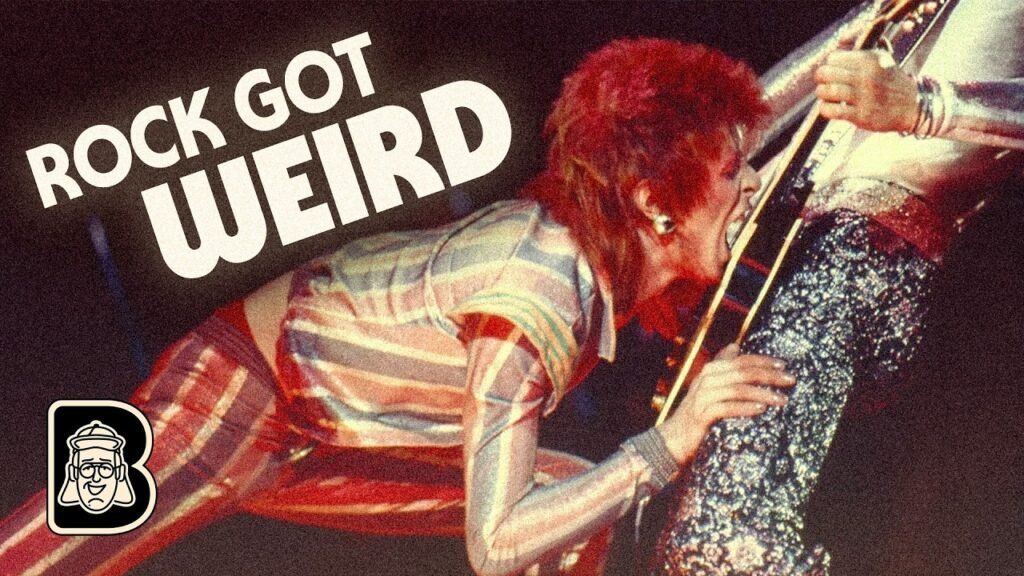

Cast your mind back to the distant year 2021 and recall, if you will, its music, its fashions, the obsessions of its youth. This probably won’t be a difficult task, since in most respects — the dampening effects of the pandemic notwithstanding — none of those aspects of popular culture seem any different today. Yet roughly the same time span separated Scott McKenzie’s “San Francisco (Be Sure to Wear Flowers in Your Hair)” and David Bowie’s “Starman.” 1967 was the year of the Summer of Love; by 1972, according to most reckonings, the cultural era known as the Sixties was, if not quite over, then at least clearly in its final days. The hippies were on their way down, and glam rockers had arisen to take their place with a vengeance.
In less than half an hour, the new video from Bandsplaining tells the whole story of glam rock, “the gender-bending proto-punk movement that was hated by the press and criminally underplayed in the U.S.” It begins in the 1970s, a time when the market for long-playing records was robust, but singles had fallen behind as a youth-oriented pop-cultural form.
Into that vacuum stepped T. Rex, a onetime avant-garde folk duo reinvented as a straight-ahead rock band bent on reviving that genre as it rowdily was before the Beatles came along. When they hit it big, other acts imitated not just their bluesy sound, but the androgynous, brazenly fabrication-forward image of frontman Marc Bolan. Practically overnight, the name of the game changed from earnest self-expression to outlandish self-creation.
Other bands reshaped by this glam rock movement, as it was soon dubbed in the British media, included Slade, The Sweet, and Mott the Hoople. “My brother’s back at home with his Beatles and his Stones,” sang that last outfit in their breakout hit. “We never got it off on that revolution stuff.” That song, “All the Young Dudes,” had been written by the single most defining glam-rock figure: David Bowie, who himself shot to prominence in the thoroughly anti-Sixties guise of Ziggy Stardust, the bisexual, synthetics-clad rocker from outer space who swaggered as if already famous across the universe. Within a few years, Bowie’s antenna for the zeitgeist would have him retiring Ziggy Stardust and ditching glam rock, a genre whose flame burned as brilliantly — and indeed garishly — as it did briefly. But in pop music, its characteristic lack of sociopolitical ideals, obsession with fame, and casual relationship with reality were here to stay.
Related content:
David Bowie’s Final Gig as Ziggy Stardust Documented in 1973 Concert Film
Freddie Mercury: The Untold Story of the Singer’s Journey From Zanzibar to Stardom
The History of Rock Told in a Whirlwind 15-Minute Video
Based in Seoul, Colin Marshall writes and broadcasts on cities, language, and culture. He’s the author of the newsletter Books on Cities as well as the books 한국 요약 금지 (No Summarizing Korea) and Korean Newtro. Follow him on the social network formerly known as Twitter at @colinmarshall.


