


What Does The Rise Of AI Mean For Jobs?
Are you wondering if your job is safe from AI? You’re not alone. According to the World Economic Forum, about 85 million jobs could be replaced by automation and Artificial Intelligence by 2025. So, it’s no wonder people everywhere are concerned about the future of their careers. After all, AI has become part of our everyday lives and online interactions in many ways. From chatbots answering your questions online to robots assembling products in factories, AI systems are getting better and smarter at doing tasks.
But will AI replace your job? Well, there’s not a definitive answer to that. The way we work is changing. Some industries are seeing huge changes due to AI, while others are adapting. Understanding what the data really says about AI’s impact on jobs can help you stay prepared, not panicked. Below, we’ll show you the evolution of AI in the workplace, some surprising statistics about AI and job replacement, and even address common myths to help you see things clearly.
AI In The Workplace Over The Years
Long before AI was what it is now, industries were already considering integrating machines to replace human labor. The first step was during the Industrial Revolution in the 18th and 19th centuries. Back when steam-powered machines started taking over manual work in factories, people feared they would be left without jobs. Then, in the 20th century, the rise of computers caused similar concerns. But history has shown us that while some jobs disappeared, new ones always emerged. This is bound to happen with AI as well.
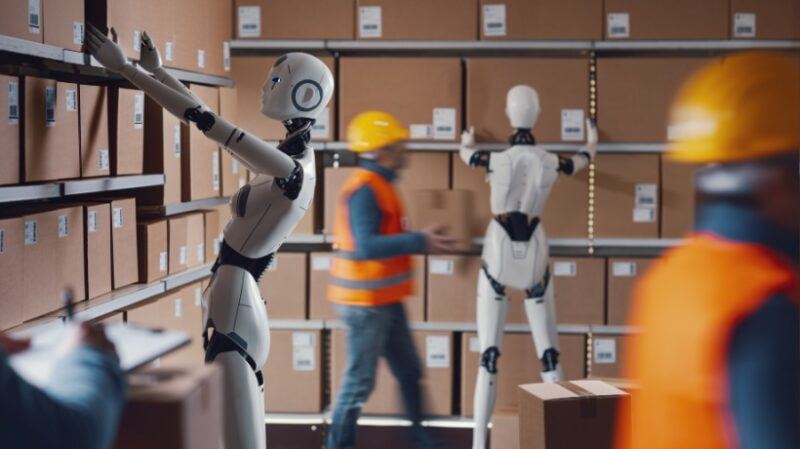
However, this evolution is a bit different because today’s AI is much smarter. Algorithms can learn patterns, solve problems, and even have conversations. Generative AI tools can write articles, generate code, create realistic images, and much more. In some industries, robots can pack orders, move products, and do quality control. In offices, AI schedules meetings or analyzes reports. Even in customer service, AI chatbots are answering queries 24/7, often solving problems before a human intervenes. But rather than replacing people, AI is working alongside them, taking care of repetitive tasks so employees can focus on the meaningful ones. So, no, AI isn’t fully replacing jobs yet, but it is changing how we do them.
20 AI Job Replacement Statistics That Clear The Picture
When we actually look at the data, we can see that while AI is automating certain tasks, it’s also creating entirely new roles and industries that didn’t exist before. So, let’s explore some statistics to understand what’s really happening with AI and jobs.
Global Statistics On The Effect Of AI On Jobs
1. As we mentioned above, according to the WEF’s findings, by 2025, AI and automation are expected to displace 85 million jobs worldwide.
2. However, WEF also predicts that 97 million new jobs will be created in new fields and industries.
3. McKinsey & Company estimates that about 400–800 million individuals globally may need to change occupations by 2030 due to automation.
4. PwC predicts that up to 30% of jobs may be automated in some countries by the mid-2030s. However, they also claim that countries that adopt automation could experience overall economic growth and increased productivity.
5. The International Monetary Fund (IMF) warns that while automation may increase inequalities between skilled and unskilled workers, it also creates opportunities for better-paying jobs if people receive the necessary training.
6. According to the Organization for Economic Co-operation and Development (OECD), countries with a higher number of routine tasks could experience AI replacing jobs. Their research shows that in some countries, 14% of jobs could be completely automated, while an additional 30% could experience significant changes in their tasks.
Industry-Specific Statistics About AI Job Replacement
7. In the manufacturing sector, robotics and AI replaced 270,000 jobs, while 94,000 new roles in machine maintenance and systems monitoring were added.
8. In Amazon’s warehouses, there’s one robot per human worker. These robots work in the fulfillment centers, sorting packages and stocking shelves.
9. By 2030, about 15% of work hours in the healthcare sector could be automated by AI, which can free healthcare workers and doctors from routine tasks. Therefore, this doesn’t result in job loss but rather a change.
10. Retail cashiers face a 38% job replacement in stores with self-checkout AI.
11. Australia has automated 34% of repetitive office jobs in finance, while New Zealand has automated only 18%. Tasks such as fraud detection can now be done with systems and algorithms, but human intervention is still needed.
12. AI automation has replaced 28% of billing and scheduling roles in healthcare administration. Nevertheless, thanks to AI, there are 14% more roles in data handling, audit, and compliance tech.
Other Findings
13. A study by McKinsey & Company found that about 60% of routine tasks, such as data entry, payroll processing, and appointment scheduling, could be automated, compared to only 12% of technical tasks. This means jobs like office employees, bookkeepers, and administrative assistants are nearly five times more likely to be replaced by AI than engineers or developers.
14. On the other hand, jobs relying on empathy, emotion, and social interaction are far safer from automation. According to an OECD report, careers like teaching, therapy, social work, and the arts have less than a 10% likelihood of being replaced by AI. Why? They require problem solving, connection, and emotion, all skills AI will probably never achieve.
15. Many AI systems don’t replace humans but work together with them. The World Economic Forum reports that in over 60% of cases where AI is introduced, it assists human workers rather than replaces them. For example, journalists use AI to draft articles faster, cybersecurity teams rely on AI to detect threats, and healthcare providers use AI tools for faster diagnostics, allowing them to focus on decision making and patient care.
AI Job Replacement Stats Based On Different Regions
16. According to the World Bank, up to 55% of jobs in developing countries could be replaced by AI in the coming decades. Countries in Southeast Asia, Latin America, and Sub-Saharan Africa, where manufacturing is a primary source of income, must balance economic growth with the rise of automation in industries like textiles, automotive, and electronics.
17. On the other hand, in developed countries like the US, UK, and Germany, office roles are more likely to be automated first. The OECD estimates that up to 40% of administrative jobs in advanced economies could be partially or fully automated in the next 10–15 years.
18. The European Union is really cautious about AI. With policies like the EU AI Act, Europe prioritizes ethical AI and worker protection. For example, AI adoption in manufacturing in the EU is about 15–20% slower than in the US and China. This means that European workers are less likely to have their jobs replaced by AI.
19. Countries like China and South Korea are moving forward fast with AI. China has some government-led projects, aiming to become the biggest AI economy in the world by 2030, which could mean millions of new tech jobs. Meanwhile, South Korea is investing heavily in robotics and already has the highest number of robots in manufacturing, with over 1000 robots for every 10,000 workers, according to the International Federation of Robotics.
20. The IMF warns that adopting automation could increase the gap between rich and poor countries. Developed nations have the resources and education to help workers move into new jobs. In contrast, developing countries may find it hard to provide proper training. The IMF predicts that, without help, the productivity gap between wealthy and lower-income nations could grow by up to 20% by 2040.
Conclusion
So, is AI taking over jobs or just changing them? To answer that, we must see this new change from an evolutionary point of view. Like past tech changes, new roles are being created, like AI trainers, prompt engineers, and data scientists. The key for workers in all industries is to keep learning and build both hard and soft skills. As far as businesses are concerned, they need to adopt AI responsibly and support their teams with training. Governments also play a role by creating policies that help people reskill and adapt. Overall, you shouldn’t panic. Instead, focus on staying adaptable, working with AI, and always keep on training.
