


The desire to ban hate speech is often framed as simply about being nice. In a recent segment on Germany’s laws against “hate speech,” 60 Minutes host Sharyn Alfonsi explained what the German state is doing to promote more positive discourse online.
“Germany is trying to bring some civility to the World Wide Web by policing it in a way most Americans could never imagine,” Alfonsi said. “In an effort, it says, to protect discourse, German authorities have started prosecuting online trolls.”
Richard Delgado and Jean Stefancic argue that bans on hate speech are simply about protecting people (especially minorities) from online harm or bigotry. Fueled by this belief, attempts to ban hate speech are on the rise. Germany prosecutes thousands of people per year for insulting other Germans in person or even online.
These policies are even gaining support in the United States. Congresswoman Jasmine Crockett (D-TX) recently suggested that there are limits to free speech, and that one of those limits was that free speech couldn’t be hateful.
Last year, then-vice-presidential candidate Tim Walz put it more bluntly. When JD Vance accused him of saying that, “There’s no First Amendment right to misinformation,” Walz nodded along, adding, “Or threatening, or hate speech.” More and more politicians are comfortable with the idea that bans on hate speech might not be such a bad thing.
It’s not just politicians. A 2022 Pew survey found that 62 percent of American teens believed that “People being able to feel welcome and safe online” was more important than “People being able to speak their minds freely online.”
But the noble intentions of the advocates of these laws aside, bans on hate speech rarely take us anywhere good. Hate speech is certainly a problem, but laws banning hate speech represent a cure far worse than the disease.
Why? For one thing, ‘hate speech’ is a stubbornly nebulous term. One person’s hate speech (for instance, calling the president an “idiot”) is another person’s righteous truth-telling. So every time a ban against so-called hate speech is passed, we should ask ourselves: who will get to decide what qualifies as hate speech?
Invariably, the answer to that question is: the wealthy and powerful, because they’re the ones who write and enforce the laws. Last year, comedian Konstantin Kisin spoke to Imran Ahmed, CEO of the Center for Countering Digital Hate, about hate speech bans in Great Britain. Ahmed called Kisin a “dickhead.” Kisin rejoined that that kind of insult “might be considered hate speech,” to which Ahmed responded, “No…it’s just a good observation.” Apparently it’s only hate speech if it’s directed at people whom Ahmed likes.
The same lesson can be seen in the case of a French woman arrested in 2023 and fined 12,000 euros for insulting French President Emmanuel Macron. What constitutes hate speech is defined by people in power, and so in practice it often means whatever speech the people in power find offensive.
The great free-speech champion Eleanor Roosevelt warned about this over 60 years ago. In the wake of World War II and the worst atrocities the modern world had ever seen, many in Europe wanted to ban hateful speech. Roosevelt warned that, “any criticism of public or religious authorities might all too easily be described as incitement to hatred and consequently prohibited.”
The question of who gets to decide what constitutes hate speech is especially poignant in the United States, where power changes hands every four to eight years. We should be leery of giving elected officials on “our team” power over what we can and cannot say, since in a few short years that power will probably be wielded by our political opponents.
Hate speech laws also cause harm far disproportionate to the harm that they seek to mitigate. There’s nothing fun about being called hateful slurs or told to go die; but in Germany, fines for an insulting meme can run thousands of euros. Alfonsi revealed that one typical fine was 3,750 euros (about $3,900), and repeat offenders can be sentenced to prison. Imagine the state slapping a struggling single mother with a 3,750 euro fine because she posted a meme online. How would that be justice?
And in Germany, the bar for what constitutes hate speech is staggeringly low. German prosecutors agreed that it would be illegal to call someone a “jerk” or an “idiot.” Being called a “jerk” online might sting, but it’s hardly worth taking food from the mouth of a struggling family over.
In the 60 Minutes segment, there’s a particularly chilling exchange where the German prosecutors laugh about taking someone’s phone and laptop after they post an insensitive meme. Why? Because, as Alfonsi says of this authoritarian law, “your whole life is typically on your phone now.”
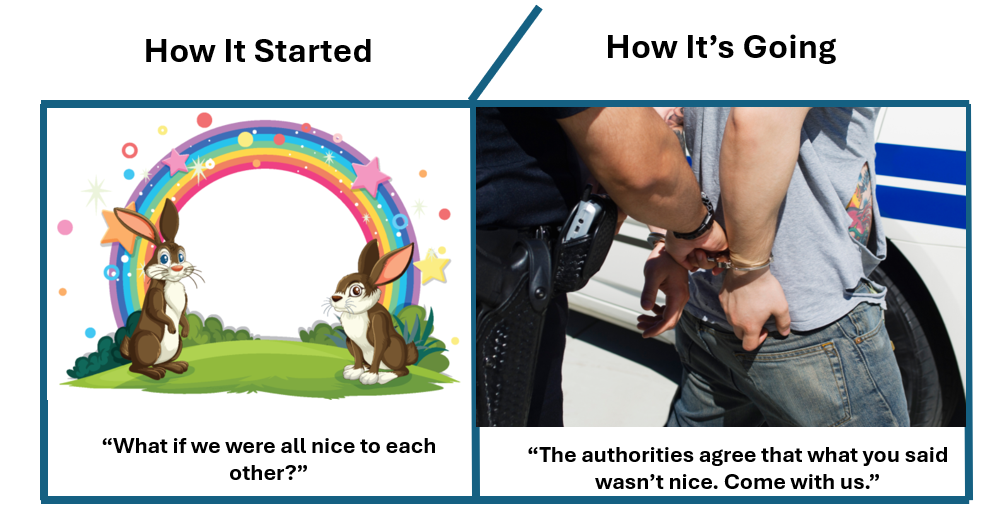
I’m reminded of the “How it started / how it’s going” brand of online meme. The idea is to showcase how something starts, and the (sometimes inauthentically) noble intentions of the advocates of a given policy; as contrasted with what the policy actually looks like when it’s implemented. Laws against hate speech might start with noble intentions and soaring rhetoric about how we should all be nice to each other. But in practice, they end up with prosecutors laughing about taking someone’s phone (which includes, for instance, the victim’s ability to contact her family) because the person said something online that the prosecutors didn’t like.
So if laws banning hate speech aren’t the answer, what can we do about hate speech? The harm from hate speech is real. But the answer isn’t to ban a nebulous category of speech, which will invariably be defined by those in power. Instead, maybe we should all embrace that old adage, “Sticks and stones may break my bones, but words will never hurt me.”
Cultivating emotional resilience is especially important for those in power. In the 60 Minutes segment, German politician Renate Künast complains that some online commenters attributed a fake quote to her, and argued that protecting herself from such disinformation was essential. If elected officials had to deal with people making things up about them, she warns, “no one would go for these jobs, you know? That would harm democracy.”
The Founding Fathers knew better. The First Amendment represents a vital check on government power, and the kinds of politicians who rail against this check are perhaps the kind who shouldn’t be trusted with power in the first place.
If we want to know what it looks like to live in a society without the First Amendment, another quote from Alfonsi offers a chilling example. Describing how Germany prosecutes online trolls, Alfonsi says, “it often begins with a pre-dawn wake-up call by the police.”
