

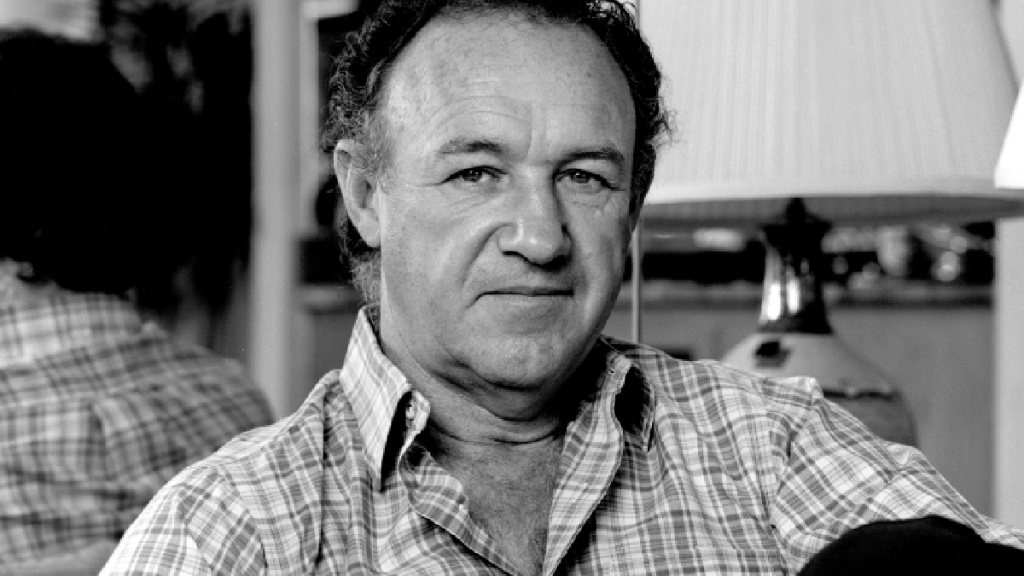
Don’t go to the masterpieces, the classics, the five-star pictures you have memorized from a hundred montages and telecasts. Pick one at random, one you don’t know. There are about 80 that meet this description. Pick … Andrew Davis’ “The Package” from 1989. It’s no one’s favorite film who doesn’t have a favorite armchair where he watched it whenever it came on TV at 3 PM on a lazy Saturday. It’s just an action movie. But about five minutes into it, we cut, and there’s Gene Hackman, walking through a Steadicam shot. He breaks off to tease a Russian chauffeur and points at guys from his regiment he hasn’t seen in a couple of weeks; the “Eyy”s and lazy gestures fly like arrows. This man is alive. Never mind what the film wants us to think, we know who he is. We know he hasn’t commanded troops in the field in a decade, we know he misses the discipline of wartime but not so much he doesn’t get a kick out of hazing his men. which he does in the next shot, dropping the familiarity for a sarcastic tough guy act we in the audience almost believe before he drop that, too. We know him because he’s a real guy, not a cliche, not a character, not a plot contrivance. Gene Hackman is real.
He came from San Bernardino in 1930, the son of a Canadian mother and American father who gave his first-born son his name: Eugene. That would be almost all he’d give him. They moved into his grandmother’s house in Illinois, and Eugene Sr. left his family behind when Gene was 13. He detailed the moment in interviews, the final wave, the way that gesture stayed with him, and how all gestures could be loaded with meaning. Could be a friendly hello, could be the last thing a man does before he walks out of his son’s life forever.
Three years later, Gene left home in the middle of the night and joined the Marine Corps, lying about is age to do so. He was stationed in China, then Japan, then Hawaii; until he was discharged in 1951. He did many odd jobs in New York as he tried to figure out what to do with himself. He was a doorman at a Howard Johnson’s on 49th and Broadway. “It was kinda fun, actually,” he’d say later. Remembering his father’s stint as a newspaper printer, he briefly considered journalism but finally remembered what he wanted to be as a boy: an actor. He ping-ponged between New York and LA, pursuing the dream, earning “no confidence” votes from classmates, teachers, and acquaintances (Hackman would thank acting teacher George Morrison when he won his Oscar in 1972 for “The French Connection“). He and fellow starving artists Dustin Hoffman and Robert Duvall shared apartments and acting classes as they prepared for their big breaks.
Hackman’s first decade as an actor yielded little in that department. He did stage shows and lots of TV. Richard C. Sarafian’s 1968 TV movie “Shadow on the Land”, released after he’d been Academy Award-nominated for “Bonnie and Clyde,” is a good indicator of the kind of parts with which he was initially trusted. He was fired from Mike Nichols’ “The Graduate” for being too young to play Mr. Robinson but couldn’t play men his own age to much success either.
In “Shadow,” he’s a priest who shelters some freedom fighters from fascist troops. He’s got to project a benevolent authority and righteousness, and the uptight Midwesterner could supply it at a glance alone. His first credited role was in the 1964 Robert Rossen movie “Lilith” with Warren Beatty, then a teen idol becoming a serious talent and Hollywood power player. He’s waiting for Beatty in his old girlfriend’s (Jessica Walter) place. He gets a minute with Beatty alone, and a nervous monologue comes out of him. His younger brother has started selling nylons, and Hackman nervously wheezes,” Every time I see him now, I say, ‘Nick, I never thought I’d see you in ladies’ underwear…’” he laughs for 15 seconds over it. He’s everything Beatty is trying not to be, the fatuous bourgeois neurotic who thinks in didactic binary. Beatty was very impressed. “There’s a scene in ‘Lilith’ between me and Gene and Jessica Walter, and I thought that Gene was such a natural, honest, brilliant actor that he made me good in our scene together. I remember thinking, I’m not going to do any other movies without him.” He kept his promise and brought him back for “Bonnie and Clyde.”
By the time Hackman tumbles out of his roadster in “Bonnie and Clyde” he’d become a much less self-conscious actor, but he wasn’t done developing either. He’s still the kind of small timer he played in “Lilith” with small dreams and a small worldview but he knows he’s up against heavy hitters in Beatty, Estelle Parsons, Michael J. Pollard, and Faye Dunaway and plays his folksiness like Babe Ruth rounding the bases after a home run. His love for his wife and his brother, his lust for the little things in life. This he can understand and tell us. “Tell me true…she as good as she looks?” He takes as much of a beat as director Arthur Penn will let him have to tell a terrible joke just to make his brother laugh. He’s falling off the screen into the seat next to you, relatable in his goofy enthusiasm. That’s the beauty of a Gene Hackman performance: you always knew the guys he was playing. You’ve sat next to them on buses and planes, they’ve talked your ear off at diners, they’ve gone on a little too long or snapped at you, they’re someone’s dad, someone’s uncle. They have presence. The Academy Award for Best Supporting Actor went to George Kennedy in “Cool Hand Luke” that year and it’s possible the vote was split between Hackman and his co-star Pollard, but the important thing is what it portended. Another Academy Award nod for Best Supporting Actor, yes, but a career more importantly.
Hackman became an actor that joined the past and the present. Thanks to “Bonnie” he was now associated with films set in eras of the past (namely the depression during which he was born, and its dusty counterpart, the old west). Along with his former roommates Hoffman and Duvall, Beatty, as well as Robert Redford, Al Pacino, and Robert De Niro, represented the new, wired vanguard of screen acting. Hackman was not yet anyone’s leading man, but he was trusted enough to assist them. In John Frankenheimer’s “The Gypsy Moths,” a perfect Hackman project in its reckoning with history and the oncoming of the future, he plays a promoter and a skydiver, the middle-man between Burt Lancaster’s scarred lifer and Scott Wilson’s fresh-faced newcomer.
In Michael Ritchie’s marvelous “Downhill Racer,” he’s Redford’s coach and confidant. In “Marooned” by John Sturges, an old studio director, he’s an astronaut whose life is in mission control’s hands. Gregory Peck was the lead and the big name, but his co-stars were like the Ghost of Christmas Future; what Hackman’s career could have been if he’d been less discerning or electric: David Janssen, Richard Crenna, James Franciscus, Scott Brady, and John Forsythe. A talented bunch, but no one who made it past “special guest star” status. The ’60s ended, and Hackman made the leap from support to lead, and his kind of movie would become popular enough to sustain him through the ’70s, even when some of them flopped.
In 1970, Hackman played a part so personal it was like it was written for him. He played a man named Gene in the maudlin but effective “I Never Sang For My Father.” He has to look after father Melvyn Douglas (another Hollywood lifer) after his mother dies, which allows him to play to his strongest suit, hitherto untapped: his seething anger, resentment, and frustration. “I’m sorry as hell for your miserable childhood but there’s nothing I can do about it now! I did not want to hate you!” He screams to this pathetic old man, knowing he’s doomed to watch history repeat itself if he never expresses the things tearing him apart. John Mills beat him for “Ryan’s Daughter” that year. You can see why it’s fallen out of the conversation. Something’s holding Hackman back, as close as it was to his own life story. He’s not yet the full uninhibited player he’d become. It’d take Wild Bill Friedkin to break him free.
“The French Connection” is still every bit the firecracker of a picture it was in 1971, even after decades of imitation. In the center of it all is Hackman, breaking apart before our eyes. He was terrified of the part of “Popeye” Doyle. He didn’t want to scream for weeks of shooting; didn’t want to say slurs in front of his black co-stars and crew members; didn’t want to sweat and fumble and pounce his way through the performance. He begged to be let go but Friedkin wouldn’t let him and every time they came to loggerheads it just made Hackman’s performance all the more intense. His nervousness at blowing his big chance to be a leading man gives his voice that extra decibel, pulls him taut like a strap. His nervous breakdown at the picture’s end is ours, glad it’s all over, terrified at what it’s been. When he won his Oscar, he teared up and ran out of things to say before he could be properly flooded with emotions and cry on TV. It’s as heartbreaking as anything in “I Never Sang for My Father.”
Moving forward, there would be two kinds of Gene Hackman movies: the ones where he hijacks the present and steers it someplace unexpected and the ones that came to him on his home turf, so to speak, the movies where the past meets the present. They’d meet in the middle on Jerry Schatzberg’s “Scarecrow,” where he and Al Pacino play drifters headed toward a dream that’s over before it’s begun. Their camaraderie is ingratiating even as it becomes clear why civilization spit these two out. In the category of street-legal Hackman movies, “Cisco Pike,” “Night Moves,” “Prime Cut,” and “The Conversation” show him barely hanging onto his place in the modern world. In the latter category, “Zandy’s Bride,” “The Hunting Party,” “Bite the Bullet,” “Lucky Lady,” and “A Bridge Too Far” all benefit from his stoic turns without becoming greater than his work. “Bite The Bullet” is a fine and underrated picture about the death of the western as told not in the revisionist mode of a Sam Peckinpah or a Michael Cimino, but in the steady handwriting of veteran director Richard Brooks. It’s about a fabled horse race, with Hackman our underdog hero with romance in his heart. His speech about the battle of San Juan Hill is a wonderful bit of bravura acting, using his horse as a prop as he tells two versions of the story. It’s a foretelling of his work in Clint Eastwood’s “Unforgiven” two decades later, about the stories that survive, the ways they live on past the facts. “We didn’t rough ride up that hill…we didn’t charge up there either…” You’d follow this man and his slippery morality into battle, nevertheless. “Scarecrow,” which won the Palme d’Or at Cannes, gets more oxygen, and it is a frequently gorgeous piece of work, but “Bite the Bullet” sees him at his most theatrical.
It’s the contemporary pictures that made him a household name. “Night Moves” by his “Bonnie” director Arthur Penn and “The Conversation” by then hotter-than-hot Francis Ford Coppola, two dueling Neo-noir visions of the death of the Americans soul, gave us the virile and furious Gene Hackman, and the introspective, searching, and terrified Gene Hackman. In “Night Moves,” he plays a private eye who, after solving the mystery of his wife’s infidelity, lets himself get wrapped up in a scuzzy mystery playing out in LA and Florida. The moral rot of Nixon’s America parachutes into this old-time vernacular. Its ending, right out of “Key Largo,” finds Hackman’s fast-and-loose Bogart impression squeezed until it explodes. In “The Conversation,” he’s a religious detective who can hear everything his marks are saying, which makes him a reluctant god. A little dash of paranoia clouds the recipe, and the kettle boils over. He loses. We all do. Hackman’s quiet fear is contagious. If this odd little man with his regimented and miserable little life can still lose something when it’s his turn, we all can lose much more. After Watergate and the Nixon wiretapping had entered the public conscience, “The Conversation” brought it all to a head, specifically the troubled head at the center in Hackman’s soft-spoken, disquieting uncertainty. The film has Coppola’s most focused direction, but it wouldn’t work without a powerful center like Hackman. All that work for the price of one name above the marquee.
After the ’70s ended (with Hackman taking a hefty paycheck to play Lex Luthor, what James Gray would call “an honorable” performance in a superhero movie) he would be called upon time and again to dip into his baggage and share it with us once more. In 1986’s “Hoosiers,” speaking of the favorite movies of guys with favorite armchairs, it’s as if his character from “Scarecrow” finally made it home. He coaches a high school basketball team to their state championship victory against all odds. It may, in fact, be better loved than “Field of Dreams,” the other misty-eyed boomer sports film of the age. In “Unforgiven,” “Wyatt Earp,” “Geronimo: An American Legend,” Sam Raimi’s “The Quick and the Dead” and especially Nic Roeg’s “Eureka,” he’s the cowboy of his ’70s period with an even meaner streak. “Eureka” finds him playing a man who strikes gold in the Klondike and uses his newfound wealth to lord over his family like a vampire. In “Unforgiven,” for which he won his last Oscar, he’s a man who wields peace like the butt of a gun, beating the hell out of people while crowds gather to see him dole out frontier justice. When he won his Oscar, he just laughed, in the most winning fashion imaginable. He’d done it, alright.
This pattern of tracing his steps to great effect would continue. When he showed up in “Postcards from the Edge” or “Get Shorty” as shameless Hollywood types, it was his genial nature that sold him as a sleazy showman. Broadly speaking, audiences had already fallen in love with him, we’d give him the room to stretch out and play to the worst of our suspicions about how Hollywood works, just as he would as government functionaries in his political thrillers. In Neo-noir “Twilight,” he revisits “Night Moves,” and in “Enemy of the State,” he effectively once more plays Harry Caul, the sound man detective from “The Conversation.”
In the midst of all of this, Hackman became an unheralded and beautiful comic voice. He was first asked to really show off his prowess playing to the cheap seats in Mel Brooks’ “Young Frankenstein” as a blind man happy to have Peter Boyle’s monster over for espresso. Brooks and Gene Wilder, another “Bonnie” co-star, never considered anyone else for the part. In forgettable films, like Bob Clark’s “Loose Cannons,” in Cold War dramedies “Reds,” once more for his old pal Warren Beatty, and “Company Business,” in the underrated “Heartbreakers” with Sigourney Weaver, and in beloved classics like Mike Nichols and Elaine May’s “The Birdcage” and Wes Anderson’s “The Royal Tenenbaums,” he is unstoppably funny, yet always affecting. The latter two provide the perfect close to an unprecedented career.
The gravitas he cultivated playing army colonels in “Uncommon Valor,” the secretary of defense in “No Way Out,” or the President in “Absolute Power” gets the workout of a lifetime as Hackman plays the very flappable Senator Keeley in “The Birdcage” who flees one scandal by driving unwittingly into the thick of another. In “Tenenbaums,” he’s an unrepentant scoundrel who wants to earn the love of his family back…by lying about a fatal illness. In both cases he’s a bigoted scumbag and in both cases he’s too hard to hate. “The Birdcage” sees him perfect the art of deflecting, turning dinner conversations into campaign speeches and his deep humiliations into ludicrous opportunities to redirect to his non-existent beliefs and achievements (“Purple mountains…green fields…”). In the latter, one of the great heartbreaking family movies, he laughs his way through recollections of years of shabby behavior and plans to ruin his wife’s impending marriage. He makes three course banquets out of the words “Assassin,” “knife,” and “damnit,” and does magnificent things with Anderson’s non sequiturs. “This is Sanchez; he’s a notary public.” He is, as Angelica Huston calls him, “a bastard,” but you cry for him in his final moments. “Hell of a damn grave…wish it was mine…”
“I think of them as…the work.” That’s what Gene Hackman said, thinking back on the movies he was in and the characters he made immortal. But you remember crying for Royal Tenenbaum, you remember laughing at and with him, fearing him, the feeling of warmth when you hear the way he gathered breath in his mouth, in a way no other actor on earth did, the way he chortled and screamed, the way he towered and shrank. You remember an actor who never seemed to be trying and who never seemed afraid of anything, who was right for every part and just right for the moment into which he was born. You remember a man who was bigger than life, yet just as real as if he were sitting next to you on a bus. He was real, Gene Hackman. He was real.
