


The future of work isn’t some distant, hazy concept—it’s arriving faster than ever.
Automation, evolving customer expectations, and global competition are reshaping industries in real-time.
In this environment, ‘skills’ aren’t just a line on a resume—they’re the currency of success.
Effective skills management is the key to unlocking a workforce’s potential and the reason an organization doesn’t just survive but thrives.
This post will zoom into skills management: not just the what, but the how—providing a practical guide for L&D professionals, HR managers, and business owners ready to build a future-proof workforce.
What is skills management?
Skills management is the strategic process of figuring out what skills your organization needs, who has them, who doesn’t, and then proactively doing something about it. It’s about having a clear, real-time understanding of your workforce’s capabilities and aligning them with your business goals.
Skills management helps an organization stay ahead of the curve, instead of scrambling to catch up.
In short, skills management helps to see and prepare for the future of work, today.
7 benefits of skills management for employees and organizations
Skills management is a strategic tool. It delivers real benefits to both the company and the people who make it run.
Let’s dive into some key advantages.
1. Identify and address skills gaps
The current half-life of a skill is about five years and shrinking fast.
This is the core challenge that skills management addresses: proactively identifying and closing those gaps before they derail productivity and innovation.
It’s no longer enough to hire for existing skills—organizations must continuously assess, train, and upskill their workforce. A 2023 report by Gartner found that 70% of employees feel that they don’t have mastery of the skills needed for their jobs today.
Ignoring this reality leads to costly consequences like unfilled roles, delayed projects, and missed opportunities.
On top of this, many companies are struggling to find talent in critical areas like data analytics, cybersecurity, and AI. A robust skills management platform helps pinpoint these needs and creates targeted training, so the organization can upskill their current employees instead of finding new talent.
A great way to identify skills gaps is through a skills gap analysis. Click below to get your template and take your first step to implementing skills management.
2. Unlock more ROI (using what’s already available)
Your current employees are your greatest untapped resource. Skills management helps you tap into that resource, getting more value from the talent you’ve already invested in.
In turn, it also helps to reduce recruitment costs, speed up the hiring process, and lean on the institutional knowledge your current team already possesses.
For example, an employee with hidden project management skills, currently in a support role, could be trained and transitioned to a project lead position, saving the time and expense of an external search.
It’s a form of strategic internal mobility, powered by insights, not intuition.
3. Better decisions in terms of hiring, training, and resource allocation
Forget guesswork. Skills management provides the hard data needed to make informed decisions about your workforce by uncovering hidden strengths, pinpointing skill gaps, and identifying specific training needs across the organization.
For example, if the data reveals a company-wide deficiency in data analysis skills, resources can be strategically allocated to targeted training, rather than wasted on less relevant initiatives.
4. Boost innovation and creativity
A workforce brimming with varied skills is a breeding ground for fresh ideas.
The right skills management strategy fosters this diversity by identifying and nurturing a wide range of talents, not just those immediately apparent on a resume. When employees are encouraged to develop new skills and explore different areas of expertise, they bring unique perspectives to problem-solving and innovation.
For example, an employee with coding skills might collaborate with a marketing specialist to develop a new customer engagement tool, leaning on their combined expertise.
5. Career pathways with purpose (for employees)
Employees crave growth, not just paychecks. Clear career and learning paths provide that growth, turning jobs into journeys.
Effective skills management helps you create structured opportunities for development, whether it’s aiming for a leadership position, becoming a technical guru, or exploring a different department altogether.
The result? More engaged employees, lower turnover, and a workforce that’s constantly evolving—a win-win for all.
6. Increased confidence and competence (for employees)
A well-structured skills management program provides the resources and opportunities for individuals to develop their expertise, leading to a tangible increase in both competence and self-assurance.
This, in turn, fuels greater job satisfaction, improved performance, and a willingness to take on new challenges. It’s a virtuous cycle: as employees become more skilled, they become more confident, and as they become more confident, they’re more likely to seek out further growth.
7. Enhanced employability
Investing in your employees’ skills is an investment in their future, and your company’s. A strong skills management platform helps people build a portfolio of marketable skills, making them valuable assets to your organization and attractive prospects elsewhere.
Sure, some might eventually move on, but highly skilled, engaged employees are significantly more productive and innovative while they’re on your team.
Furthermore, you’re offering a launchpad for continuous development—and that attracts (and keeps) top performers. In fact, a LinkedIn study found that 94% of employees would stay at a company longer if it invested in their learning and development.

How to implement skills management in your organization
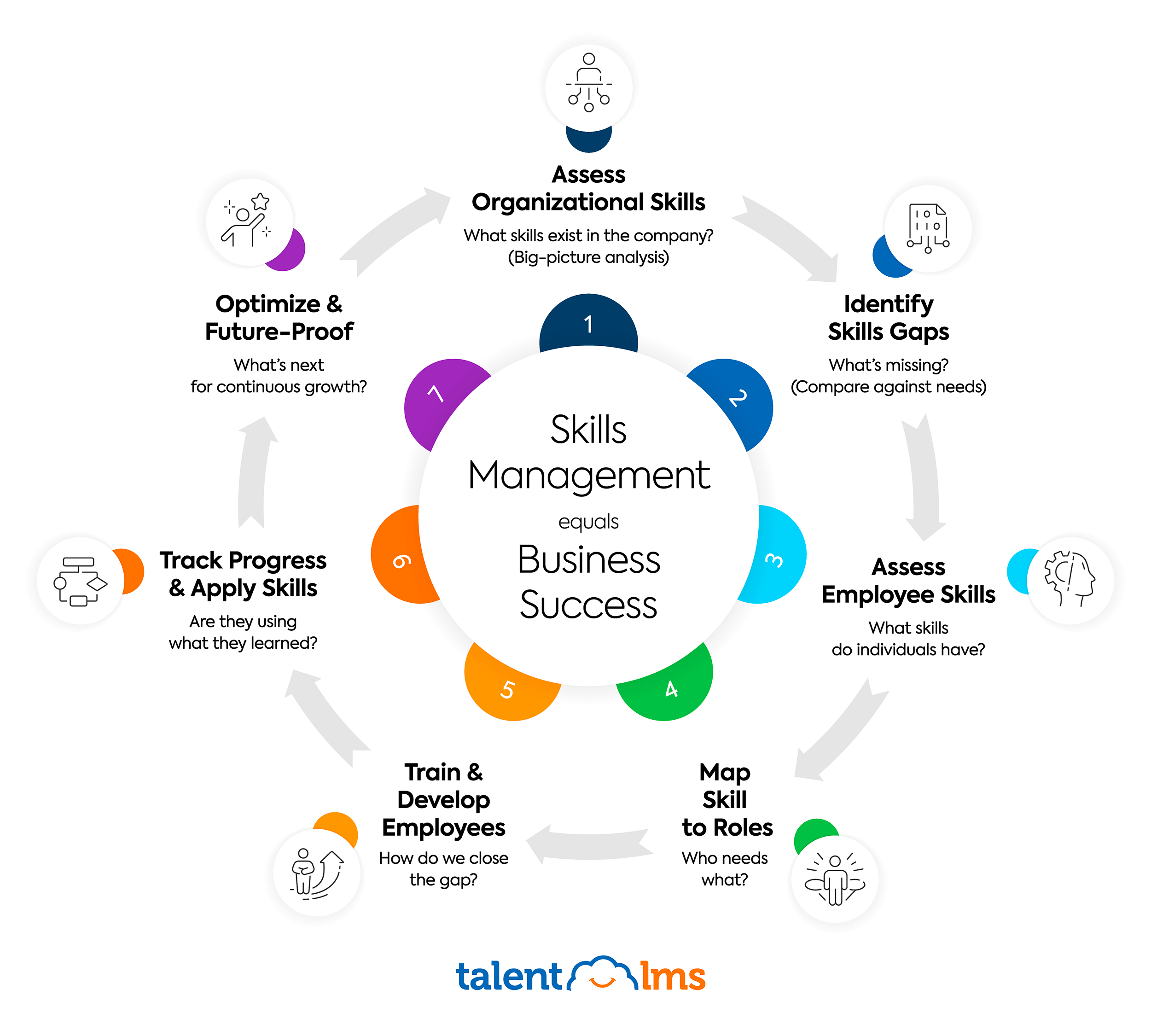
Implementing a successful skills management program is a strategic journey. It requires a systematic approach like the one we have laid out in this blog.
Assess your organization’s current skills landscape
Before you can build the workforce of the future, you need to understand the workforce you have now. To do this, you need to thoroughly assess your organization’s existing skills landscape using a skills taxonomy. A skills taxonomy is a structured classification of skills, often organized by category and proficiency level.
This can involve:
- Employee self-assessments: Asking employees to rate their own skills and identify areas where they’d like to grow.
- Manager assessments: Gathering input from managers on their team members’ skills and performance.
- Skills tests: Using standardized assessments to objectively measure specific competencies.
- Reviewing existing data: Analyzing performance reviews, project outcomes, and other data sources to identify patterns and trends.
You then compile all this together using the skills taxonomy to create a comprehensive and accurate picture of your organization’s current skills profile.
Identify critical skills gaps and future workforce needs
Once you have a clear picture of your current skills landscape, the next step is to identify the gaps. To do this, you’ll need to look beyond current job descriptions and consider industry trends, technological advancements, and your company’s strategic goals.
For example, a company might identify a growing need for data scientists, cybersecurity experts, or specialists in artificial intelligence.
Map skills to roles and career paths
Now that you understand your current skills and future needs, connect the dots.
Here’s how that looks in action:
- For each role, identify the specific technical skills, soft skills, and experience levels needed for success.
- Develop clear pathways showing how employees can progress from one role to another by acquiring specific skills.
- Offer opportunities for employees to move across departments or teams based on their skills and interests.
For example, a junior marketing specialist might have a clear path to becoming a senior marketing manager by developing skills in data analysis, campaign management, and leadership.
Implement skills-based learning training programs
Next, it’s time to put those identified skills gaps and future needs into action by creating and implementing targeted skills-based learning and training programs designed specifically for upskilling and reskilling.
It helps to know that employees are hungry for it. Research by TalentLMS and Workable reveals that 80% of employees believe their employers should increase their investment in upskilling and reskilling.
To increase your impact, consider a blended approach:
- Leverage e-learning: Online courses, modules, and platforms offer flexibility and accessibility, allowing employees to learn at their own pace.
- Foster mentorship: Pairing experienced employees with those seeking to develop specific skills creates a powerful learning dynamic, facilitating knowledge transfer and personalized guidance.
- Prioritize hands-on experience: Employees need opportunities to apply new skills in real-world projects and scenarios. Think job shadowing, cross-functional assignments, or “stretch” projects.
Foster internal mobility by aligning skills with career growth
Internal mobility – moving talent within the company – is a powerful, yet often overlooked, tool. It boosts employee engagement, retention, and the bottom line.
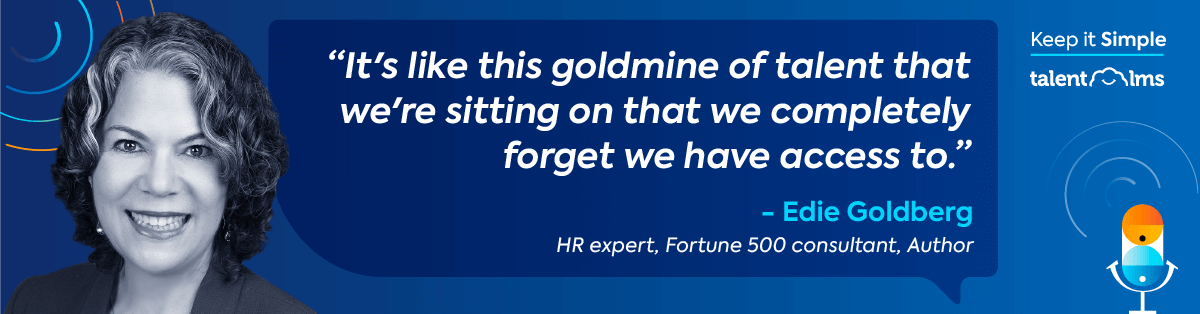
As Edie Goldberg, HR expert and co-author of The Inside Gig, highlights in the TalentLMS podcast, Keep It Simple, internal mobility requires a shift in mindset: “You need to move managers from a mindset of talent scarcity, where they kind of covet and hoard their talent to a mindset of abundance, where they see all the employees in the company as a potential source for their talent.”
A robust skills management program makes strategic internal mobility possible. Clearly defining the skills needed for different jobs and giving employees ways to learn those skills, creates a culture of growth within the company. Employees can then explore different roles or departments based on their evolving skills and interests.
Track skills development and measure business impact
You can’t improve what you don’t measure.
On top of that, tracking skills development and measuring its impact on the business is how you demonstrate the ROI of your skills management program and make those data-driven adjustments we mentioned in the benefits section.
For this, you’ll want to go beyond simply counting the number of employees who have completed training courses. Instead, use a combination of:
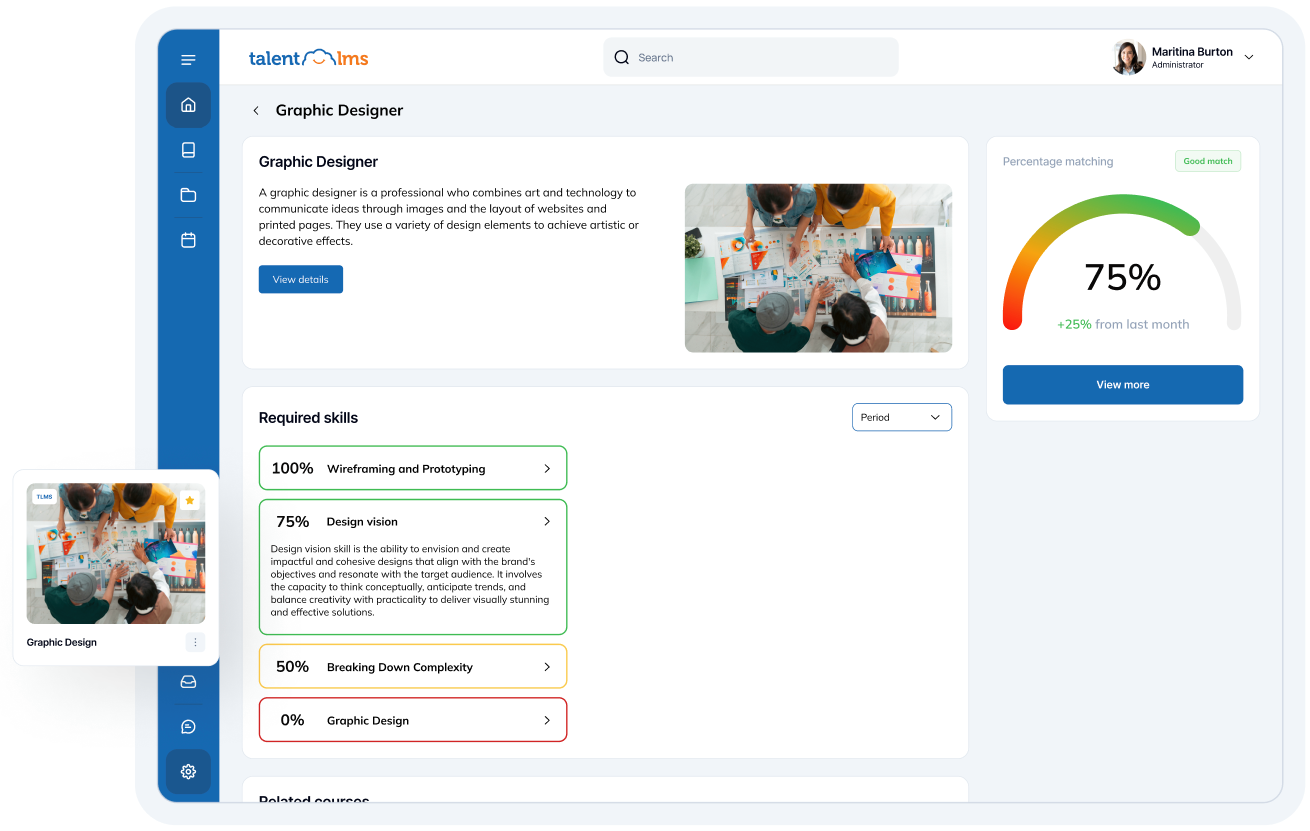
- Skills management software: Implement systems (like TalentLMS with its skills management features) that help you map out and monitor the skills profiles of individual employees and track their progress over time.
- Learning platforms (or LMSs): Use training platforms or LMSs, that provide data on course completion rates, assessment scores, and learner engagement.
- Performance metrics: Connect skills development to key business performance indicators (KPIs) such as productivity, efficiency, sales, customer satisfaction, and innovation.
For example, if you’ve started a training program to improve data analysis skills, track not only how many people finish the program, but also how those new skills are being used on the job and whether they’re yielding important business results better (e.g., faster reporting, better decision-making, more money).
Continuously adapt and evolve your skills strategy
The skills landscape is constantly evolving, which is why a successful skills management strategy requires continuous adaptation and evolution.
To keep your workforce future-ready, regularly update your skills frameworks, learning opportunities, and overall approach based on:
- Industry shifts
- Technological advancements
- Internal feedback
- Business performance data
For example, the rise of AI is drastically changing the skills needed in many industries. A company that proactively adapts its skills strategy to incorporate AI skills training will be far better positioned to compete. It’s about staying agile, anticipating change, and ensuring your workforce has the skills to thrive—to lead, not lag.
5 tips for effective skills management
To build a workforce that’s adaptable, engaged, and ready for the future, prioritize these five key tips for skills management:
Treat skills as an asset, not just an HR metric
Skills aren’t just data points for HR reports—they’re valuable assets that should drive core business decisions. Forward-thinking companies integrate employee skills data into workforce planning, project assignments, and strategic growth initiatives.
A proactive approach enables organizations to optimize talent, adapt quickly to change, and maintain a competitive edge.
Create a culture of skills development and growth
Skills development shouldn’t be a sporadic event—it should be woven into the fabric of your company culture. Embed learning into everyday work, actively encourage continuous development, and celebrate employee growth.
Employee development plans are powerful tools in reinforcing this culture, providing a structured framework for employees to identify skill gaps, set learning goals, and track their progress.
To simplify this, you can use and grab your skill development template below.
Get leadership and management on board
Skills development initiatives thrive when championed from the top down. If leaders don’t prioritize skills growth, employees likely won’t either.
Train managers to be open about what skills they are learning and to express how they are applying them at work. It also helps to train them to act as coaches and mentors, supporting upskilling efforts and focusing on long-term development, not just short-term productivity.
Incentivize skill application, not just learning
Completing training is only the first step, applying new skills is where the real value lies. However, a lot of people do not know or are not motivated enough to use new knowledge.
Therefore, it helps to reward employees for using their acquired skills, not just for finishing courses. Recognize and incentivize real-world application through promotions, bonuses, special project opportunities, or other tangible benefits.
Invest in a robust skills management software solution
Centralizing employee skills management and training is paramount for efficiency and effectiveness. A platform like TalentLMS expedites the entire process, benefiting employees, managers, and the business as a whole.
Employees gain easy access to learning resources and personalized development paths. Managers can track progress, identify skill gaps, and assign relevant training. And the organization gains a comprehensive view of its employee skills landscape, enabling data-driven workforce planning and strategic decision-making.
Get serious about skills, or get left behind
Stop treating employee skills as an afterthought. Your competitors aren’t.
The companies winning today, and tomorrow, are those that actively cultivate, track, and deploy their employees skills. This isn’t just about filling training quotas—it’s about knowing exactly what your workforce is capable of, and leveraging that knowledge for a strategic competitive advantage.
FAQs: Skills management
What is a skills management system?
A skills management system is a software solution or process that helps organizations identify, track, develop, and deploy the skills of their existing employees to meet business objectives.
What are the steps in skills management?
The key steps involve identifying needed skills, assessing current employee skills, developing learning pathways, and tracking progress to align skills with organizational goals.
How can skills management help with talent acquisition?
Skills management streamlines recruitment by clarifying the precise skills needed for each role, enabling you to hire candidates who are a genuine fit.
Is there a platform that offers both skills management and training?
TalentLMS combines skills management and training in one platform, centralizing skill tracking, development, and deployment. It also uses AI to help simplify and create more effective programs.
