

On March 24, Canada’s newly appointed Prime Minister Mark Carney called a snap election for April 28. If the economic record of his Liberal Party, which has been in office since Justin Trudeau’s victory in 2015, is a major factor in voters’ decisions, bookies would be giving you pretty long odds on them.
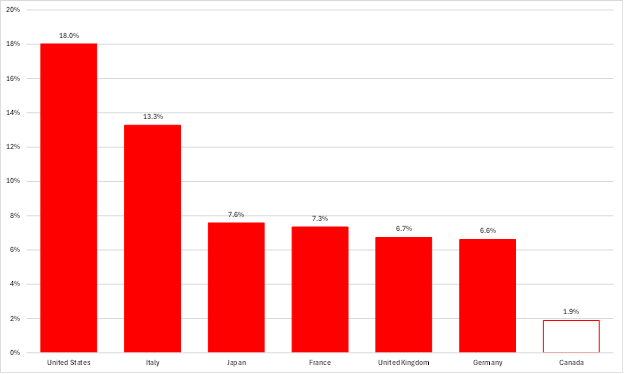
Gross Domestic Product (GDP) per capita is a key metric of economic performance which tells us how much per person is available to be consumed, invested, or put to some other use. Under the Liberals, Canada’s performance relative to its G7 peers has been miserable. As Figure 1 shows, between 2014 and 2023, Canadian GDP per capita grew by just 1.9 percent in real terms, the worst performance in the G7 and less than a third the growth in Germany, the next-worst performing country. Indeed, Canadian GDP per capita was lower in 2023 than it was in 2018.
Figure 1: Real per capita GDP growth, 2014 to 2023 (PPP, constant 2021 international $)
Source: World Bank World Development Indicators
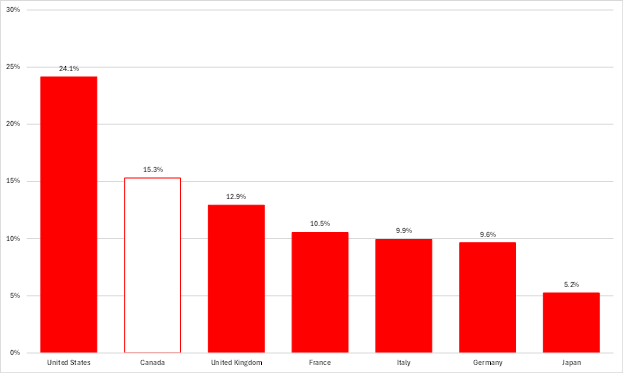
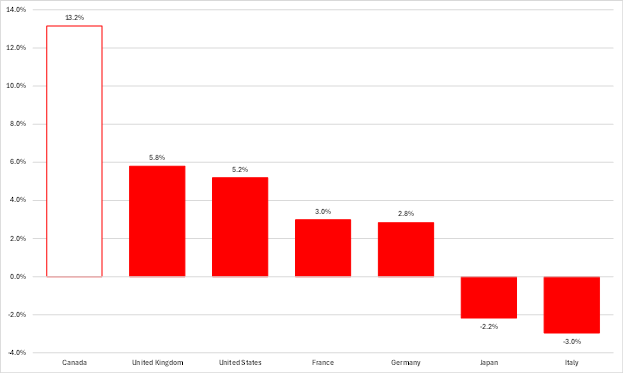
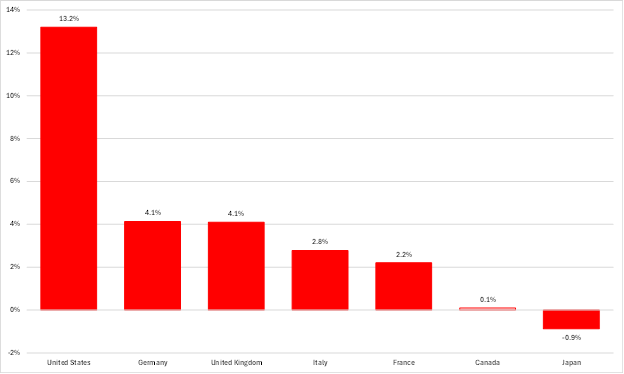
What accounts for this dismal performance? GDP per capita is calculated by simply dividing total GDP by the population. Canada’s record on total GDP growth is relatively strong. Between 2014 and 2023, the Canadian economy grew by 15.3 percent in real terms, second only to the United States among the G7 countries, as Figure 2 shows. But while the numerator in our equation – GDP – has grown rapidly, so has the denominator, population. Between 2014 and 2023, Canada’s population grew by 13.2 percent, the fastest rate in the G7 and more than double that of the second-placed United Kingdom, as Figure 3 shows.
Figure 2: Real GDP growth, 2014 to 2023 (PPP, constant 2021 international $)
Source: World Bank World Development Indicators
Figure 3: Population growth, 2014 to 2023
Source: World Bank World Development Indicators
Given that the growth rate of GDP is just the sum of the growth rate of GDP per capita and the growth rate of the population, we can calculate that population growth accounted for 84.9 percent of the average annual growth of Canada’s total GDP between 2014 and 2023, the highest share among the G7 countries and 42.3 percentage points more than the country with the second biggest share, the United Kingdom. A decade of Liberal government in Canada has seen impressive growth of total GDP thanks to population growth – 88.1 percent of which between the fourth quarter of 2014 and the fourth quarter of 2024 came from immigration – but, in economic terms, the average Canuck isn’t much better off.
Canada’s Productivity Problem
This is because, as Paul Krugman wrote: “Productivity isn’t everything, but in the long run it is almost everything. A country’s ability to improve its standard of living over time depends almost entirely on its ability to raise its output per worker.” And Canada’s record on raising output per worker is poor. As Figure 4 shows, GDP per person employed increased, in real terms, by just 0.1 percent between 2014 and 2023, a rate better than only Japan among the G7 countries. This is not new. Among its G7 peers, Canadian GDP per person employed ranks fifth in every single year from 1990 onwards.
Figure 4: Real per worker GDP growth, 2014 to 2023 (constant 2021 PPP $)
Source: World Bank World Development Indicators
What accounts for this stagnation? A recent report by RBC, Canada’s biggest bank, offers some answers.
Regulations and red tape are a problem. RBC notes that “Canadian businesses invest substantially less than in the US — about half as much per worker in aggregate.” While “part of the slowing in investment has been from a pullback in investment in the Canadian oil and gas sector,” it explains that “businesses have also invested a substantially smaller share of GDP in the manufacturing sector in Canada than in the US over the last decade.”
“The issue does not appear to be a lack of available funding,” RBC’s report continues, but “an inefficient project approvals backdrop [which] is making investing in Canada relatively expensive.” RBC notes that, “In 2020, Canada ranked 188th out of 208 economies tracked by the World Bank on the number of days businesses spent dealing with construction permits for new projects. That is three times longer than time spent in the US.”
Regulations and red tape also retard trade domestically. “A patchwork of regulatory and administrative rules across different municipalities and provinces…restricts trade within Canada,” the report notes. Indeed, “The International Monetary Fund has estimated that internal trade barriers…cost the equivalent of a 20-percent average tariff between provinces. By comparison, the effective tariff rate collected on international imports from abroad in Canada is less than one percent.”
Trading across international borders is also relatively onerous. While “Actual tariff rates on international trade in Canada are low…Canada ranks poorly (51st globally) in the ease of trading across borders in large part due to high administrative costs associated with importing and exporting,” RBC writes.
Taxes are a problem too. “Canadian corporate tax rates are still comparable to other advanced economies,” RBC notes, “But taking into account the tax on company dividends at the personal income tax level, the total tax on distributed profits from Canadian companies is the highest in the G7, according to the OECD.”
Canadian economic growth has also been tilted toward sectors which have seen slow productivity growth. In the case of services this may be unavoidable, but, RBC write, “Construction is one of the industries that has struggled the most to boost productivity over time” and “Investment in residential structures accounts for twice the share of GDP in Canada (6 percent) than in the US (3 percent)…As a result, construction accounts for about twice the share of total hours worked in Canada (8 percent) as it does in the US (4 percent).”
Finally, “A large and growing public sector is less productive,” RBC note. “Canada’s large public sector education and healthcare industries are much less productive than in the US by 70 percent and 50 percent, respectively. and accounting (sic) for a fifth of the total economy productivity gap despite only accounting for 14 percent of the economy.”
Who Gets to Fix It?
Until early March, the Liberals looked certain to pay a heavy price for Canada’s poor economic performance, among other things, with polls showing Pierre Poilievre’s Conservatives with comfortable leads. Then, fortunes suddenly flipped and every poll since Carney’s election call has shown the Liberals in the lead. Conventional wisdom holds that the Canadians are rallying round the flag in response to President Trump’s bellicose statements, and conventional wisdom may be right. It is hard to see anything in Mark Carney which would generate such a turnaround.
Canada is not doomed to be an economic laggard. It is well placed geographically and blessed with abundant natural resources. But its next government, whoever heads it, will have its work cut out to reverse decades of economic underperformance.
