

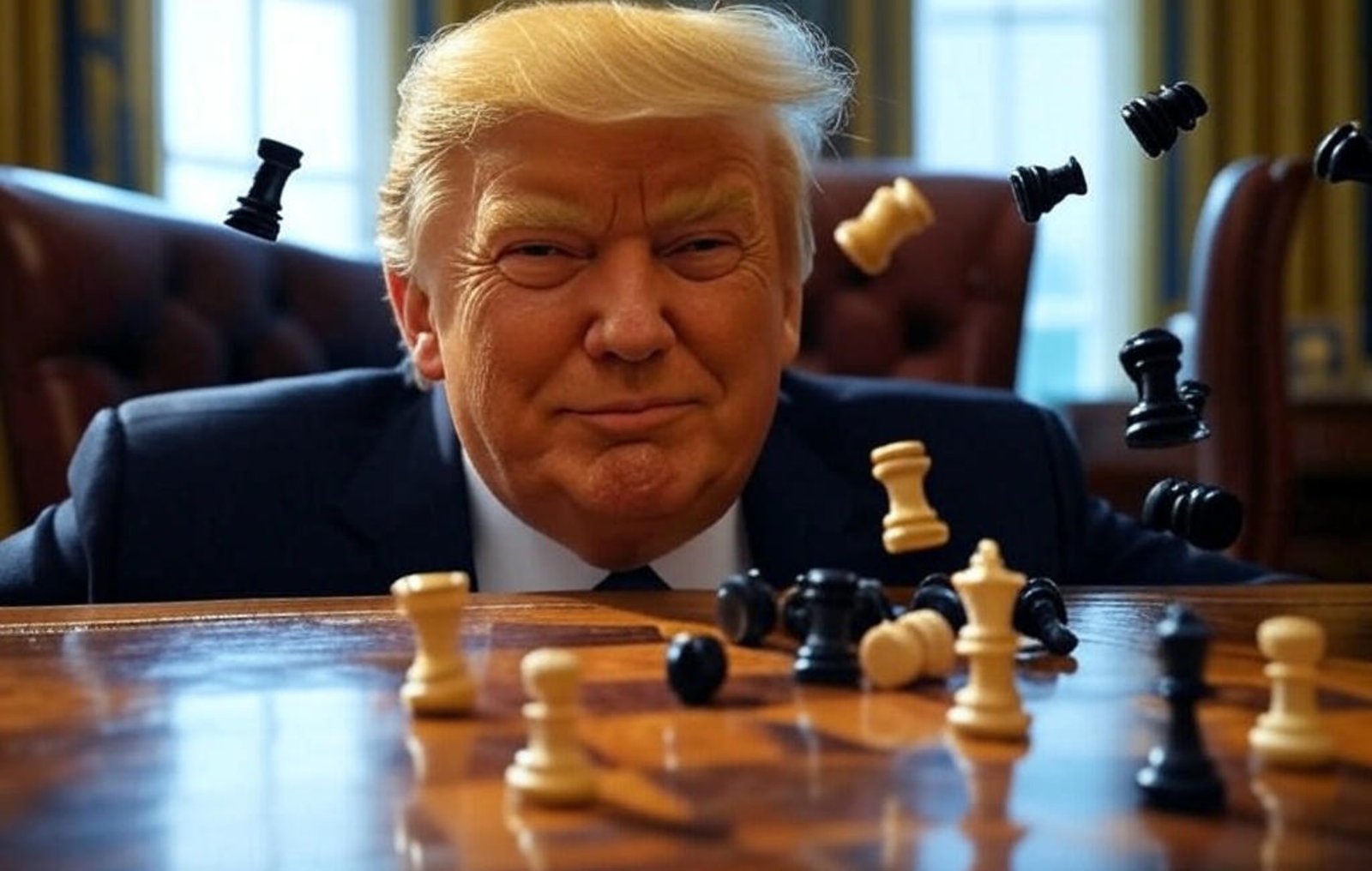
Supporters of tariffs claim that mainstream economists don’t understand the game. This “game” has been described by Peter Navarro as three-dimensional chess. I want to take that claim at face value, break down its dimensions, and then evaluate whether Trump’s actions are likely to lead to his desired outcomes. And the answer is “no,” because the administration is playing three quite different, inconsistent games all at once. That isn’t a strategy at all; rather, it’s a scheme for certain failure.
Trump and his advisers claim that their policies have three justifications. For simplicity, I will call these (1) security, (2) reciprocity, and (3) revenue. I’ll present these (as the lawyers put it) arguendo, meaning that for the sake of argument, we will just consider the case for Trump’s actions, and mostly put aside the counterarguments.
Security: First, national security requires securing supply chains, reducing US dependence on other nations. The main concern is China, but any such dependency weakens our strategic position. In this view, the US is vulnerable not only to holdup of essential items such as advanced semiconductor chips, but more generally to the hollowing out of our national capacity to produce large ships and other manufactured products. Since modern manufacturing is shut down by any missing component, many parts are shipped to the US from abroad — this exposure to the whim of foreign leaders or the fragility of shipping and fast delivery is an unacceptable risk.
Of course, ending the offshoring of supply chains is wrenching, and developing domestic sources will be terribly expensive. But national security is always expensive: if these dependencies are the main American security vulnerabilities, as has been argued by Jon Pelson or the House Homeland Security Committee, then the expense will be worth it. If it’s true that “trade is bad,” then high, permanent tariffs and other trade barriers are essential to national security.
Reciprocity: Second, the goal might be to reset world trade by encouraging consumers in other nations to buy more American products. On this view, the US has been played for a fool for decades, having (relatively) open markets for foreign imports but not requiring reciprocal openness in our trading partners. It’s time to stop losing: foreign nations need the US market more than we need theirs.
If the US raises tariffs on imports, other countries will be forced to lower their barriers to our products. Everyone understands that this strategy is costly in the short-run, because tariffs disrupt existing patterns of business and raise costs for consumers. But these short-run costs will quickly be recovered, as US exporters will have greater opportunities to sell American products abroad on a level playing field.
Revenue: Third, the administration has touted tariffs as a (nearly) free revenue source, under the claim that these taxes are paid primarily by the foreigners who want to move their products through US customs. Taking that claim at face value (even though it is nonsense) requires that tariffs be low and permanent. After all, there is a tariff “Laffer Curve” just like for income taxes: a zero rate produces zero revenue, and at some high rate revenue also falls to zero.
The revenue rationale is sometimes based on the claim that the nineteenth-century US budget was (almost) entirely funded by tariff revenue, meaning that the income tax can be eliminated. Alternatively, the new revenue could be used to reduce the burgeoning fiscal deficit, or the government could declare a “tariff dividend,” returning the money to taxpayers as a windfall paid by foreigners.
The Contradiction: Pick a Dimension
The argument for free trade is that nations, and the people who comprise them, face thousands of complex “make or buy” decisions. The rule for a nation, just as for a family or a business, is that if something is cheaper to buy than it is to make, then it is better to specialize in making only those things we can make best and cheapest, and buy everything else. If other countries have barriers to their consumers buying our products, that’s their problem; the argument for free trade is unilateral, meaning that only the “make or buy” comparison is relevant. Artificial price increases that result from trade barriers distort this comparison, so that the US ends up making things that it could have purchased more cheaply from another nation.
I have outlined the three main counterclaims to this general rule of “make or buy”: security, reciprocity, and revenue. The way the arguments were presented assumed that each, while not perfect, had some merit. (I do not myself think that is true, but it is useful in each case to grant the premise arguendo, as a way of understanding the claim.)
The problem for Trump supporters is that even if one grants that each argument has some merits on its own, the three together are an incoherent and highly destructive muddle.
The security argument implies, and in fact requires, that the US must permanently set up industries to make things that it could buy more cheaply on international markets. In particular, tariffs need to be high and fixed forever to block the import of foreign semiconductors, ships, and whatever else security demands. Only if there is a credible commitment to permanent confiscatory tariffs will domestic industries invest in the capacity to make these products, since by definition other countries can make them more cheaply than we can.
Fair enough, but then high tariffs cannot be used as a bargaining chip in reciprocal negotiations, and tariffs cannot be low enough to earn revenue. After all, the only way tariffs produce revenue is if they are low enough as to not discourage substantial imports, and that is the opposite of the stated goals. The security argument requires no imports, no negotiated tariff reductions, and no revenue, because trade itself is the danger. The security argument, if it is correct, rules out the reciprocity argument and the revenue argument.
The reciprocity argument requires that the tariffs are temporary, and that the commercial bargaining strength of the US — based on the unmatched size of our consumer market — will force other nations to lower trade barriers against US goods. That view is largely nonsense, because (just as in the US) the political benefits of tariffs are valuable to concentrated interests in countries that maintain tariffs against us. If other countries cared about their consumers, they wouldn’t have tariffs in the first place. What that means is that other countries are likely to raise, not lower, their tariffs in response to “Liberation Day.”
But ignoring that problem still means that US tariffs would have to be very high (ruling out revenue) but temporary (ruling out security). The whole point of reciprocity is that the barriers won’t last. Temporary reciprocity tariffs cannot spur domestic investment or change our supply chain sourcing.
Finally, the revenue argument requires that there is little change in the volume of trade. Low, across the board tariffs would be necessary to avoid the substitution of products from adversary nations such as China to neutral countries such as India or the nations of Southeast Asia. Since the only way to make money from tariffs is to have them low enough as to not to discourage imports, the security argument is entirely precluded, and no domestic producers will invest in US capacity.
The reciprocity argument is likewise contradicted, since reciprocity claims tariffs are temporary, but revenue requires that they are permanent. The high tariffs required for reciprocity bargaining now, and the low tariffs after reciprocal agreements in the future, will produce relatively little revenue.
The bottom line is that whatever you think about the merits of each of the three “games” — security, reciprocity, revenue — moves that might work in one game are disastrous in the other two.
By pretending to be playing all three games at once, the administration has ensured that we will lose them all.
