

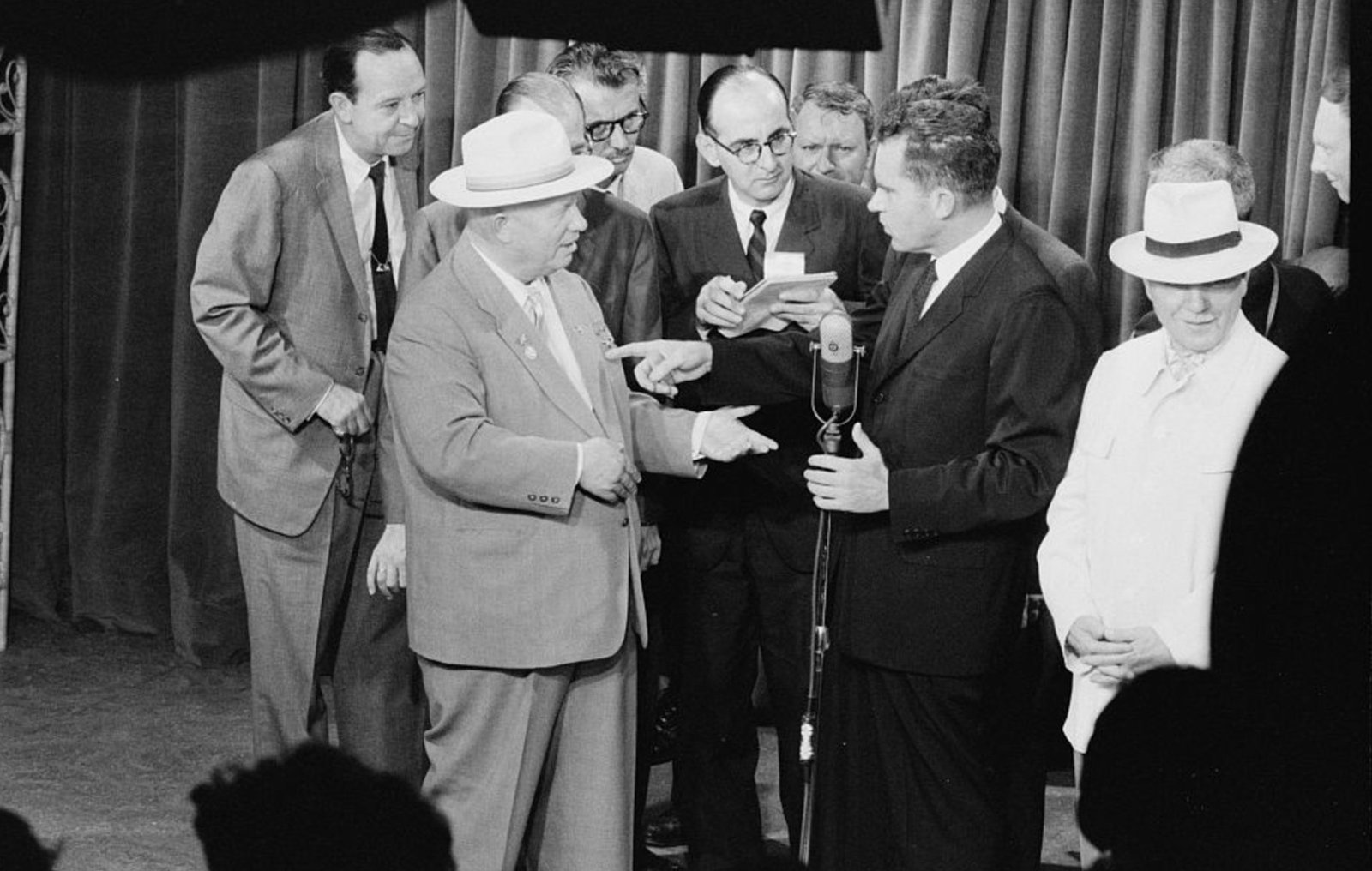
In July 1959, at the American National Exhibition in Moscow’s Sokolniki Park, Vice President Richard Nixon stepped into a model suburban kitchen and found himself in a now-famous impromptu exchange with Soviet Premier Nikita Khrushchev.
Known as the “Kitchen Debate,” the moment became emblematic of Cold War tensions — not over missiles or military power, but over washing machines, color televisions, and the promise of frozen orange juice. Nixon used the showroom kitchen to champion the market economy, arguing that capitalism’s genius lay in offering ordinary citizens a growing array of affordable comforts. Khrushchev scoffed, calling it all frivolous and morally hollow compared to the Soviet system, which he claimed prioritized basic needs over material excess. Once widely known, the moment remains etched in Cold War history — not least because of Nixon’s later, troubled exit from the presidency.
While that Cold War moment became cultural shorthand for the difference between liberal economic systems and centrally planned ones, echoes of Khrushchev’s arguments are now emerging from unexpected places — including the highest levels of the US government, where the President recently suggested that American children might need to “be happy with two dolls instead of 30” if tariffs raise the prices of toys.
“We used to make toys in this country,” he added, implying that curbing imports and reducing consumption are necessary sacrifices for revitalizing US industry.
That shift in rhetoric — from abundance to austerity, from choice to control — deserves far closer scrutiny than it has been given. Within the last two months, US Treasury Secretary Scott Bessent expressed the view that affordability is not part of the American project. This new twist, that Americans should embrace fewer goods in the name of national policy, may sound like hard-nosed industrial strategy, but it’s simply protectionism repackaged as virtue.
Philosophically, it expresses a form of economic collectivism that runs contrary to the very system that made American kitchens, stores, and lives the envy of the world.
The Illusion of National Self-Reliance
Tariffs are taxes. They’re imposed not on foreign producers, as political rhetoric commonly suggests, but on American consumers and firms that buy imported goods. If the US government raises tariffs on toys, the cost doesn’t fall on a factory owner in Shenzhen: it falls on the American parent buying a birthday present at Target, as well as wholesalers and retailers managing slimmer margins.
Tariffs are often justified as tools to protect domestic jobs or rebuild domestic industries. But the track record is dismal. When tariffs raise prices, consumers reallocate spending away from more efficient producers toward less efficient ones. That may benefit a few politically favored sectors in the short term, but it leaves the broader economy poorer and less dynamic over time. Moreover, modern supply chains are by their very nature deeply globalized.
Domestic industries rely on imported components, materials, and equipment. Tariffs intended to “help American factories” often end up increasing their input costs, undercutting competitiveness, and reducing innovation. A policy meant to create jobs instead destroys them.
The 2002 Bush steel tariffs depict that trade-off starkly:
President George W. Bush imposed tariffs on a variety of steel products beginning in March 2002 and lasting for three years and one day. The rates ranged from 8 percent to 30 percent on certain steel product imports from all countries except Canada, Israel, Jordan, and Mexico. These tariffs affected products used by US steel-consuming manufacturers, including: producers of fabricated metal, machinery, equipment, transportation equipment, and parts; chemical manufacturers; petroleum refiners and contractors; tire manufacturers; and nonresidential construction companies. This definition of steel consumers is conservative, as many other industries are also consumers of steel.
The vast majority of the manufacturers that use steel in their business processes are small businesses. Ninety-eight percent of the 193,000 US firms in steel-consuming sectors, at the time of the Bush steel tariffs, employed less than 500 workers, according to the above study. The effects of higher steel prices, largely a result of the steel tariffs, led to a loss of nearly 200,000 jobs in the steel-consuming sector, a loss larger than the total employment of 187,500 in the steel-producing sector at the time.
Thus, a policy intended to protect steel jobs ended up causing larger job losses in downstream industries and made goods less affordable across the board.
From Industrial Policy to Collective Sacrifice
At its core, the recent wave of protectionism is not about efficiency or economic growth. It’s about national control — about engineering particular outcomes, even if they come at the expense of consumer welfare, business autonomy, and global integration. That’s where the comparison to Khrushchev becomes more than rhetorical.
When a political leader tells citizens they should be content with fewer toys, fewer choices, or less convenience — all in the service of a broader policy agenda — we are no longer in the realm of market economics. We are in the realm of planned outcomes and collective sacrifice. And that is the operating system of command economies: individual preferences and price signals are subordinate to political imperatives.
Of course, the modern American version doesn’t come wrapped in socialist slogans. It comes in the language of economic nationalism and reindustrialization. But the mechanism is the same: centralized decisions about what gets produced, what gets consumed, and terms upon which who is allowed to benefit.
The Forgotten Lessons of Choice
Two levels of irony are at work. In 1959, Khrushchev argued that the US emphasis on choice was wasteful. Nixon countered that it was the essence of freedom. Today, some voices on the American right and even some libertarians are repeating Khrushchev’s mistake — dismissing the vast benefits of variety, innovation, and consumer sovereignty as frivolous.
Even more ironic are messages from the current US President encouraging asceticism, coming as they do from a man evincing a high degree of comfort, indeed an affinity, for spirited decadence.
Market economies are not about “30 dolls” versus “two dolls.” They are about letting individuals decide what they want, what they value, and what they’re willing to pay for. They are about discovery, experimentation, and progress. They are feedback between producers and consumers, sent through the price system, profit margins, and competitive jostling; not uniformity and constraint.
Policies that limit choice, raise prices, and redistribute economic control to political authorities are neither a reinvention of the market or a novel rejiggering of it. They are its repudiation. Pursued far enough, they risk reviving not the glory days of American manufacturing, but the gray sameness of the planned economy Nixon once stood against — kitchen after kitchen, refrigerator by refrigerator, and toy by toy.
