Close Menu
KumbhCoinorg
    What's Hot

    This coat cost $248 in illegal tariffs. Will he ever get the money back?

    April 10, 2026

    Bitcoin Could Be Quantum-Safe Without Protocol Changes

    April 10, 2026

    Sam Levinson talks inspiration behind ‘Euphoria 3’ and Angus Cloud: ‘He was someone I loved very much’ |

    April 10, 2026
    Facebook X (Twitter) Instagram
    Trending
    • This coat cost $248 in illegal tariffs. Will he ever get the money back?
    • Bitcoin Could Be Quantum-Safe Without Protocol Changes
    • Sam Levinson talks inspiration behind ‘Euphoria 3’ and Angus Cloud: ‘He was someone I loved very much’ |
    • AVAX Price Moves With the Market as Avalanche Activity Picks Up
    • Ollie Watkins helps Aston Villa defeat Bologna in quarter-final of Europa League | Football News
    • Bihar Jeevika cut off 2026 released for various categories: Check details here
    • Dogecoin Price Prediction: New Free Mint NFTs Land on Dogecoin
    • NYSE Develops Blockchain Platform for Tokenized Stock Trading
    Facebook X (Twitter) Instagram
    KumbhCoinorg
    Friday, April 10
    • Home
    • Crypto News
      • Bitcoin & Altcoins
      • Blockchain Trends
      • Forex News
    • Kumbh Mela
    • Entertainment
      • Celebrity Gossip
      • Movie & TV Reviews
      • Music Industry News
    • Market News
      • Global Economy Insights
      • Real Estate Trends
      • Stock Market Updates
    • Education
      • Career Development
      • Online Learning
      • Study Tips
    • Airdrop News
      • Ico News
    • Sports
      • Cricket
      • Football
      • hockey
    KumbhCoinorg
    Home»Market News»Global Economy Insights»Social Security at 90: A Brief History of America’s Sacred Cow 
    Global Economy Insights

    Social Security at 90: A Brief History of America’s Sacred Cow 

    kumbhorgBy kumbhorgAugust 17, 2025No Comments8 Mins Read
    Facebook Twitter Pinterest LinkedIn Tumblr Email
    Social Security at 90: A Brief History of America’s Sacred Cow 
    Share
    Facebook Twitter LinkedIn Pinterest Email Copy Link

    On August 14, 1935, President Franklin D. Roosevelt signed the Social Security Act into law. The program was designed to give private sector retired workers old-age benefits. In the ninety years since, the program has grown in both size and scope. It is currently the single largest expenditure in the federal budget, and nine out of 10 Americans age 65 and older are receiving a Social Security benefit.  

    But a just-released survey of 2,200 Americans from the Cato Institute shows that most know very little about how the Social Security program works. Many do not understand, for example, its pay-as-you-go funding approach. They incorrectly presume that the program has accumulated assets on their personal behalf like a traditional pension. 

    In an effort to remedy this and other misconceptions, this article will examine the program’s history and how the evolution of Social Security led to the challenges it currently faces.

    The Push for a Social Safety Net 

    We can infer from both words and deeds that FDR’s primary goal in creating the Social Security program was to provide social insurance, a phrase he used many times that had already come into widespread use since being introduced by Otto von Bismarck in 1889. FDR also made it clear that his goal was not to produce a utopian outcome, but to ensure that no one would have to suffer terribly from “…the vicissitudes of life.”  

    From the very beginning, however, the goal of having the government provide insurance against bad outcomes was conflated with the goal of increasing equality. This tension is evident from debates among the program architects of Social Security, as documented in economist Sylvester Shieber’s 2012 book The Predictable Surprise. This debate was never settled. Bargaining among the program’s architects simply continued until the program achieved a mutually acceptable balance between these two goals.  

    From 1937 until 1940, Social Security paid benefits in the form of a single, lump-sum payment for those who paid into the program but did not participate long enough to be vested for monthly benefits, with monthly benefits beginning in 1942. The earliest reported applicant for one of these lump-sum benefits was Ernest Ackerman, who retired one day after Social Security began in 1937. During his one day of participation, a nickel ($1.12 in current dollars) was withheld from his paycheck for Social Security. Upon retirement the next day, Ackerman received a lump sum payment of 17 cents ($3.81 in current dollars), more than triple the value of what he paid into the program!  

    The first recorded recipient of monthly benefits was Ida May Fuller. She paid into the program for three years, a total of $24.75 ($570.24 in current dollars) by 1939. Her first monthly check, issued January 31, 1940, was worth $22.54 ($519.32 in current dollars), collecting a total of $22,888.92 in benefits by the time of her death in 1975, a 925 percent return on what she paid into the program.

    Social Security’s Growth in Size and Scope 

    FDR insisted that the program be a fully self-funded pension program. Although he understood that initially self-funding was impossible, he strongly opposed the use of extracurricular federal funding as an ongoing practice. His primary goal was not redistribution but to use government to provide a social insurance mechanism to ensure that no American would be impoverished in old age. Except for short-term budget smoothing, once the program was in balance it should stay that way. 

    By 1939, Social Security was extended to spouses of retired workers, children, and survivors of deceased workers.  

    Contrary to FDR’s wishes, not long after his death, the program expanded its scope and its size and emphasis on income redistribution. The program did, however, continue to rely on pay-as-you-go budgeting. 

    In 1956, Disability Insurance was added, covering workers aged 50-64 who became permanently disabled as well as disabled adult children of retired, disabled, or deceased workers. Then, in 1960, disability coverage was expanded to disabled workers of any age if they met work and disability criteria. Soon thereafter, the old-age insurance was expanded to include farm workers, domestic workers, self-employed, as well as state and local government employees.  

    In 1972, the federal government passed P.L. 92-336, which authorized a 20 percent cost-of-living adjustment (COLA) effective in September of that year and established the procedure for issuing automatic COLAs each year beginning in 1975. Finally, federal employees hired after 1983 were eligible to receive reduced Social Security benefits in addition to their federal pension. This changed in 2024, when the Social Security Fairness Act was passed, allowing federal employees to receive full old-age insurance benefits along with their federal pension. 

    As promises proved to be more generous than what payroll taxes could cover, the threat of insolvency continued to grow.  

    The Current Crisis 

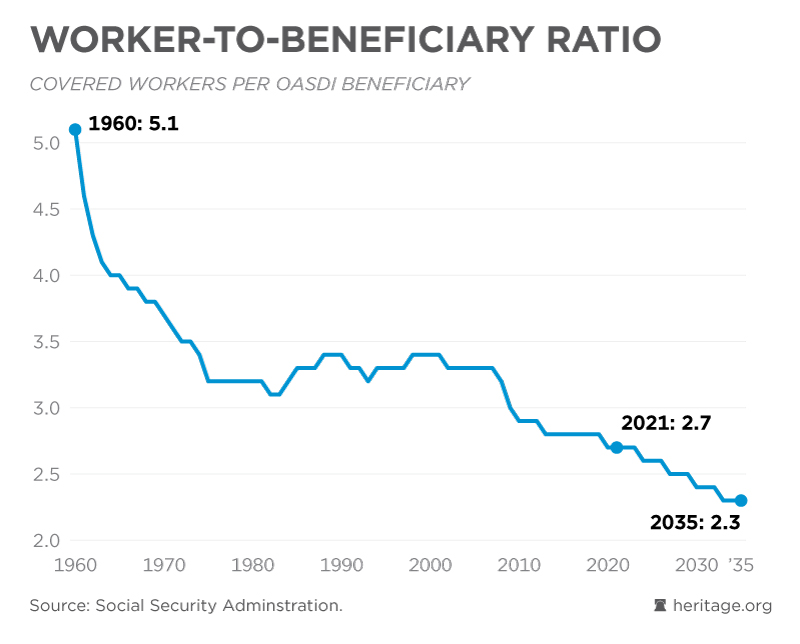
    Although Social Security was meant to be a self-funding program, to quickly begin providing benefits to the elderly poor pay-as-you-go budgeting was required. Given the high ratio of workers to citizens over the age of 65 at the time, this was politically palatable because only a small payroll tax was required to fund the program. 

    But this opened the door to insolvency from increasingly generous promises that could not be covered out of payroll tax revenues when demographics became less favorable (by 2021 the ratio of workers to recipients and fallen to 2.8). Even after 20 payroll tax increases from 1950 to 1990, the irresponsible expansion of benefits left the program with a persistent operating deficit that now threatens the ability to deliver genuine social insurance.  
    Even in years when the so-called trust fund was being drawn down to cover the operating deficit, additional borrowing by the Treasury was required because the funds in the Social Security trust fund were illusory (The Entitlement Collapse Is Worse Than It Looks).  

    The slew of recent revisions to when the Social Security trust fund would run out in the aftermath of the Social Security Fairness Act and the enactment of the One Big Beautiful Bill Act (OBBBA) are therefore a distraction. We are already increasing the federal debt each day to cover the redemption of assets in the Social Security and Medicare Part A trust funds, so when the funds run out that process can simply continue as before – until it can’t. 

    The real problem is the remaining unfunded obligation problem, which has also jumped in response to these two most recent events. Over the next 75 years, its unfunded obligation problem has jumped up to $28 trillion. 

    Moody’s recent downgrading of the US government’s long-term debt instruments is but one piece of growing evidence that we are entering a debt cost spiral due to the increasing debt burden feeding on itself as rising interest rates increase the cost of servicing the debt, requiring more debt, and so on.  If one thing is clear, Social Security in its current form is not sustainable. Fortunately, there are numerous solutions available to stop a catastrophic meltdown of the program (and the US government at large). The challenge of implementing solutions is overcoming those both in government and the private sector who have strong incentives to maintain the status quo.

    David C. Rose, Thomas Savidge

    David C. Rose is a Senior Research Fellow at AIER, an Emeritus Professor of Economics at the University of Missouri-St. Louis, and a member of the US Commission on Civil Rights. He was formerly Senior Fellow and Vice President for Curriculum at the Common Sense Society. For 14 years he was president of The Discussion Club. He has a PhD in Economics from the University of Virginia and a BS in Economics from Missouri State University.

    Dave has published empirical and theoretical scholarly articles in a wide range of areas and his research has been funded by the National Institute of Mental Health, the Weldon Spring Foundation, the HFL Foundation, the Earhart Foundation, and the Templeton Foundation. In recent years his work has increasingly focused on how moral beliefs provide the basis for the cultural foundation of free societies by supporting institutions like the rule of law, property rights, contracts and their enforcement, and the presumptive extension of trust. His book, The Moral Foundation of Economic Behavior, was selected one of CHOICE’s outstanding titles of 2012. His newest book, Why Culture Matters Most, is also from Oxford University Press. His most recent work provides an account of the coevolution of rationality, cooperation, property, and freedom.

    Dave also frequently contributes to policy debates through podcast, radio, and television interviews, as well as in Op-Eds on topics ranging from social security, monetary policy, fiscal policy, judicial philosophy, the rule of law, education reform, healthcare reform, and freedom of speech.

    Thomas Savidge is a Research Fellow at the American Institute for Economic Research. He earned his Master in Public Policy from George Mason University and a Bachelor of Arts in Political Science and Philosophy from SUNY New Paltz.

    Prior to joining AIER, Mr. Savidge was a Research Director at the American Legislative Exchange Council focusing on tax and fiscal policy. He was a co-author of several publications focused on public pensions, public retiree benefits, bonded obligations, tax and expenditure limits, and state taxes. In 2020, Mr. Savidge published a peer-reviewed study on Tennessee public retirement systems with the PERI Center at MTSU titled, “Tennessee Public Pensions: A Model for Reform.”

    Mr. Savidge has also written articles published in The Wall Street Journal, The Orange County Register, Taxnotes, The Washington Post, US News & World Report, The New York Post, and The Daily Caller.

    Americas Cow History Sacred security Social
    Share. Facebook Twitter Pinterest LinkedIn Tumblr Email
    Previous ArticleLinkfest: 14 August, 2025
    Next Article Nobody 2 review – a quick cash grab
    kumbhorg
    • Website
    • Tumblr

    Related Posts

    Global Economy Insights

    Full Employment May Still Signal Stagnation in Labor

    By kumbhorgApril 10, 2026
    Global Economy Insights

    Aksi Balas Dendam Brutal Jason Statham » Dashofinsight

    By kumbhorgApril 9, 2026
    Football

    Preview, prediction and how to watch as Rory McIlroy bids to make history at Augusta

    By kumbhorgApril 9, 2026
    Global Economy Insights

    The Lesson of The Lorax Isn’t What You Think

    By kumbhorgApril 9, 2026
    Global Economy Insights

    Bedah Spesifikasi Mesin XMAX 2026 Facelift Yang Makin Gahar » Dashofinsight

    By kumbhorgApril 8, 2026
    Global Economy Insights

    Economist and Revolutionary – Adam Smith and 1776

    By kumbhorgApril 8, 2026
    Add A Comment

    Comments are closed.

    Don't Miss

    This coat cost $248 in illegal tariffs. Will he ever get the money back?

    By kumbhorgApril 10, 2026

    Importers are in line for tariff refunds. But whether everyone who paid the for the…

    Bitcoin Could Be Quantum-Safe Without Protocol Changes

    April 10, 2026

    Sam Levinson talks inspiration behind ‘Euphoria 3’ and Angus Cloud: ‘He was someone I loved very much’ |

    April 10, 2026

    AVAX Price Moves With the Market as Avalanche Activity Picks Up

    April 10, 2026
    Top Posts

    Satwik-Chirag storm into China Masters final with straight-game win over Malaysia | Badminton News

    September 21, 2025165 Views

    SaucerSwap SAUCE Crypto Breaks Key Resistance Amid Nvidia-Hedera Deal

    July 15, 202546 Views

    Unlocking Your Potential with Mubite: The Future of Crypto Prop Trading

    September 17, 202533 Views

    Stablecoins 2025 Exchange Reserves: Insights into DeFi Trends

    September 8, 202532 Views
    Stay In Touch
    • Facebook
    • Twitter
    • Pinterest
    • Instagram
    • YouTube
    • Vimeo
    About Us

    Welcome to KumbhCoin!
    At KumbhCoin, we strive to create a unique blend of cultural and technological news for a diverse audience. Our platform bridges the spiritual significance of the Kumbh Mela with the dynamic world of cryptocurrency and general news.

    Facebook X (Twitter) Pinterest WhatsApp
    Our Picks

    This coat cost $248 in illegal tariffs. Will he ever get the money back?

    April 10, 2026

    Bitcoin Could Be Quantum-Safe Without Protocol Changes

    April 10, 2026

    Sam Levinson talks inspiration behind ‘Euphoria 3’ and Angus Cloud: ‘He was someone I loved very much’ |

    April 10, 2026
    Most Popular

    7 things to know before the bell

    January 22, 20250 Views

    Reeves optimistic despite surprise rise in UK borrowing

    January 22, 20250 Views

    Barnes & Noble stock soars 20% as it explores a sale Barnes & Noble stock soars 20% as it explores a sale

    January 22, 20250 Views
    • Terms and Conditions
    • Privacy Policy
    • Contact Us
    • About Us
    © 2026 Kumbhcoin. Designed by Webwizards7.

    Type above and press Enter to search. Press Esc to cancel.