

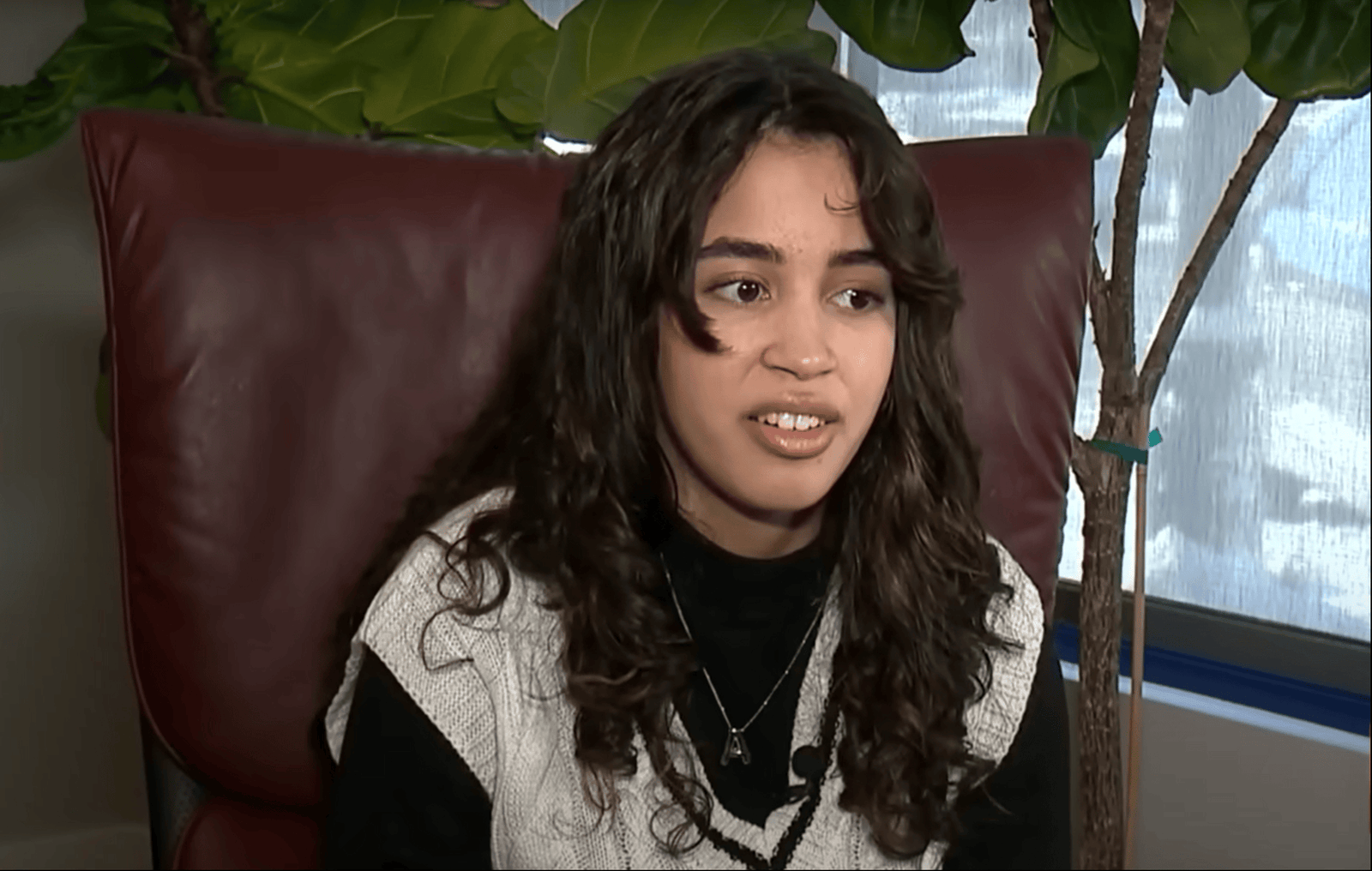
A nineteen-year-old college student is suing her former high school for negligence because she graduated despite being unable to read or write.
The student, Aleysha Ortiz, graduated from Hartford Public Schools in the spring of 2024 with honors. She earned a scholarship to attend the University of Connecticut, where she’s studying public policy. But while she was in high school, she had to use speech-to-text apps to help her read and write essays, and despite years of advocating for support for her literacy struggles, her school never addressed them.
Her story is shocking, but unfortunately, it isn’t isolated. At 24 Illinois public schools, not a single student can read at grade level. Nationwide, 54 percent of the American adult population reads at or below a sixth grade level. Put a different way: only 46 percent of American adults gained even a middle-school level mastery of literacy — let alone high school or collegiate levels.
In a first-world country where we spend nearly $16,000 per student per year to educate our children, that’s a horrifying statistic.
Literacy is supposed to be the bedrock of a free and liberally educated society. As the Washington Post’s motto so aptly reminds us, “democracy dies in darkness.”
Illiteracy is a form of darkness, and an illiterate populace is not one equipped to handle the demands of a world filled with forms and papers and words, let alone be the voting citizens of a democratic society.
What Do Literacy Stats Actually Mean?
Officially, the United States reports a basic literacy rate of 99 percent (which should perhaps be called into question, if students like Aleysha Ortiz can graduate with honors and still be illiterate).
But “basic literacy” is a bit of a sales pitch. It sounds impressive, but in practice, “basic literacy skills” means a K-3 grade level of reading – things like Hop on Pop and Amelia Bedelia.
“Functional literacy” is what actually matters: the ability to read and understand things like forms, instructions, job applications, and other forms of text you’ll encounter in your day-to-day life. It measures both technical reading skill and comprehension – your ability to decipher the words, and your ability to discern their meaning.
An estimated 21 percent of American adults (~43 million Americans) are functionally illiterate, meaning they have difficulty reading and comprehending instructions and filling out forms. A functionally illiterate American adult is unable to complete tasks like reading job descriptions or filling out paperwork for Social Security and Medicaid.
Perhaps worse still is the statistic that 54 percent of the American adult population reads at or below a sixth-grade level. Most of us don’t think about reading in terms of grade level, so this statistic feels intuitively bad but practically meaningless. What is a sixth-grade level?
Books written at the sixth-grade level are intended (in both literacy and comprehension skills) for eleven- and twelve-year-olds. Think of books like A Wrinkle in Time, Percy Jackson and The Olympians, and The Giver.
They’re good stories, but they don’t require the same vocabulary and mental acuity as making sense of a tax form. This is an excerpt from The Giver:
Garbriel’s breathing was even and deep. Jonas liked having him there, though he felt guilty about the secret. Each night he gave memories to Gabriel: memories of boat rides and picnics in the sun; memories of soft rainfall against windowpanes; memories of dancing barefoot on a damp lawn.
More complex than Dick and Jane or Hop on Pop, obviously. But this isn’t an adult level of comprehension. If your reading abilities cap out here, you’re going to encounter a lot of text in your day-to-day life that’s difficult to decipher – often things that are important for you to be able to comprehend, like the terms of a lease agreement or the instructions on a medication.
Has It Always Been Like This?
Our public education system has been plagued by literacy struggles for decades. But American literacy was not always in such poor condition. Famous American historical texts are particularly interesting to study as an example.
Second only to the Bible, the most popular work of the Colonial Era was John Bunyon’s Pilgrim’s Progress. It sold millions of copies, and Benjamin Franklin described it as being found in nearly every colonial home. As Harriet Beecher Stowe later wrote, “no book, save the Bible, has been more read by the common people.”
Its language is not watered down for the literarily meek:
Mr. Worldly-Wiseman is not an ancient relic of the past. He is everywhere today, disguising his heresy and error by proclaiming the gospel of contentment and peace achieved by self-satisfaction and works. If he mentions Christ, it is not as the Savior who took our place, but as a good example of an exemplary life. Do we need a good example to rescue us, or do we need a Savior?
This is, again, well above a sixth-grade level. Today, “heresy” is considered to be a college-level word. “Exemplary” is eleventh grade.
Pilgrim’s Progress was used for both spiritual and literacy instruction, and Protestant early America (especially in New England) valued a literate population, one where every man could read his own Bible.
Today, over half the American population cannot read and understand that passage. So what happened?
America’s Literacy Woes: A Brief History
Alas, our literacy crisis has existed for nearly as long as our public education system. In the 1950s, mere decades after the public school system entrenched itself as part of American life, Rudolf Flesch wrote a scathing book titled Why Johnny Can’t Read, in which he pulled no punches about our already staggering literacy failings.
At the time, official reports were that around 95 percent of American adults were literate. But Flesch, and other critics like him, were raising growing concerns about functional literacy and reading comprehension. Not “can Johnny see the words on the page and know what each one says,” but “can Johnny understand what he’s reading?”
Flesch argued that the answer, in many cases, was no.
We trundled on. In the 1980s, Reagan’s administration published the landmark paper titled A Nation at Risk, in which Americans were warned about our falling academic test scores – including our literacy – and that if the trend wasn’t corrected, it would lead to a national crisis.
Fifty years later, the trend has not been corrected, and we are a nation in risky waters, especially considering the financial lengths we’ve gone to trying to improve it. As a nation, we spend nearly $16,000 per student per year on our public K-12 education. Nationwide, we spend $857.2 billion per year on public K-12 schools.
If that isn’t buying literacy for all, then what exactly is it paying for?
The issue, in part, is the approach. In the Sold a Story documentary podcast series published in 2022, Emily Hanford started a controversy by pulling back the curtain on how reading instruction is done in America. For decades, schools have been instructed to teach children to read using the whole-word method (or the look-say method), not phonics, despite the clear empirical evidence that whole-word methods do not create literacy.
Phonics is the cheat code that allows readers to decode language: memorize 26 letters and their corresponding 44 sounds, and unlock the lifelong ability to sound out nearly any word you will ever encounter in every language using the Roman alphabet (about 3,000 languages, making it the most widely-used alphabet in the world). Children learn to read first by learning the alphabet and memorizing each letter’s sounds, then slowly stringing those sounds together into words: h-o-p o-n p-o-p. Over time, they build the muscle to decode longer and longer words, building their comprehension skills along the way.
The whole-word method, on the other hand, bypasses phonics altogether. Children are taught to read by recognizing words, not by sounding them out, in what one critic calls ‘a psycho-linguistic guessing game.’ If they don’t recognize a word, they’re encouraged to guess its meaning by context clues — in the early years, by looking at the pictures in a picture book; in later years, by gleaning the context from the words around them. If you experienced Dick and Jane readers, you were exposed to early whole-word education. This approach to reading is mere word memorization, not true literacy mastery. The concept of phonics — prerequisite to meaning-making and accurate decoding — is never even introduced in many school systems.
Once we learn to read, we often use the whole-word method as a shortcut — you’re likely reading this sentence by recognizing the words, not by sounding them out. But if you bypass the ability to sound out words you don’t know (and to phonetically write words you don’t know how to spell), you break the foundation of actual literacy. This is what many public school classrooms have been doing for decades — teaching from a long-disproven method we know puts students at risk of illiteracy.
But even this is only part of the problem. The methods for tracking student progress and understanding their level of mastery are also broken. Some kids are fully conscious of their struggles to read, like Aleysha Ortiz. But other students come home with glowing report cards, and no one, students or parents alike, realizes that anything is wrong. This is why ACT scores are falling while high school GPAs are rising. Grade inflation has rendered report cards meaningless as a measure of overall academic performance.
Some of the problem is nuanced – GPAs include things like diligence in homework and class participation as well as test results, while ACT scores measure only rote academic performance – but teachers are also often pressured to keep their pass rates high. Funding and policy are often tied to student performance and graduation rates, so schools are incentivized to keep students passing and moving through the system, even when they’re not learning.
To many, it may be inconceivable that teachers would continue to teach in a way they know doesn’t work, bowing to political pressure over the needs of students. But to those familiar with the incentive structures of public education, it’s no surprise. Teachers unions and public district officials fiercely oppose accountability and merit-based evaluation for both students and teachers. Teachers’ unions consistently fight against alternatives that would give students in struggling districts more educational options. In attempts to improve ‘equity,’ some districts have ordered teachers to stop giving grades, taking attendance, or even offering instruction altogether.
Grade inflation, social promotion, and a general disinterest in individual outcomes keep kids shuffling along the conveyor belt. Aleysha Ortiz used speech-to-text apps to help her write her high school essays, which were strong enough for her to graduate from Hartford Public School with honors. Like Ortiz, students keep getting passed through the system, passing tests and advancing from grade to grade without ever actually learning the core skills they need to survive in the world.
Which is how we’ve ended up with a population where 54 percent of American adults don’t have the literacy skills to read this article, and with a country that will, very quickly, drop behind the world in its overall ability if we don’t turn things around.
