

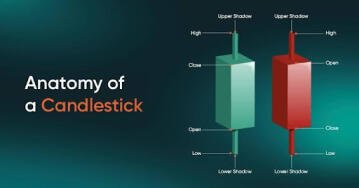
Candlestick charts are one of the most widely used tools in technical analysis, offering traders a clear and concise way to interpret price movements over specific time intervals. Each candlestick captures four key data points—the open, high, low, and close—providing valuable insight into market behaviour within that period.
By studying the shapes and formations of candlestick patterns, traders can gauge market sentiment, identify potential reversals or continuations, and make more informed trading decisions. Whether you’re trading forex, stocks, or commodities, understanding candlestick charts can enhance your ability to analyse price action and refine your strategy.
In this guide, we’ll explore 16 essential candlestick charts every trader should know—and how to apply them effectively in real-world market conditions.
Key Points
- Candlestick charts visually represent price action by displaying the open, high, low, and close of an asset within a specific timeframe.
- Recognising key candlestick patterns helps traders anticipate market reversals, continuations, and shifts in sentiment.
- Learning how to interpret candlestick charts is essential for building a solid technical trading strategy across various markets.
What are Candlesticks in Trading?
Candlesticks are a key tool used in trading to represent price movements of an asset over a specific time period. Each candlestick displays four essential pieces of information:

Image 1: Anatomy of a candlestick
- Open: The open is the price of an asset at the start of the trading period, showing where the market begins. It provides a baseline for comparison with the close to determine whether the price has risen or fallen.
- Close: The close is the final price of an asset at the end of the trading period. It is a key indicator of market sentiment and is compared with the open to assess if the market ended higher (bullish) or lower (bearish).
- High: The high represents the maximum price reached by the asset during the trading period. It reflects the strongest point of buyer interest before the price retraces.
- Low: The low is the minimum price the asset reached within the trading period. It shows the lowest point of selling pressure before the price rebounded.
With all this information derived from one humble candlestick, do not underestimate the value of using candlesticks in your trading as each candlestick tells a certain story.
Why Use Candlestick Charts
Candlestick charts are widely used by traders because they provide a clear visual representation of price movements within a specific period. One of the key advantages of candlesticks is that they offer more detail than simple line charts, allowing traders to quickly grasp market sentiment and identify potential trends.
The distinct shapes, colours, and patterns formed by candlesticks provide deeper insights into whether an asset is in a bullish or bearish trend, helping traders refine both their short-term and long-term strategies.
Additionally, candlestick charts can reveal important reversal or continuation patterns that may not be easily spotted using other chart types. By recognising these patterns, traders can make more informed decisions about when to enter or exit a trade, potentially capitalising on market opportunities.
How to Read Candlesticks Charts
Interpreting candlestick charts is key to understanding market sentiment.
A bullish candle indicates the price closed higher than it opened, signalling buyer dominance and an upward trend. This is typically represented by a green candle.
In contrast, a bearish candle shows that the price closed lower than it opened, reflecting stronger selling pressure and a downward trend. This is usually represented by a red candle.
Beyond colour, the size of the candlestick body and its wicks (or shadows) offer deeper insights:
- A long body reflects strong buying or selling activity, confirming a decisive market move.
- A short body suggests market indecision or minimal price change during the session.
- Long upper or lower wicks may indicate price rejection at those levels, pointing to possible reversals or weakening trends.
As you continue reading, we’ll explore the most common candlestick patterns and how traders use them to make informed decisions.
Bullish Candlestick Patterns
Bullish candlestick patterns are formations on a candlestick chart that suggest a potential reversal from a downtrend to an uptrend. These patterns signal growing buying pressure and are commonly used by traders to identify entry points in a bullish market setup.
1. Hammer
The hammer is a single-candle bullish reversal pattern that forms after a downtrend. It has a short body near the top and a long lower wick, showing that although sellers initially pushed the price down, buyers regained control by the close.

Image 2: Hammer candlestick pattern
Pattern Characteristics:
- Appears at the bottom of a downtrend
- Small body, long lower shadow
- Signals buyer strength returning
- Common in reversal trading strategies
2. Inverted Hammer
The inverted hammer also forms after a downtrend but has a long upper wick and a small body near the base. It reflects early buying interest, though confirmation from the next bullish candle is usually required to validate the pattern.

Image 3: Inverted hammer candlestick pattern
Pattern Characteristics:
- Occurs during a downtrend
- Small body with long upper shadow
- Indicates potential bullish reversal
- Requires follow-up confirmation
3. Bullish Engulfing
The bullish engulfing pattern consists of two candles. The first is a small bearish candle, followed by a larger bullish candle that completely covers or ‘engulfs’ the previous body. This shows a decisive shift from selling to buying momentum.

Image 4: Engulfing candlestick patterns
Pattern Characteristics:
- Two-candle reversal pattern
- Second candle engulfs the first
- Appears after a downtrend
- Strong sign of a shift in sentiment
4. Three White Soldiers
This pattern features three strong bullish candles forming consecutively, each closing higher than the last. It represents sustained buying momentum and is considered one of the more reliable bullish candlestick patterns.

Image 5: Three white soldiers candlestick pattern
Pattern Characteristics:
- Three consecutive green candles
- Higher closes with little wick shadows
- Indicates strong upward momentum
- Suggests potential trend reversal or continuation
5. Piercing Line
The piercing line is a two-candle formation. It starts with a long bearish candle, followed by a bullish candle that opens lower but closes above the midpoint of the first. It signals buying strength entering the market.

Image 6: Piercing line candlestick pattern
Pattern Characteristics:
- Found after a price drop
- Bullish candle closes above 50% of previous candle
- Suggests market recovery
- Early indicator of a bullish shift
6. Morning Star
The morning star is a three-candle bullish reversal pattern. It begins with a bearish candle, followed by a small-bodied candle that signals indecision, and ends with a strong bullish candle. Together, they indicate weakening selling pressure and growing buyer confidence.

Image 7: Morning star candlestick pattern
Pattern Characteristics:
- Three-candle reversal setup
- Forms after a downtrend
- Centre candle shows hesitation
- Often confirms a new bullish trend
7. Bullish Marubozu
A bullish marubozu is a single, full-bodied candle with no visible wicks. It opens at the low and closes at the high, reflecting total buyer control during the session. It’s a strong signal of continued bullish momentum.

Image 8: Bullish Marubozu candlestick pattern
Pattern Characteristics:
- No wicks, just a solid green body
- Strong confirmation of buyer dominance
- Common in breakout strategies
- Indicates confidence in price rise
8. Dragonfly Doji
The dragonfly doji appears when the open, close, and high prices are nearly the same, with a long lower shadow. This suggests sellers had the upper hand early on, but buyers pushed the price back up, showing signs of a potential reversal.

Image 9: Dragonfly Doji candlestick pattern
Pattern Characteristics:
- Long lower wick, flat top
- Indicates rejection of lower prices
- Signals shift in momentum
- Watch for confirmation candle after
Bearish Candlestick Patterns
Bearish candlestick patterns are chart signals that suggest a potential shift from an uptrend to a downtrend. These formations often appear at the top of price movements and are widely used by traders to anticipate selling pressure and identify potential exit or short-selling opportunities.
1. Bearish Engulfing
The bearish engulfing is a two-candle reversal pattern that appears after an uptrend. It forms when a small bullish candle is followed by a larger bearish candle that completely covers the previous candle’s body, signalling a strong shift in momentum from buyers to sellers.

Image 10: Engulfing candlestick patterns
Pattern Characteristics:
- Appears after an uptrend
- Bearish candle fully engulfs the prior bullish body
- Indicates rising selling momentum
- Suggests potential trend reversal
2. Morning Star
While commonly known as a bullish pattern, the morning star has a bearish counterpart—appearing as a three-candle formation at the top of an uptrend. It consists of a bullish candle, a small-bodied candle showing indecision, and a strong bearish candle, signalling a potential reversal.

Image 11: Morning Star candlestick pattern
Pattern Characteristics:
- Three-candle setup
- Occurs after an uptrend
- Signals weakening buyer strength
- Confirms bearish shift when followed by downward price action
3. Hanging Man
The hanging man is a single-candle bearish pattern found at the peak of an uptrend. Its small real body and long lower shadow suggest that selling pressure is emerging even as the price attempts to rise.

Image 12: Hanging Man candlestick pattern
Pattern Characteristics:
- Forms after a price rise
- Small body, long lower wick
- Resembles a hammer but signals bearishness
- Often needs confirmation from the next candle
4. Shooting Star
A shooting star appears at the top of an uptrend and signals a potential reversal. It features a small real body near the bottom and a long upper wick, indicating that buyers pushed prices up, but sellers regained control by the close.

Image 13: Shooting Star candlestick pattern
Pattern Characteristics:
- Appears in an uptrend
- Long upper shadow, small body below
- Suggests rejection of higher prices
- Implies possible price decline ahead
5. Three Black Crows
This pattern consists of three consecutive long bearish candles with lower closes each day. It shows a strong reversal from bullish to bearish sentiment, often confirming a developing downtrend.

Image 14: Three Black Crows candlestick pattern
Pattern Characteristics:
- Three strong red candles in a row
- Little to no lower wicks
- Each closes lower than the previous
- Indicates strong and sustained selling pressure
6. Dark Cloud Cover
The dark cloud cover is a two-candle bearish reversal pattern that appears after an uptrend. It starts with a strong bullish candle, followed by a bearish candle that opens higher but closes below the midpoint of the first. This pattern signals weakening buying pressure and a potential shift towards a downtrend.

Image 15: Dark Cloud Cover candlestick pattern
Pattern Characteristics:
- Two candles: bullish then bearish
- Bearish candle closes below the midpoint of the bullish
- Appears after an uptrend
- Signals a potential shift to downside momentum
7. Bearish Harami
The bearish harami features a large bullish candle followed by a smaller bearish candle that is completely contained within the body of the previous one. It reflects waning buying pressure and potential market hesitation at the top.

Image 16: Bearish Harami candlestick pattern
Pattern Characteristics:
- Two-candle pattern
- Small bearish candle inside larger bullish body
- Indicates weakening bullish momentum
- Requires confirmation for a stronger signal
8. Bearish Marubozu
A bearish marubozu is a long red candle with no upper or lower shadows, meaning the price opened at the high and closed at the low. It shows strong selling pressure throughout the session and often signals the beginning or continuation of a downward trend.

Image 17: Bearish Marubozu candlestick pattern
Pattern Characteristics:
- Long bearish body with no shadows
- Opens at the high and closes at the low
- Reflects strong seller control
- Useful for confirming trend direction
The Power of Candlestick Analysis in Your Trading Journey
Candlestick analysis is a vital tool for traders who need to decipher market sentiment and identify potential trends effectively. It provides a visual representation of price movements, offering insights into the open, high, low, and close values within a specific period.
By integrating these patterns with other technical indicators like RSI and moving averages, traders can obtain more reliable signals and refine their trading strategies. This comprehensive approach not only helps in making informed decisions but also aids in better risk management.
Ready to unlock the full potential of candlestick analysis in your trading? Sign up for a live trading account today with Vantage today.
