

British satirist and cultural commentator Konstantin Kisin — author of An Immigrant’s Love Letter to the West (2022) — recently shared a debate clip from Doha, Qatar, in which he made a simple observation: Slavery has existed in every human society and across the whole of human history.
It’s a statement so uncontroversial it should have, at most, drawn some polite nods. Instead, it provoked gasps, giggles, boos, and tut-tuts from the hostile audience (see below).
Understanding history means confronting uncomfortable truths, not rewriting them. pic.twitter.com/sLkVuPgxTZ
— Konstantin Kisin (@KonstantinKisin) August 1, 2025
This reaction reflects a troubling trend in modern discourse.
Rather than seriously engaging with arguments that challenge their preconceived ideas, many people have been so ravaged by ideological tribalism that they retreat into their comforting bubbles of confirmation bias.
In this case, Kisin’s point disrupts the one-dimensional narrative often presented in discussions on colonialism, slavery, and racial politics — a narrative reinforced in recent decades by figures like Ibram X. Kendi, Robin DiAngelo, and Nikole Hannah-Jones.
But slavery was the global norm for millennia and existed on every inhabited continent.
The very word “slave” originally referred to Slavic people in northern Europe, who were frequently captured by Vikings.
The Arab slave trade operated for over a thousand years and likely enslaved as many as 18 million people, as compared to 12 million over about 400 years for the Transatlantic slave trade. It was also often far more brutal. Male slaves were routinely castrated using barbaric and unsanitary methods that led to the painful deaths of between 60-90 percent of them, according to historians such as Bernard Lewis, Murray Gordon, Jan Hogendorn, and Marion Johnson.
Barbary pirates from North Africa enslaved perhaps a million Europeans, in addition to millions of other Africans, between the mid-1400s and the beginning of the nineteenth century, when the US destroyed much of the pirates’ capacity to capture slaves during the First and Second Barbary Wars.
Slavery was widespread across Asia as well — India, China, Japan, Korea, Thailand, and Mongolia all have significant histories of enslavement, and the practice still persists in parts of Africa, the Middle East, and China today.
To place sole blame on Europeans as many leftists do betrays profound ignorance and an utter disregard for reality.
As Kisin correctly pointed out, it was in fact the West — particularly Britain and the United States — that ultimately led the global effort to abolish slavery.
The abolitionist movement was born from the same philosophical ideas that informed America’s founding, typically coupled with the evolving religious viewpoint that all human beings deserve to be treated with dignity and grace as they are all part of God’s creation.
Given that fact, it’s unsurprising that one of the earliest organized objections to slavery came from Quakers in Germantown, Pennsylvania, in 1688.
Four men — Francis Daniel Pastorius, Garret Hendericks, Derick op den Graeff, and Abraham op den Graeff — wrote a petition invoking the principle, “do unto others as you would have them do unto you,” challenging society’s acceptance of enslavement. Over the eighteenth century, Quakers increasingly barred slaveholders from their congregations and lobbied governments to outlaw the practice.
Enlightenment philosophers provided a broader intellectual foundation.
John Locke’s theory of natural rights — “life, liberty, and property” — strongly influenced Thomas Jefferson and the entire structure of America’s Constitution and Bill of Rights. David Hume, Montesquieu, and Adam Smith critiqued both the morality and economics of slavery. In The Wealth of Nations, Smith argued that slavery was not only unjust but also economically inefficient:
“The work done by slaves… comes dearer to the master than that performed by freemen.”
These ideas fueled some of history’s most remarkable anti-slavery campaigns.
British Abolitionists such as William Wilberforce, Thomas Clarkson, and Granville Sharp wove those Enlightenment ideas and Christian teachings into effective advocacy, while firsthand accounts amplified the call for change. Former slave Olaudah Equiano documented the horrors of enslavement and the promise of liberty. He worked with Thomas Clarkson, who collected evidence of the trade’s brutality to persuade the public and Parliament.
As Clarkson famously wrote,
“We cannot suppose that God has made such a difference between us and them, as to intend one part of mankind to be the perpetual slaves of another.”
Thanks to their efforts, Britain abolished the slave trade across its vast empire with the Slave Trade Act in 1807.
Abolition was neither cheap nor politically expedient.
Britain spent the modern equivalent of hundreds of billions of dollars enforcing abolition, tasking the Royal Navy’s West Africa Squadron with hunting down slavers, sinking their ships, demolishing their slave ports, and freeing the men and women enslaved there. Over a period of a few decades, they seized over 1,600 slave ships and freed at least 150,000 Africans. They also paid an enormous amount of money as compensation to slaveowners under the 1833 Slavery Abolition Act, in exchange for more peacefully ending the practice where they could.
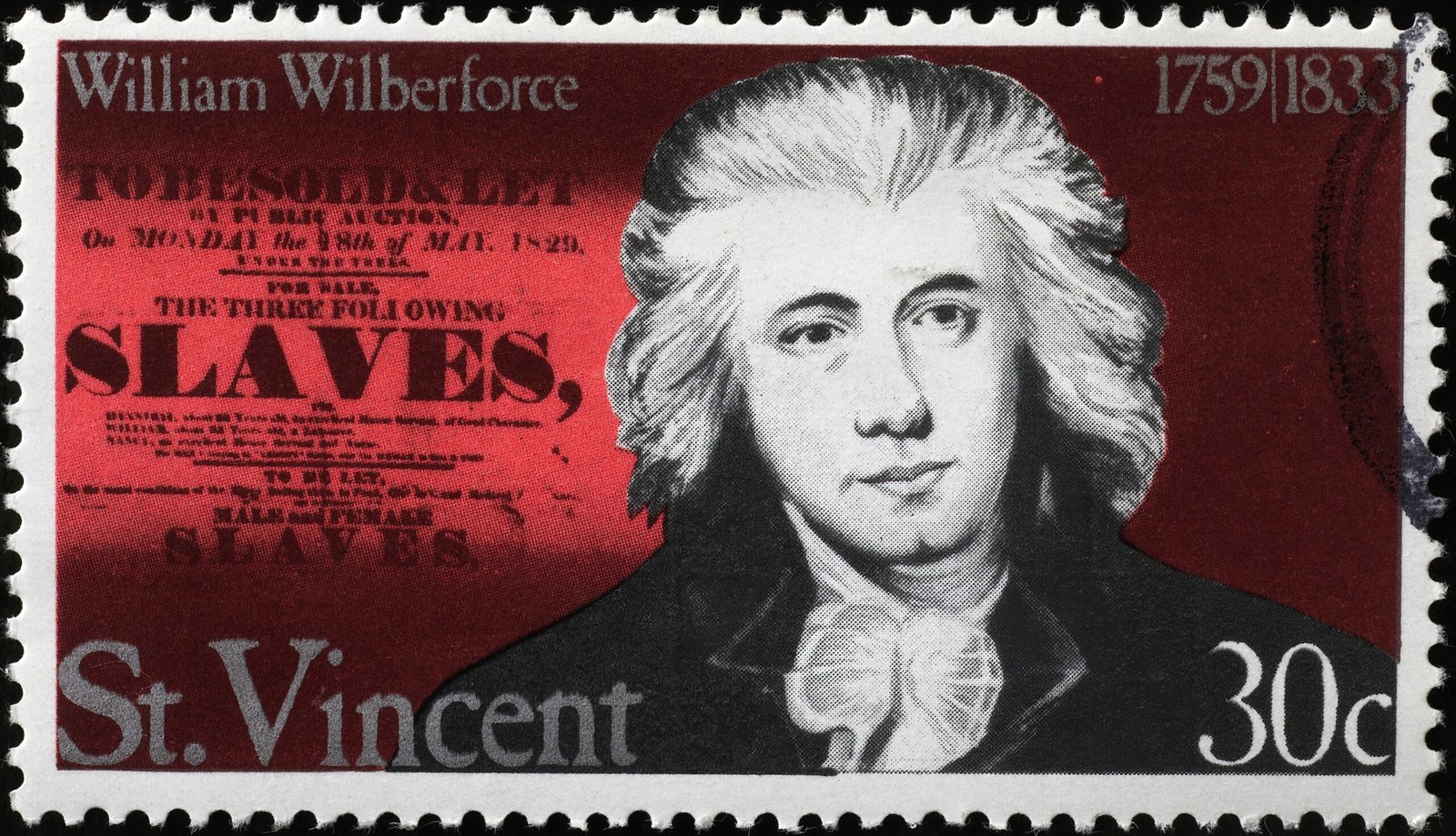
William Wilberforce, who championed abolition in Parliament for decades, finally witnessed his life’s work realized just days before his death in 1833.
Meanwhile, the United States’ founders grappled with the same moral questions.
America’s relationship to slavery was more complicated but still deeply informed by the same Enlightenment principles. At the Constitutional Convention, slavery was one of the most divisive issues. Northern states were already moving toward abolition. Several southern states had begun phasing it out or restricting the trade.
But even the strongest voices for abolition among the Founders, such as Benjamin Franklin and John Adams recognized that pushing total abolition in that moment would have broken the union in its infancy, negating their hard-won fight for independence. Instead, they deployed mechanisms like the Three-Fifths Compromise — which, contrary to many people’s mistaken understanding, was a way to reduce the political power of slave states within the federal government.
Even some of the slave-owning Founders such as George Washington (who inherited slaves from his father and his wife Martha’s family) viewed slavery as morally abhorrent, writing “I can only say that there is not a man living who wishes more sincerely than I do to see a plan adopted for the abolition of it,” in a letter to Robert Morris in 1786.
Hypocrite though he may have been, Washington also freed the 123 slaves he owned at the time of his death. It’s worth noting that this was the only example of such a large-scale emancipation in Virginia at the time.
The moral tension between human dignity and political expediency was always inescapable — and it percolated for decades.
Abolitionist voices grew louder, from Frederick Douglass to Sojourner Truth. Eventually, that tension exploded in the form of the Civil War — the bloodiest conflict in U.S. history. And at its conclusion, the Thirteenth Amendment finally abolished slavery in 1865, making America one of the first nations in the world to do so.
The West’s confrontation with slavery was imperfect but principled. It was driven by ideas valuing human dignity, liberty, and moral responsibility. These efforts demonstrate that moral courage, grounded in reason and ethics, can reshape societies.
The lesson remains relevant today. Ideologically blinkered presentism has compelled a huge number of people to reduce the complex reality of these issues to a moral black and white built almost entirely on falsehoods.
But recognizing the historical scope of slavery, the complexity of its abolition, and the immense human cost involved should not be a matter of ideology; it is a matter of truth. Understanding this history equips us to engage with moral and political questions more thoughtfully and to appreciate the principles that helped dismantle one of humanity’s darkest institutions.
