


Gold (XAU/USD) attracts buyers for the second straight day and jumps back above the $4,000 psychological mark during the early European session on Thursday. Concerns about the economic fallout from a prolonged US government shutdown prompt some US Dollar (USD) selling and drag it away from the highest level since late May, touched on Wednesday. This, along with persistent geopolitical uncertainties, turns out to be a key factor driving some safe-haven flows towards the bullion.
Meanwhile, the latest optimism over easing US-China trade tensions remains supportive of a positive risk tone and might hold back the XAU/USD bulls from placing aggressive bets. Furthermore, the US Federal Reserve’s (Fed) hawkish tilt should limit deeper USD losses and also cap the non-yielding Gold. Hence, it will be prudent to wait for strong follow-through buying before confirming that the recent corrective decline from the record high touched in October has run its course.
Daily Digest Market Movers: Gold attracts some safe-haven flows amid a modest USD pullback
- The US government shutdown entered its sixth week on Wednesday, becoming the longest in history and surpassing the 35-day record set during President Donald Trump’s first term. Economists now seem worried that a prolonged government closure would affect the economic performance.
- The nonpartisan Congressional Budget Office estimated the government shutdown could slice between 1.0 and 2.0% off Gross Domestic Product in the fourth quarter. This caps the recent US Dollar rally to its highest level since late May and supports the safe-haven Gold for the second straight day.
- Russian President Vladimir Putin has ordered preparations for nuclear testing after Trump said last week that the US would be running tests. Moreover, Russia has intensified its offensive and launched coordinated artillery strikes across eastern Ukraine, further benefiting the bullion.
- Automatic Data Processing reported that private sector employment in the US rose by 42K in October, against 25K estimated and a 29K decrease recorded in the previous month. Separately, the Institute for Supply Management’s (ISM) Non-Manufacturing Purchasing Managers’ Index rose to an eight-month high.
- Traders scaled back their bets for another 25-basis-point rate cut in December following the US Federal Reserve’s hawkish tilt last week. This could limit any meaningful USD corrective decline and keep a lid on a further appreciation for the non-yielding yellow metal, warranting some caution for bulls.
- Traders look forward to speeches from influential FOMC members later during the North American session for cues about the future rate-cut path. This will play a key role in driving the USD demand, which, along with the broader risk sentiment, should provide some impetus to the XAU/USD pair.
- On the trade-related front, China said on Wednesday that it would extend a suspension of additional tariffs on US goods for one year, making official an agreement reached in talks between Presidents Xi Jinping and Donald Trump last week.
Gold might now aim towards testing the next relevant hurdle near the $4,025-4,030 region
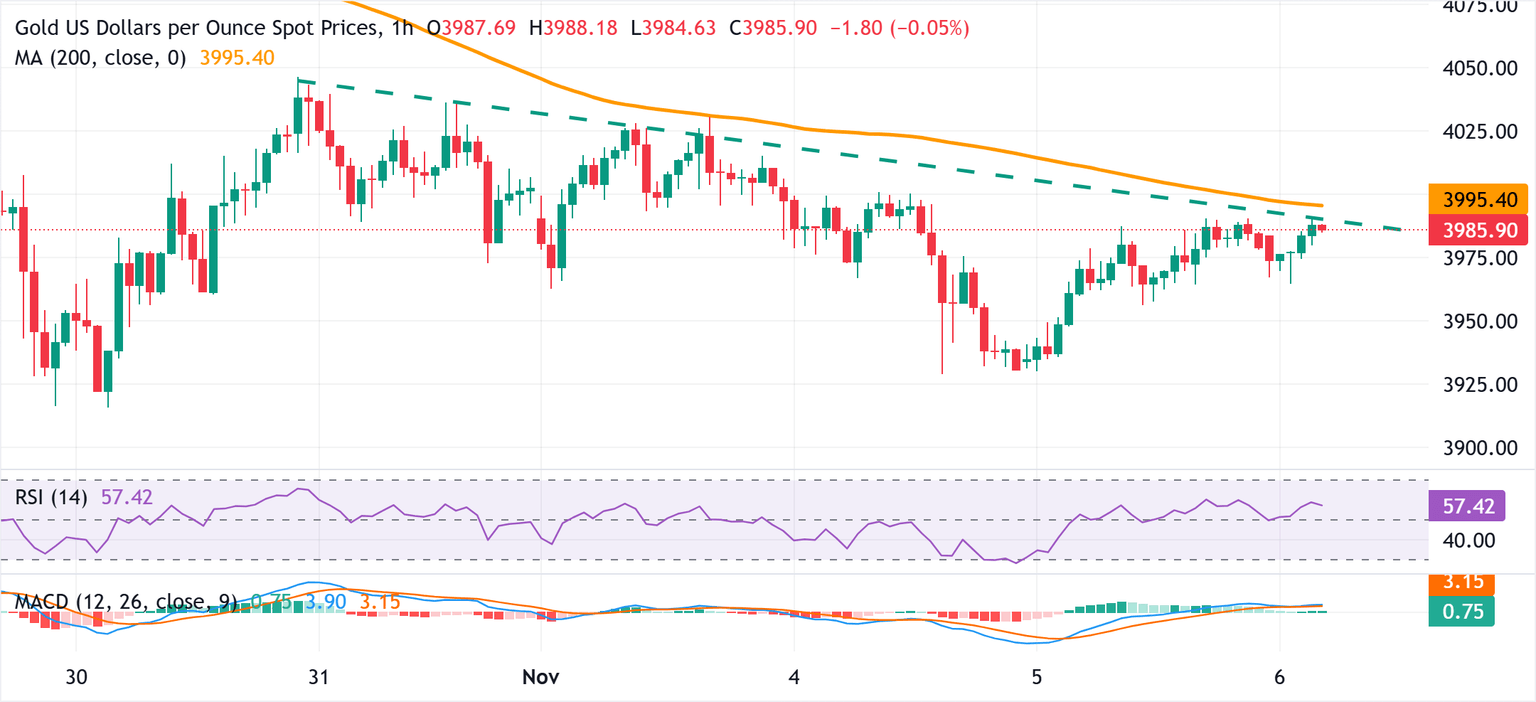
The commodity is currently placed near the $3,990-3,995 confluence hurdle – comprising a short-term descending trend-line extending from last Friday and the 200-hour Simple Moving Average (SMA). A convincing breakout through the said barrier could trigger a short-covering move towards the $4,025-4,030 horizontal resistance. Some follow-through buying beyond the $4,040-4,045 region might shift the near-term bias back in favour of the XAU/USD bulls and pave the way for a move towards reclaiming the $4,100 mark with some intermediate hurdle near the $4,075 area.
On the flip side, weakness below the $3,972-3,970 immediate support might continue to attract some dip-buyers, which should help limit the downside for the Gold near the $3,940-3,935 region. The next relevant support is pegged near the $3,910-3,900 region and last week’s swing low, around the $3,886 zone. Failure to defend the said support levels would be seen as a fresh trigger for bearish traders and set the stage for the resumption of the recent corrective decline from the all-time peak.
US Dollar Price Today
The table below shows the percentage change of US Dollar (USD) against listed major currencies today. US Dollar was the strongest against the New Zealand Dollar.
| USD | EUR | GBP | JPY | CAD | AUD | NZD | CHF | |
|---|---|---|---|---|---|---|---|---|
| USD | -0.18% | -0.10% | -0.18% | -0.07% | -0.11% | 0.08% | -0.16% | |
| EUR | 0.18% | 0.08% | -0.02% | 0.11% | 0.07% | 0.26% | 0.02% | |
| GBP | 0.10% | -0.08% | -0.06% | 0.03% | -0.01% | 0.18% | -0.06% | |
| JPY | 0.18% | 0.02% | 0.06% | 0.12% | 0.09% | 0.25% | 0.04% | |
| CAD | 0.07% | -0.11% | -0.03% | -0.12% | -0.03% | 0.12% | -0.10% | |
| AUD | 0.11% | -0.07% | 0.00% | -0.09% | 0.03% | 0.19% | -0.05% | |
| NZD | -0.08% | -0.26% | -0.18% | -0.25% | -0.12% | -0.19% | -0.24% | |
| CHF | 0.16% | -0.02% | 0.06% | -0.04% | 0.10% | 0.05% | 0.24% |
The heat map shows percentage changes of major currencies against each other. The base currency is picked from the left column, while the quote currency is picked from the top row. For example, if you pick the US Dollar from the left column and move along the horizontal line to the Japanese Yen, the percentage change displayed in the box will represent USD (base)/JPY (quote).
